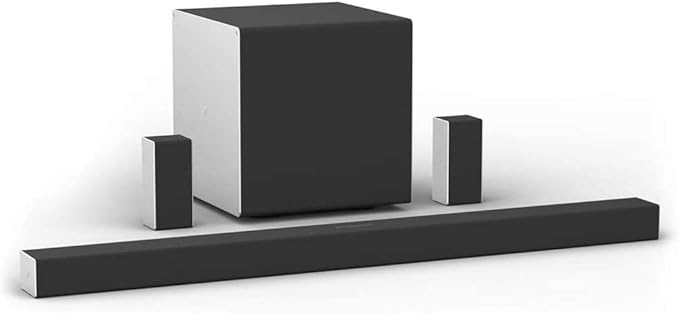
VIZIO vs SVS: Overview
Comparing VIZIO and SVS helps you determine which brand is best suited for your needs in Home Theaters. Both brands offer strong choices depending on your budget and key feature requirements.
Key Features & Comparison
Evaluate factors such as build quality, warranty, customer satisfaction, and total value before making your final purchase choice between VIZIO and SVS.
Features
VIZIO packages a formidable array of consumer-centric digital features designed to maximize plug-and-play simplicity. Modern VIZIO soundbars frequently feature Dolby Atmos and DTS:X decoding, eARC connectivity for seamless single-cable TV integration, Bluetooth streaming, and voice assistant integration. Higher-tier models, such as the VIZIO Elevate, incorporate motorized height drivers that physically rotate upward when 3D spatial audio formats are detected. However, VIZIO's feature ecosystem remains largely closed; the processing, amplification, and speaker matching are hardwired, offering limited manual equalization, rudimentary bass management, and no path for upgrading individual components as home theater standards evolve.
Conversely, SVS focuses its feature engineering on acoustic optimization, advanced DSP tuning, and system flexibility. Rather than packaging all-in-one novelty mechanics, SVS provides professional-grade tools like their proprietary smartphone app, which connects via Bluetooth to their subwoofers and active speakers for real-time parametric EQ, room gain compensation, and precise phase control. SVS systems integrate seamlessly with standard AV receivers, allowing users to leverage advanced multi-channel processing like Dirac Live or Audyssey MultEQ XT32. While SVS lacks the integrated, all-in-one convenience of VIZIO’s packaged soundbars, it delivers vastly superior architectural versatility, infinite modularity, and sophisticated calibration tools for precision tuning.
Performance
Performance highlights the stark acoustic divide between lifestyle soundbars and high-fidelity component audio. VIZIO punches admirably above its weight class, delivering crisp dialogue intelligibility, respectable spatial effects via psychoacoustic processing, and substantial low-end presence compared to TV speakers. Nevertheless, VIZIO systems are constrained by physical laws: small driver enclosures, narrow soundstages inherent to soundbar form factors, and compact subwoofers with limited amplifier power lead to dynamic compression and distortion at high volumes, struggling to authentically reproduce true infrasonic cinema bass below 35Hz.
SVS, by comparison, delivers reference-level acoustic performance characterized by massive dynamic headroom, ultra-low distortion, and subterranean low-frequency response. SVS subwoofers—such as the SB-1000 Pro or PB-2000 Pro—frequently dig well below 20Hz, generating tangible, chest-thumping bass that VIZIO cannot emulate. SVS Prime and Ultra series speakers feature premium crossovers, treated silk-dome or aluminum tweeters, and stiff composite midrange woofers that maintain linearity even under extreme SPL demands. For critical music listening and fully immersive cinema playback that preserves nuanced micro-details alongside explosive impact, SVS exists in an entirely superior performance category.
Design
From a design perspective, VIZIO prioritizes low-profile minimalism aimed at complementing contemporary thin-bezel televisions. Their soundbars utilize slim physical profiles wrapped in dark acoustical fabric or matte plastic, engineered to tuck neatly beneath displays or mount flush to the wall. The accompanying wireless subwoofers and surrounds are compact enough to be hidden next to couches or tucked beneath side tables, minimizing living room clutter. While this aesthetic aligns well with general consumer decor, the materials are heavily plastic-centric, prioritizing lightweight construction and production efficiency over structural resonance damping.
SVS adopts an industrial design rooted in acoustic functionality, acoustic mass, and luxury finishes. SVS enclosures are meticulously constructed from thick medium-density fiberboard (MDF) with extensive internal bracing to eradicate cabinet resonances. Speakers and subwoofers are available in premium piano gloss black or textured black ash veneers that serve as deliberate visual statements in a room. While SVS components require significantly more floor space, careful placement away from boundaries, and the routing of dedicated speaker wire, the resulting aesthetic reflects artisanal craftsmanship, mechanical durability, and timeless high-end audio engineering.