VIZIO vs Acoustic Audio: Overview
Comparing VIZIO and Acoustic Audio helps you determine which brand is best suited for your needs in Home Theaters. Both brands offer strong choices depending on your budget and key feature requirements.
Key Features & Comparison
Evaluate factors such as build quality, warranty, customer satisfaction, and total value before making your final purchase choice between VIZIO and Acoustic Audio.
Features
In terms of modern connectivity and digital processing features, VIZIO holds a commanding lead over Acoustic Audio. VIZIO’s home theater bundles frequently feature advanced connection interfaces including HDMI eARC, dedicated voice assistant auxiliary inputs, and optical digital ports. Crucially, VIZIO systems often support modern immersive audio processing codecs such as Dolby Atmos and DTS:X, leveraging psychoacoustic algorithms or dedicated up-firing drivers to construct three-dimensional soundstages. Additionally, VIZIO’s wireless active subwoofers, which double as hubs for wired rear surround speakers, reduce cable clutter across the living space and provide app-based equalization controls and automated calibration profiles directly from a smartphone.
Acoustic Audio approaches feature sets with an emphasis on utilitarian input diversity and component flexibility rather than high-end digital spatial processing. Many of their powered home theater sets incorporate legacy connectivity such as multi-channel RCA, 3.5mm auxiliary jacks, optical inputs, Bluetooth streaming, and even onboard SD card and USB flash drives for direct media playback. However, they generally lack modern HDMI eARC ports, advanced automated room correction, and cutting-edge object-based audio decoding like Dolby Atmos. Where Acoustic Audio makes up ground is in hardware configuration flexibility; their architectural series boasts paintable grilles, integrated crossover networks, and variable frequency controls on subwoofers, serving users who want physical control over signal routing rather than algorithmic processing.
Performance
Evaluating acoustic performance reveals stark differences in sonic delivery, frequency response, and tonal accuracy. VIZIO’s engineering leans heavily on digital signal processing (DSP) to maximize the acoustic output of compact transducers. Mid-range dialogue clarity is a standout strength across VIZIO soundbars, largely due to dedicated center-channel drivers and specialized dialogue-enhancement modes. The compact subwoofers provided with VIZIO kits punch above their physical footprint, delivering tight, punchy low-end response down to approximately 40Hz, which satisfies the dynamic demands of modern cinematic mixes without generating excessive cabinet resonance or structural rattle.
Acoustic Audio systems, particularly their multi-piece satellite and discrete architectural lines, excel in raw physical sound dispersion and dynamic range potential. Because their systems typically use separate, dedicated satellite speaker enclosures rather than a single unified soundbar enclosure, they inherently offer superior stereo separation and a wider physical front soundstage. However, without the heavy-handed DSP correction found in VIZIO units, Acoustic Audio speakers can exhibit a brighter, occasionally harsher treble response and may require manual graphic equalization to tame mid-range irregularities. Their subwoofers offer robust output for bass-heavy tracks and action sequences, though they can suffer from port chuffing and less controlled transient response when pushed to their absolute limits.
Design
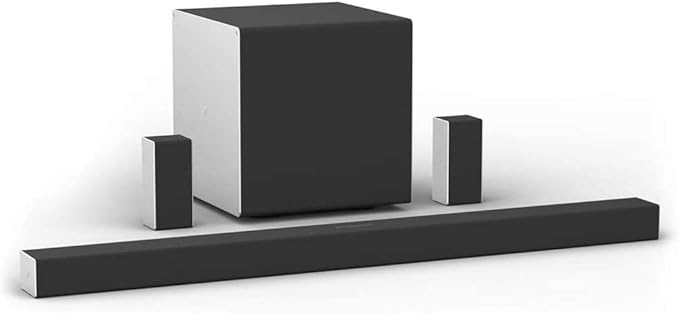
Aesthetic execution and physical architecture highlight contrasting priorities in industrial design. VIZIO embraces a minimalist, contemporary aesthetic designed to complement ultra-thin modern televisions and sleek living room furniture. Their soundbars, surround speakers, and subwoofers utilize clean lines, dark fabric wraps, rounded edges, and low-profile silhouettes. This compact footprint ensures that components can be positioned on shallow mantels or media consoles without obstructing television screens or drawing unwanted attention. The industrial engineering of VIZIO focuses on unobtrusiveness, where satellite modules blend effortlessly into modern home decor.
Acoustic Audio, by contrast, favors traditional box-style enclosures, exposed driver cones, and utilitarian cabinet materials such as vinyl-wrapped MDF. Their multimedia systems often feature prominent digital LED displays, exposed volume knobs, and integrated lighting accents that reflect an older generation of PC and home audio styling. On the architectural side, Acoustic Audio designs flush-mount in-wall and in-ceiling speakers built with glass fiber or polypropylene woofers and paintable ABS frames. This design requires permanent cutting into drywall, contrasting completely with VIZIO’s zero-construction, plug-and-play philosophy, but yielding a completely invisible install once finished.