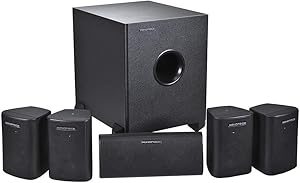
SVS vs Monoprice: Overview
Comparing SVS and Monoprice helps you determine which brand is best suited for your needs in Home Theaters. Both brands offer strong choices depending on your budget and key feature requirements.
Key Features & Comparison
Evaluate factors such as build quality, warranty, customer satisfaction, and total value before making your final purchase choice between SVS and Monoprice.
Features
In terms of feature sets, SVS distinguishes itself primarily through cutting-edge digital signal processing and intuitive user control. A defining advantage of modern SVS gear—particularly their 1000 Pro series and above—is the proprietary SVS Subwoofer Smartphone App. This interface utilizes bidirectional Bluetooth to provide real-time control over volume, low-pass filters, phase, polarity, room gain compensation, and parametric EQ profiles from the listening position. Additionally, SVS speakers feature custom-tuned crossovers and specialized driver surrounds, complemented by robust physical features like high-grade binding posts and flexible port tuning capabilities with provided foam bungs in their ported iterations.
Monoprice, predominantly through its Monolith division, focuses on feature sets driven by physical specifications and industry benchmarks rather than smartphone-connected digital ecosystems. Many Monolith subwoofers and amplifiers are THX Ultra or THX Select certified, guaranteeing specific dynamic output and distortion ceilings under defined room volumes. Monolith subwoofers frequently feature variable port-tuning switches alongside physical EQ toggles (THX Mode vs. Extended Mode), XLR balanced inputs, and heavy-duty internal bracing. However, Monoprice generally lacks the advanced wireless app-based DSP control championed by SVS, requiring users to rely more heavily on their AV receiver's internal calibration tools or external hardware like miniDSP for fine-tuning.
Performance
Acoustic performance between SVS and Monoprice is fiercely contested, with SVS leaning toward clinical speed, low-end musicality, and pristine integration. SVS subwoofers are renowned for exceptionally low distortion, linear frequency response down into infrasonic territories, and rapid transient response. Their sealed models (such as the SB-series) offer tight, articulate bass that transitions seamlessly into stereo listening, while their ported PB-series delivers massive, room-shaking tactile impact without introducing unwanted chuffing or cabinet resonance. SVS speakers, such as the Prime and Ultra series, exhibit crisp dispersion, exceptional dialogue clarity from dedicated three-way center channels, and neutral tonal balance suitable for both film and complex audio tracks.
Monoprice, particularly within the Monolith lineup, is a heavyweight contender engineered for brutal home theater dynamics and maximum SPL output. Monolith subwoofers frequently post equal or slightly superior maximum continuous output measurements at subterranean frequencies (16Hz–25Hz) compared to comparably priced SVS equivalents, owing to massive magnet assemblies, high-excursion drivers, and substantial enclosure volumes. For purely cinematic, high-decibel home theater applications, Monoprice delivers staggering visceral punch and reference-level volume with minimal compression. However, outside the Monolith sphere, budget Monoprice speakers exhibit less refined frequency linearity, and their subwoofers can feel slightly less agile during intricate musical passages compared to SVS's fine-tuned DSP architecture.
Design
SVS adopts a polished, contemporary aesthetic that strikes a balance between acoustic functionality and living-room-friendly decor. The brand offers premium cabinet finishes, including deep piano gloss black, piano gloss white, and durable black ash veneers. SVS cabinets incorporate softly radiused edges, chamfered front baffles to reduce edge diffraction, and non-resonant steel mesh grilles that protect driver components while providing an aggressive, modern look. Even their larger ported enclosures maintain proportions that, while substantial, integrate harmoniously into dedicated theaters or shared media rooms without appearing excessively industrial.
Monoprice, particularly in its high-performance Monolith category, embraces an uncompromising, highly industrial design language. Monolith subwoofers and tower speakers are built like fortified bunkers, utilizing high-density fiberboard (HDF) rather than standard MDF, internal cross-bracing, and thick satin black or simulated ash finishes. The result is an exceptionally dead, inert cabinet, but one that is significantly heavier, bulkier, and utilitarian in appearance compared to SVS. While Monoprice products convey an undeniable sense of physical durability and functional acoustic mass, they lack the refined contours, premium lacquer options, and domestic elegance that make SVS easier to blend into upscale interior spaces.