Sony vs SVS: Overview & Brand Philosophy
When engineering a modern home theater, few decisions are as critical as selecting the right acoustic foundation. In this space, Sony and SVS represent two fundamentally distinct engineering philosophies. Sony, a titan of global consumer electronics, approaches home theater from an ecosystem perspective. Their goal is seamless, end-to-end integration across audio and visual hardware. Leveraging proprietary digital signal processing, spatial audio algorithms, and cutting-edge wireless architectures, Sony designs audio solutions—ranging from high-end soundbars to architectural AV receivers—that prioritize user convenience, living room aesthetics, and synergy with modern displays.
In stark contrast, SVS (Specialty Video & Sound) was forged in the passionate, performance-driven crucible of enthusiast audio. Founded in Ohio, SVS made its name by revolutionizing the direct-to-consumer subwoofer market, delivering chest-thumping low frequencies previously unattainable at consumer price points. Today, SVS is a premier loudspeaker and subwoofer specialist, championing an uncompromised, physics-first approach to acoustic design. While Sony emphasizes processing and lifestyle integration, SVS focuses on driver mass, cabinet bracing, clean amplifier power, and pure sonic dynamics, appealing directly to discerning audiophiles and dedicated home theater purists.
Key Differences & Technological Comparison
The technical divergences between Sony and SVS become immediately apparent when examining their driver engineering, amplification, and acoustic room correction suites.
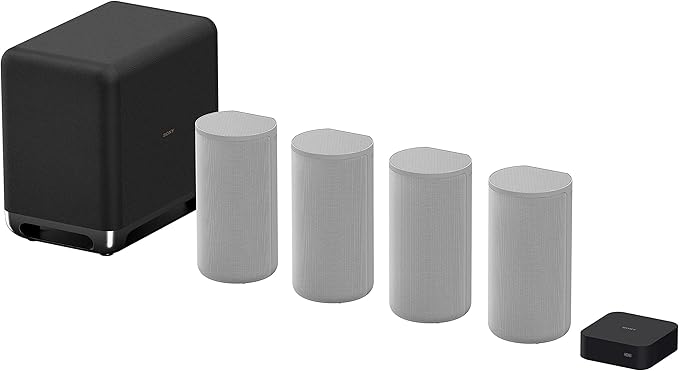
Acoustic Architecture and Transducers: SVS designs traditional dynamic transducers with custom voice coils, premium crossover networks, and structurally dead cabinets. Their flagship Prime and Ultra Series utilize FEA-optimized diffusers, aluminum dome tweeters, and composite glass-fiber cones capable of massive excursion with near-zero distortion. Sony, while competent in traditional speaker design with their ES line, leans heavily into compact footprints, upward-firing drivers, and innovative form factors (such as the discrete wireless pods seen in the HT-A9 system). Sony often trades cabinet volume for active DSP correction.
Subwoofer Performance and Bass Extension: SVS dominates the low-frequency realm. Utilizing high-current Sledge Class-D amplifiers coupled with custom edge-wound voice coils, SVS subwoofers (such as the PB-1000 Pro or SB-4000) routinely hit subterranean frequencies below 16 Hz with vanishingly low total harmonic distortion (THD). Furthermore, SVS offers a sophisticated smartphone DSP app, providing users with three-band parametric EQ, polarity control, and room gain management. Sony's consumer-grade subwoofers prioritize mid-bass punch (40 Hz–80 Hz) to create dramatic cinematic impact within smaller footprints, but they lack the visceral depth, mechanical extension, and surgical precision championed by SVS.
Spatial Audio and Room Optimization: Sony holds a definitive edge in computational acoustics. Technologies such as 360 Spatial Sound Mapping synthesize "phantom speakers" to envelop the listener, effectively correcting for asymmetrical or imperfect room layouts. Sony's Digital Cinema Auto Calibration (D.C.A.C. IX) rapidly maps room geometry. SVS, functioning primarily as a passive speaker and active subwoofer manufacturer, does not provide spatial sound algorithms, instead relying on the processing power of third-party AV receivers (like Dirac Live or Audyssey) to optimize its neutral, wide-dispersion speakers.
Pros & Cons Comparison
Sony Home Theaters
- Pro: Cutting-edge spatial audio processing (360 Spatial Sound Mapping) creates an expansive soundfield from minimalist footprints.
- Pro: Effortless setup and seamless synergy with Sony BRAVIA televisions via Acoustic Center Sync.
- Pro: Versatile ecosystem offering both streamlined wireless multichannel systems and traditional ES receivers.
- Con: Subwoofers lack true subterranean bass extension and high-output headroom compared to dedicated audio brands.
- Con: Proprietary hardware ecosystems often limit modular upgradability and third-party speaker integration.
SVS Home Theaters
- Pro: Reference-grade subwoofer technology offering industry-leading low-frequency extension, power, and low distortion.
- Pro: Audiophile-grade cabinet construction, massive driver magnets, and transparent crossovers built for critical music and cinema listening.
- Pro: Highly customizable integration via the Bluetooth SVS Subwoofer DSP smartphone application.
- Con: Requires third-party amplification (AV receiver) and manual speaker calibration for optimal multichannel deployment.
- Con: Larger, heavier physical footprints that are less forgiving in multi-use, design-conscious living spaces.
Performance, Durability & Value Analysis
From a longevity and build quality standpoint, SVS products are built like professional acoustic instruments. Utilizing rigid Medium Density Fiberboard (MDF) with extensive internal bracing, thick baffles, and premium real-wood or piano-gloss finishes, SVS cabinets resist mechanical resonances effortlessly. Their components—especially the high-excursion driver surrounds and heavily protected Sledge amplifiers—are designed to endure high thermal and mechanical stress for decades. Sony's build quality varies based on the product tier; their flagship Elevated Standard (ES) series features tank-like engineering, whereas their lifestyle and soundbar setups rely significantly on ABS plastics and lighter composite materials that are more prone to cosmetic wear and obsolete wireless protocols over time.
When assessing value, the return on investment depends on your long-term acoustic roadmap. Sony offers extraordinary convenience-per-dollar, delivering an immediate, room-filling surround sound experience straight out of the box with zero requirement for speaker wire installation or standalone processing gear. However, SVS offers unparalleled acoustic value. Because SVS passive speakers do not rely on rapidly evolving HDMI standards, Wi-Fi chips, or streaming firmware, they maintain their performance and resale value for decades. An investment in an SVS 5.1 system provides a timeless, modular foundation that only requires occasional upgrades to the front-end processor.
Final Verdict: Which Brand Should You Choose?
The choice between Sony and SVS hinges on whether you value computational convenience or unadulterated acoustic performance.
Choose Sony if: You are seeking a sleek, unobtrusive home theater solution that integrates effortlessly into an existing living space. Sony is the ideal choice for consumers who prioritize clean aesthetics, wireless connectivity, effortless setup, and proprietary spatial audio mapping that works in harmony with modern television displays without the clutter of an AV rack and miles of speaker wire.
Choose SVS if: You are building a dedicated home theater or a high-fidelity media room and demand cinema-grade dynamics, reference-level clarity, and ground-shaking, tactile bass. SVS is the definitive brand for enthusiasts willing to invest in dedicated component-based audio, an AV receiver, and proper acoustic placement in exchange for a dynamic, professional-grade theater experience that no all-in-one wireless package can emulate.
Features
When evaluating the feature ecosystems of Sony and SVS within the home theater domain, the comparison highlights a fundamental divergence in design philosophy: ecosystem-wide digital integration versus specialized acoustic optimization. Sony approaches home theater through the lens of comprehensive, bleeding-edge connectivity and video-audio synergy. Their AV receivers and spatial audio systems (such as the HT-A9 and STR-AZ series) boast an exhaustive suite of modern convenience features, including full HDMI 2.1 switching, 8K/120Hz pass-through, native wireless surround expansion, and proprietary technologies like 360 Spatial Sound Mapping and Acoustic Center Sync, which integrates compatible Sony Bravia TVs as the dedicated center channel. Furthermore, Sony features sophisticated automatic room calibration via Digital Cinema Auto Calibration (D.C.A.C. IX), tailored for users seeking effortless convergence between gaming consoles, smart home ecosystems, and dynamic display panels.
Conversely, SVS approaches features strictly from an audiophile engineering perspective, prioritizing acoustic control and raw mechanical fidelity over broad multimedia convenience. Rather than producing integrated, all-in-one AV control centers, SVS focuses on powered subwoofers and precision reference speakers. The hallmark feature of modern SVS hardware is their groundbreaking DSP smartphone app, which connects via bi-directional Bluetooth to provide parametric EQ, volume adjustments, low-pass filter settings, phase alignment, and room-gain compensation directly from the listening position. While SVS lacks the video processing, native HDMI handshaking, and multi-channel matrixing found in Sony’s electronic hubs, they provide deeper technical utility for sonic calibration. Features like custom presets for movies, music, and gaming allow fine-grained acoustic shaping that Sony’s automated systems often obscure behind proprietary algorithms.
Ultimately, the practical trade-off between Sony and SVS regarding features comes down to lifestyle-driven digital convenience versus enthusiast-grade acoustic precision. Sony delivers an end-to-end multimedia feature set that minimizes cable clutter, handles complex modern video formats, and creates immersive spatial fields through automated, algorithmic processing. SVS deliberately forgoes mainstream video and smart-display features to deliver unmatched mechanical and low-frequency management capabilities, making their hardware a dedicated sonic backbone rather than a central media hub. Consumers who prioritize seamless video pass-through, TV-speaker synergy, and automated surround mapping will favor Sony’s feature suite, while those assembling a modular, high-output theater demanding granular acoustic tuning will find SVS’s DSP controls far superior.
Performance
When evaluating raw acoustic and spatial performance in the home theater category, Sony and SVS approach the sonic experience from fundamentally different engineering philosophies. Sony excels in the digital domain, leveraging proprietary digital signal processing (DSP) and computational acoustics to create vast, cinematic soundscapes. Technologies such as 360 Spatial Sound Mapping synthesize physical drivers with virtual "phantom" speakers, dynamically calibrating the soundfield to compensate for irregular room layouts via advanced room-correction algorithms like D.C.A.C. IX. In contrast, SVS adheres to purist, analog-first acoustic engineering. SVS speakers and subwoofers prioritize physical cabinet volume, custom-engineered motor assemblies, high-current MOSFET amplification, and precision crossover networks. While Sony uses software to expand perceived space, SVS relies on mechanical headroom, transient speed, and exceptionally low harmonic distortion to deliver uncolored, reference-grade dynamics.
The performance divergence is most pronounced in low-frequency reproduction and dynamic scale. SVS is widely recognized as an industry benchmark for subwoofers, with models featuring high-excursion drivers and proprietary Sledge DSP engines that effortlessly dig into the infrasonic range below 16 Hz with vanishingly low distortion. This gives SVS home theaters tactile, chest-thumping impact and pristine musicality that easily fills expansive, dedicated screening rooms. Sony’s low-frequency performance, while punchy and tuned to integrate seamlessly with its soundbars and mid-tier wireless subwoofers, relies heavily on aggressive limiting to protect smaller drivers, which often sacrifices extreme subterranean rumble and mid-bass articulation during heavy, peak-demand cinematic transients. However, Sony compensates for this with superior high-resolution audio processing, pristine dialogue isolation via Acoustic Center Sync (pairing directly with Sony televisions), and cutting-edge HDMI 2.1 video passthrough integration that guarantees low-latency, glitch-free audio processing for modern 4K/120Hz content.
Ultimately, the practical trade-offs come down to ecosystem integration versus uncompromised acoustic fidelity. Sony delivers an effortlessly immersive, highly adaptable performance profile ideal for everyday living rooms and multi-purpose spaces where aesthetics and complex acoustic challenges hinder traditional setups. Their digital mastery extracts startlingly cohesive surround-sound performance from minimalist form factors. SVS, conversely, is built for home theater purists seeking dynamic linearity, massive SPL capabilities, and uncompromising low-frequency impact. For consumers prioritizing plug-and-play spatial algorithms and smart AV ecosystems, Sony is the superior performer; for enthusiasts demanding true high-fidelity dynamics, neutral frequency response, and visceral bass extension, SVS operates in a significantly higher performance tier.
Design
In the home theater space, the design philosophies of Sony and SVS represent a fundamental divide between integrated consumer lifestyle elegance and acoustically optimized audiophile engineering. Sony approaches hardware design with an emphasis on seamless living-room integration, architectural minimalism, and advanced digital convergence. Modern Sony systems, exemplified by the HT-A9 and premium soundbar ecosystems, feature low-profile footprints, neutral matte or fabric finishes, and discrete cylindrical or low-slung geometric chassis designed to disappear into modern interior decor. Conversely, SVS champions acoustic-first industrial design, engineering robust, high-mass MDF cabinets engineered specifically to counteract internal air pressure and mechanical resonances. Whether evaluating their celebrated sealed and ported subwoofers or the Prime and Ultra speaker lineups, SVS incorporates acoustically inert construction, heavy bracing, and sweeping front-baffle chamfers designed specifically to eliminate high-frequency edge diffraction, opting for a traditional, commanding presence rather than architectural camouflage.
When assessing structural materials, driver execution, and functional interface design, the technical trade-offs between the two brands become pronounced. SVS invests heavily in passive component engineering, deploying aircraft-grade aluminum or treated cellulose drivers, die-cast aluminum baskets, advanced motor structures, and multi-layer piano gloss or real-wood veneer finishes. Their physical user interfaces are famously robust, pairing tactile, precision back-panel controls with the innovative SVS smartphone app, which allows deep parametric EQ, low-pass filter, and phase adjustments via a bespoke Bluetooth platform. Sony, while utilizing lighter composite plastics to house proprietary innovations like the non-circular X-Balanced Speaker Units (which maximize diaphragm area without increasing cabinet height), focuses heavily on digital calibration over passive enclosure mass. Sony’s physical units often incorporate sleek capacitive touch surfaces and concealed OLED micro-displays, supported by complex internal beam-forming tweeters, upward-firing height drivers, and built-in microphones engineered to execute automated 360 Spatial Sound Mapping.
Ultimately, the practical choice regarding design rests on the consumer's spatial constraints and performance priorities. Sony delivers an engineered masterclass in spatial efficiency, cable minimization, and visual harmony, making their gear the superior aesthetic choice for multi-use living rooms where massive speaker cabinets and thick umbilical wiring are non-starters. The trade-off is an enclosure inherently constrained by internal air-volume limits and structural plastics. SVS demands physical compromise through substantially larger, heavier footprints and deliberate acoustic positioning, but rewards the user with uncompromising cabinet rigidity, superior thermal dissipation, and long-term modular durability that resists acoustic fatigue and enclosure coloration. While Sony designs for the eye and modern spatial convenience, SVS designs strictly for the physics of acoustic reproduction.