Sony vs Polk Audio: Overview
Comparing Sony and Polk Audio helps you determine which brand is best suited for your needs in Home Theaters. Both brands offer strong choices depending on your budget and key feature requirements.
Key Features & Comparison
Evaluate factors such as build quality, warranty, customer satisfaction, and total value before making your final purchase choice between Sony and Polk Audio.
Features
From a feature and connectivity standpoint, Sony holds a distinct advantage in contemporary technological integration and smart home versatility. Sony's AV receivers and premium audio systems frequently incorporate the latest HDMI 2.1 specifications, offering 4K at 120Hz, 8K passthrough, VRR (Variable Refresh Rate), and ALLM (Auto Low Latency Mode), which makes them the definitive choice for next-generation gamers and media enthusiasts. Furthermore, Sony equips its systems with sophisticated proprietary technologies such as 360 Spatial Sound Mapping, Acoustic Center Sync (which pairs seamlessly with Sony BRAVIA televisions), and native wireless multi-room protocols like AirPlay 2, Chromecast, and Spotify Connect. These features simplify calibration via automated microphone-driven digital room correction, adjusting phase and reflection characteristics in real time.
Polk Audio focuses its feature development on passive mechanical enhancements and specialized driver configurations, offering fewer integrated software bells and whistles in favor of superior physical audio control. On their active soundbar lines, Polk incorporates targeted tools such as VoiceAdjust technology, which allows users to physically alter center-channel frequency levels independently to achieve crystal-clear dialogue without muddying surrounding sound effects. However, in their core passive speaker lineups (such as the Reserve and Signature Elite series), the "features" are purely acoustical: engineered crossover networks, diffraction-reducing grilles, and bi-ampable/bi-wireable binding posts. While Polk may lack the cutting-edge digital interfaces native to Sony, its components offer universal compatibility with third-party amplification and future-proof modularity that resists digital obsolescence.
Performance
In terms of acoustic performance, Sony excels at spatial accuracy, dynamic digital steering, and virtualized soundstaging. Using proprietary psychoacoustic algorithms, Sony can manipulate sound waves to create convincing phantom ceiling and surround channels, even from single-unit or simplified multi-channel arrays. The sonic profile is generally balanced and crisp, with an emphasis on dialogue intelligibility and pinpoint directional tracking for high-octane cinematic content. However, Sony’s reliance on compact driver enclosures and heavy digital equalization can sometimes result in dynamic compression at extreme volumes, and their bundled subwoofers occasionally struggle with sub-bass extension below 30Hz compared to dedicated acoustic units.
Polk Audio counters with raw acoustic dynamism, effortless low-end extension, and a natural, warm mid-range reproduction that is difficult to replicate with DSP-reliant designs. Because Polk prioritizes larger cabinet volumes and dedicated driver arrays, its home theater configurations deliver immense sound pressure levels (SPL) without acoustic strain or harmonic distortion. The integration of high-resolution Pinnacle ring radiator tweeters and mineral-filled turbine cones produces smooth, detailed high frequencies alongside rich, punchy bass. While Polk relies on the quality of upstream amplification and manual room acoustics rather than automatic DSP correction, the end result is a wider, more organic stereo and surround image that performs with equal magnificence across multi-channel cinematic mixes and demanding high-resolution music playback.
Design
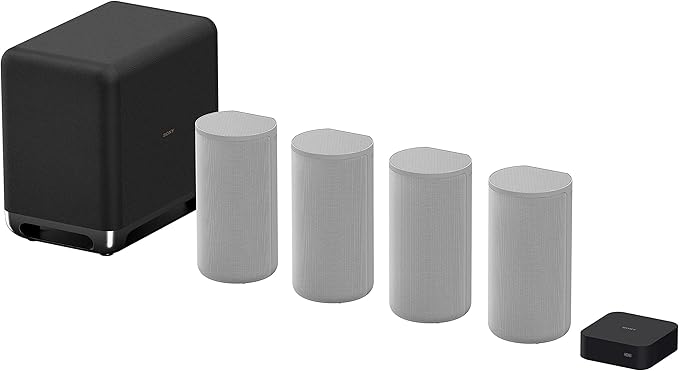
Sony’s industrial design ethos is rooted in minimalist, hyper-modern aesthetics designed to integrate invisibly into high-end contemporary interiors. Their soundbars, satellite speakers, and AV components feature sleek, low-profile form factors finished in matte textures, acoustic fabric wraps, and brushed metals. The visual language is deliberately understated, emphasizing compact footprints that sit comfortably underneath ultra-thin OLED displays or mount flush against walls. Sony’s physical engineering also prioritizes thermal dissipation within compact enclosures, allowing sophisticated digital processors and amplification modules to run silently without intrusive cooling fans, maintaining a discreet visual and physical presence in the living room.
In contrast, Polk Audio champions a traditional, substantial loudspeaker aesthetic that celebrates the physical presence of home theater equipment. Their cabinets are typically constructed from dense, non-resonant Medite MDF wrapped in high-grade vinyl or real wood veneers, exuding classic audio craftsmanship. Design details like the curved edges on the Signature Elite series, prominent floor-spikes, and the rear-mounted flared Power Port funnels serve dual purposes: they function as bold visual statements while serving precise thermodynamic and acoustic functions. While Polk speakers demand significantly more physical real estate and careful placement within the listening environment, their durable construction and timeless aesthetic cater to buyers who view their audio equipment as legitimate furniture rather than stealthy electronics.