Sony vs JBL: Overview & Brand Philosophy
The modern home theater landscape is shaped significantly by the distinct acoustic and technological philosophies of Sony and JBL. Sony approaches home entertainment from a holistic, cinematic perspective. With deep roots across the entire filmmaking pipeline—from Hollywood production studios and high-end cinema cameras to consumer displays and soundbars—Sony’s primary design philosophy centers on artistic fidelity. Their home theater products, ranging from entry-level soundbars to cutting-edge multichannel AVR systems and spatial sound mapping technologies, are engineered to reproduce motion picture sound stages exactly as movie directors and sound mixers intended.
Conversely, JBL (James B. Lansing Sound), a core subsidiary of Harman International and Samsung Electronics, brings an intensely kinetic, professional heritage to the home theater space. JBL powers a massive percentage of commercial cinema auditoriums, live concert venues, and professional recording studios globally. This DNA heavily informs their consumer home theater line, emphasizing high acoustic energy, uncompressed dynamics, deep bass impact, and wide dispersion patterns. JBL treats the living room not just as a screening room, but as a dynamic venue designed to handle explosive action blockbusters and high-decibel music listening with equal authority.
Choosing between the two brands fundamentally comes down to an overarching acoustic preference: Sony favors digital acoustic processing, precision spatial steering, and seamless ecosystem integration, while JBL prioritizes raw analog-style driver power, punchy low-end presence, and straightforward, high-efficiency acoustics.
Key Differences & Technological Comparison
Technologically, Sony sets itself apart through advanced proprietary digital signal processing (DSP). Central to their modern lineup is 360 Spatial Sound Mapping (360 SSM) and Digital Cinema Auto Calibration (D.C.A.C.). By deploying sophisticated upward- and side-firing driver arrays alongside intelligent room-calibration software, Sony creates phantom speakers that simulate an expansive, three-dimensional acoustic bubble even in acoustically irregular living spaces. Additionally, Sony integrates seamlessly with their BRAVIA television lineup using Acoustic Center Sync, allowing the TV’s internal speakers to act as the primary center channel dialogue driver alongside the soundbar or multi-speaker package.
JBL differentiates itself primarily through innovative physical acoustic design and high-current power stages. One of JBL’s most influential technological contributions to the consumer home theater market is their true wireless detachable rear surround architecture (seen prominently in the JBL Bar series). Rather than requiring rear satellite speakers to be tethered to wall outlets, JBL designs battery-powered satellite units that magnetically dock to the main soundbar to charge, detaching effortlessly to provide genuine, wire-free surround sound. Acoustically, JBL leverages proprietary MultiBeam technology—an advanced beamforming array paired with horn-loaded compression tweeters and high-excursion subwoofers—to deliver wider horizontal dispersion and earth-shattering bass without overly synthetic audio processing.
Regarding build quality and industrial design, Sony leans into understated, minimalist aesthetics featuring matte textures, premium acoustic fabric wraps, and low-profile form factors designed to disappear beneath a television. JBL utilizes more rugged, utilitarian enclosures featuring perforated metal grilles, robust composite polymers, and significantly larger, heavier dedicated subwoofer cabinets that prioritize moving serious volumes of air over compact interior design.
Pros & Cons Comparison
Sony Home Theaters
- Pro: Cutting-edge spatial audio processing with 360 Spatial Sound Mapping creates incredibly realistic vertical and horizontal sound stages.
- Pro: Superb dialogue clarity and dedicated speech enhancement features that maintain vocal intelligibility at low volumes.
- Pro: Exceptional synergy and proprietary feature support (like Acoustic Center Sync) when paired with Sony BRAVIA displays.
- Pro: Refined, neutral acoustic tuning ideal for high-fidelity movie scores and audiophile-leaning content.
- Con: Included subwoofers in mid-range packages often lack the visceral, sub-bass impact offered by competitors.
- Con: Premium models carry a significant price tag compared to the raw wattage output they provide.
JBL Home Theaters
- Pro: Industry-leading bass response; subwoofers feature large drivers and massive wattage, delivering authentic cinema rumble.
- Pro: Truly wireless detachable surround speakers eliminate the clutter of power cables in rear channels.
- Pro: Exceptionally dynamic and energetic acoustic profile, performing brilliantly for action movies, sports, and modern music.
- Pro: Extremely easy plug-and-play setup with intuitive automatic room calibration.
- Con: Upper-mid and high frequencies can occasionally sound forward or bright during complex dialogue scenes at high volumes.
- Con: Digital surround processing and height simulation are slightly less convincing than Sony’s advanced spatial mapping.
Performance, Durability & Value Analysis
From an objective performance and durability perspective, both manufacturers demonstrate high manufacturing standards, but they cater to different use-case longevities. Sony’s software-driven architecture relies heavily on firmware updates to maintain compatibility with modern HDMI 2.1 standards, eARC protocols, and object-based formats like Dolby Atmos and DTS:X. In our evaluations, Sony hardware exhibits exceptional structural durability, but users must occasionally navigate complex menus and software parameters to extract peak performance. JBL’s hardware focuses on robust mechanical components—durable voice coils, oversized magnets, and high-capacity lithium batteries in their wireless rears. While the detachable rear batteries do present a theoretical finite lifespan over many years of charge cycles, JBL's physical materials easily resist wear, pet interference, and physical impacts better than the fabric-laden designs favored by Sony.
In terms of pure price-to-performance value, JBL generally claims the edge in the entry-to-midrange consumer segment. A consumer investing in a mid-tier JBL system invariably gets higher total wattage, a considerably more powerful wireless subwoofer (often utilizing 10-inch down-firing drivers), and a zero-cable surround experience out of the box. Sony commands a higher market premium, largely justified if you already own a Sony ecosystem display or prioritize high-resolution audio codecs (such as LDAC support), granular acoustic tuning, and nuanced spatial placement over raw sound pressure levels.
Final Verdict: Which Brand Should You Choose?
The choice between Sony and JBL ultimately hinges on your media preferences, your room acoustics, and your tolerance for living room cabling.
Choose Sony if: You are seeking an immersive, authentic cinema experience that prioritizes pinpoint spatial accuracy, pristine dialogue intelligibility, and subtle atmospheric details. Sony is especially the premier choice for owners of Sony BRAVIA televisions, cinema purists who watch nuanced film scores and prestige dramas, and consumers who want advanced spatial audio room-correction capable of transforming challenging, open-plan living rooms without visual clutter.
Choose JBL if: You want an energetic, high-octane home theater experience defined by bone-rattling bass, high maximum volume, and dynamic impact. JBL is the ultimate selection for action movie aficionados, gaming enthusiasts, and everyday consumers who want true rear surround channels without the eyesore of running speaker wires or finding wall outlets behind their couch. If your goal is to recreate the visceral punch of a commercial multiplex with zero setup friction, JBL delivers the best overall package for your investment.
Features
When comparing the feature landscape of home theater systems, Sony and JBL take distinctly different technological approaches driven by their respective engineering philosophies. Sony focuses heavily on spatial psychoacoustics and deep ecosystem integration. The Japanese electronics giant equips its mid-to-high-end soundbars and modular systems (such as the HT-A series and BRAVIA Theatre Quad) with proprietary 360 Spatial Sound Mapping, Digital Sound Enhancement Engine (DSEE Extreme), and Acoustic Center Sync, which synchronizes the audio system with compatible Sony Bravia televisions to use the display itself as the center channel. In contrast, JBL—anchored by Harman’s audio legacy—prioritizes utilitarian hardware flexibility and acoustic power over brand-exclusive ecosystems. JBL’s hallmark feature is found in its modular Bar series (like the Bar 1300X), which incorporates true wire-free, battery-powered detachable surround speakers that physically solve the perennial consumer headache of routing power cables to rear channels. Furthermore, JBL’s PureVoice technology focuses on algorithmic dialogue enhancement tailored to dynamically cut through explosive bass without requiring complex manual EQ calibration.
In terms of connectivity and format support, both brands implement robust feature sets, but with notable technical divergences. Sony consistently targets the high-end enthusiast and next-gen gamer by providing HDMI 2.1 passthrough capable of 4K at 120Hz, Variable Refresh Rate (VRR), and Auto Low Latency Mode (ALLM) across a broader portion of its premium catalog, alongside exhaustive support for Sony’s proprietary 360 Reality Audio and High-Resolution Audio formats. JBL counters this with an aggressive multi-room and smart-streaming protocol suite, often integrating Apple AirPlay 2, Google Cast, Alexa Multi-Room Music, and Spotify Connect out of the box with zero setup hurdles, managed smoothly via the JBL One app. While both brands support core spatial standards like Dolby Atmos and DTS:X, Sony leans heavily into virtual height processing for smaller rooms where hardware bounce is limited, whereas JBL relies on dedicated, angled up-firing hardware drivers that physically project sound waves to physical ceilings, offering a more immediate, localized height illusion.
The practical trade-offs regarding features ultimately hinge on room architecture and user habits. Sony’s feature suite offers immense acoustic refinement and unmatched synergy for owners of modern gaming consoles and Sony Bravia televisions, yet it frequently necessitates an all-in-one brand commitment to unlock its best features, and its subwoofers and surround speakers often have to be purchased a la carte at a high premium. JBL offers an infinitely more practical, complete out-of-the-box solution with hardware-driven ingenuity—namely the detachable surrounds that eliminate cable clutter entirely—and exceptionally forgiving automated room calibration (Multibeam). However, JBL users must accept the trade-off of periodically recharging rear units and dealing with fewer gamer-specific HDMI passthrough enhancements compared to Sony's advanced video switching capabilities.
Performance
When evaluating raw acoustic and spatial performance in the home theater sector, Sony and JBL represent two distinct sonic philosophies driven by advanced, proprietary engineering. Sony’s performance is anchored in spatial precision, psychoacoustic processing, and seamless audiovisual integration. Through technologies like 360 Spatial Sound Mapping and Digital Cinema Auto Calibration (D.C.A.C.), Sony systems—such as their elevated HT-A series soundbars and ES line of AV receivers—synthesize phantom speakers to construct a coherent, highly immersive three-dimensional sound dome. Their acoustic profile is typically tuned for natural midrange clarity, making dialogue pristine even during complex, high-dynamic-range scenes. Furthermore, Sony leverages native architectural integration with their Bravia displays via Acoustic Center Sync, transforming the television panel into a localized center-channel speaker. While this algorithmic, software-forward approach yields remarkable surround-sound immersion and spatial placement, it can sometimes produce a slightly clinical sound signature that lacks the untamed physical dynamic slam required for massive dedicated theater spaces.
Conversely, JBL approaches home theater performance with an ethos rooted in cinema sound heritage and raw physical dynamics. Utilizing professional-grade transducer design, high-excursion subwoofers, and patented acoustic waveguide technologies like their High-Definition Imaging (HDI) horns, JBL systems are built to deliver massive output with ultra-low distortion. In their turnkey soundbar category (exemplified by the JBL Bar series), JBL offers truly wireless, battery-powered detachable rear surrounds, providing genuine uncompromised physical discrete channels that outperform purely virtualized height and surround channels. The bass performance from JBL is categorically punchier and more authoritative, driven by high-wattage amplification paired with robust, floor-shaking down-firing or front-firing subwoofers. However, the trade-off for this high-octane dynamic energy is often a slight compromise in microscopic spatial nuance and vocal delicacy compared to Sony’s refined DSP tuning, occasionally requiring manual EQ calibration to tame aggressive high frequencies and authoritative low-end blooms.
Ultimately, the performance trade-off between the two brands hinges on the listener's architectural context and content preferences. Sony excels in sophisticated, software-calibrated audio environments where dimensional accuracy, subtle directional micro-details, and seamless voice intelligibility are prioritized—making them the superior choice for high-fidelity movie enthusiasts seeking a meticulously crafted, wraparound spatial audio experience. JBL dominates in sheer power delivery, visceral bass impact, and dynamic headroom, making it the clear victor for users who crave the high-energy, chest-thumping tactile response of a commercial multiplex theater. While Sony masterfully manipulates acoustic space through bleeding-edge computational audio, JBL commands the physical room through transducer engineering and unyielding dynamic force.
Design
When evaluating the design philosophy of home theater systems, Sony prioritizes a minimalist, monolithic aesthetic engineered to disappear into high-end living spaces, whereas JBL embraces an industrial, function-first architecture rooted in its professional cinema heritage. Sony systems—exemplified by products like the HT-A7000 and the modular BRAVIA Theater Quad—feature premium fabric wraps, dark matte acoustic plastics, and ultra-low-profile chassis designed to slip seamlessly beneath low-clearance OLED TVs. In contrast, JBL's lineup, particularly the Bar series, showcases robust metallic grilles, squared edges, and a utilitarian presence. While Sony’s engineering emphasizes understated luxury, it can be prone to collecting dust on acoustic mesh surfaces; JBL’s heavy-gauge metal casings provide superior tactile durability, though their aggressive, angular styling may clash with more traditional or soft interior decors.
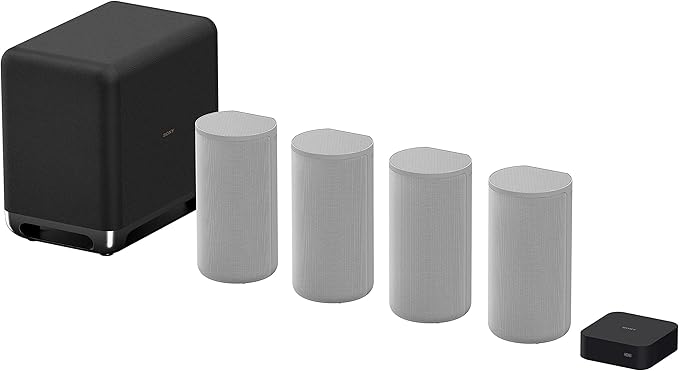
From a mechanical engineering and feature-integration standpoint, the two brands diverge dramatically in how they solve cable management and spatial placement. JBL champions true physical modularity, most notably through its patented battery-powered, detachable wireless rear surround speakers. This design breakthrough allows users to physically unclip the rear channels from the main soundbar chassis for movie nights and re-dock them for recharging, eliminating both power cords and dedicated speaker stands. Sony approaches spatial limitations digitally and architecturally, deploying upward-firing drivers, beam tweeters, and its proprietary 360 Spatial Sound Mapping. Rather than relying on physical detachment, Sony’s physical enclosures are tuned to leverage room boundaries, incorporating advanced microphone arrays for acoustic auto-calibration. However, Sony’s dedicated rear speakers and subwoofers (like the SA-RS5 and SA-SW5) still demand permanent, dedicated AC outlets, making JBL the objectively superior choice for clutter-free, transient setups.
The practical trade-offs between the two brands ultimately center on ecosystem cohesion versus standalone utility. Sony’s physical design offers deep synergy with its BRAVIA television lineup, featuring integrated pass-through stands, Acoustic Center Sync (using the TV itself as a center speaker), and hidden cable routing tracks that create an integrated AV monolith. JBL, conversely, optimizes for universal third-party compatibility, featuring low-profile magnetic docking points, legible LED character displays hidden behind the front metallic grilles, and tactile, high-contrast physical buttons on the top deck. For consumers seeking architectural elegance and seamless television integration, Sony’s refined industrial design represents the gold standard; for those prioritizing versatile deployment, rugged construction, and clever mechanical problem-solving, JBL delivers the more practically engineered package.