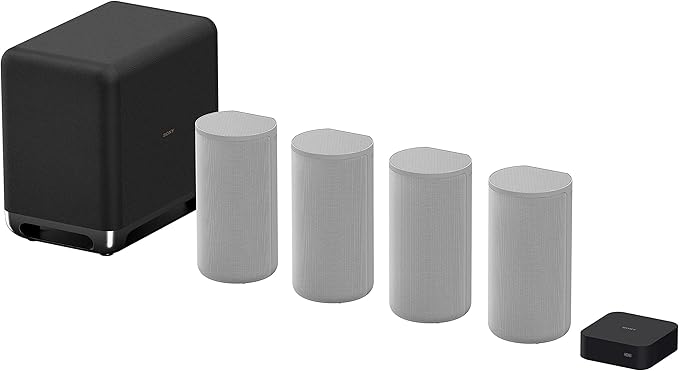
Sony vs Enclave: Overview
Comparing Sony and Enclave helps you determine which brand is best suited for your needs in Home Theaters. Both brands offer strong choices depending on your budget and key feature requirements.
Key Features & Comparison
Evaluate factors such as build quality, warranty, customer satisfaction, and total value before making your final purchase choice between Sony and Enclave.
Features
Sony’s feature suite represents one of the most technologically advanced and diversified portfolios in consumer electronics. Central to their modern acoustic lineup is 360 Spatial Sound Mapping, a proprietary technology that synthesizes phantom speakers between physical enclosures to generate an intensely wide, three-dimensional acoustic bubble. Sony products also boast cutting-edge HDMI 2.1 connectivity with 4K/120Hz and 8K passthrough, VRR, and ALLM support, making them the superior choice for high-frame-rate console gaming. Additional flagship features, such as Acoustic Center Sync—which repurposes compatible Bravia television panels as dedicated center dialogue channels—and DSEE Extreme audio upscaling, demonstrate an intricately unified hardware and software platform designed for total entertainment immersion.
Enclave, conversely, narrows its feature set to focus relentlessly on seamless wireless deployment and uncompressed multi-channel transmission. Using WiSA technology operating in dedicated UNII radio frequency bands, Enclave systems bypass congested domestic 2.4GHz and 5GHz Wi-Fi networks to deliver 24-bit/48kHz uncompressed audio with an imperceptible 5-millisecond latency. Setup is controlled via the Enclave CineHub, which supports eARC, optical, and auxiliary inputs alongside Dolby Audio and DTS formats. However, Enclave’s reliance on pure discrete transmission means it foregoes advanced computational audio processing, object-based spatial upmixing tricks, and smart assistant integrations, presenting a simplified, utilitarian ecosystem that prioritizes wireless stability over software-driven acoustic features.
Performance
Acoustic performance between the two brands reveals distinct strengths tailored to different viewing environments and source materials. Sony excels in spatial precision, dynamic range, and psychoacoustic processing. Across their high-end soundbars and modular wireless systems, Sony's DSP algorithms excel at rendering Dolby Atmos and DTS:X height channels, creating an expansive, layered soundstage that belies the physical footprint of the drivers. High frequencies are crisp without inducing fatigue, dialogue clarity is bolstered by dedicated voice-enhancement profiles, and the integration with optional wireless subwoofers yields deep, cinema-grade low-end extension. Sony’s ability to recreate a holographic audio environment from fewer physical positions makes it an acoustic powerhouse in modern living rooms.
Enclave counters by relying on the raw physics of true, discrete physical speaker placement rather than virtualized height or reflection cues. Because the CineHome HD and CineHome II systems position physical enclosures behind and around the listener, directional panning effects feel naturally organic and pinpoint-accurate without requiring reflective flat ceilings. The dialogue delivered through Enclave’s dedicated center channel is robust, clean, and entirely free of digital compression artifacts. However, because Enclave lacks the proprietary acoustic correction algorithms and raw amplifier wattage of Sony’s upper-tier components, its bass response can feel slightly less authoritative, and its ability to replicate height effects in non-standard rooms is more limited than Sony's virtualized 360-degree soundfield.
Design
From an industrial design standpoint, Sony strikes a balance between minimalist Japanese aesthetics and acoustic engineering principles. Their soundbars, subwoofers, and independent speakers feature refined, fabric-wrapped surfaces, matte polymers, and rounded edges that blend seamlessly into contemporary architectural interiors. Products like the HT-A9 showcase visionary industrial design, using cylindrical, light-gray enclosures with omnidirectional grilles that look like sculptural art rather than traditional black speaker boxes. Internally, Sony employs proprietary X-Balanced Speaker Units, which maximize diaphragm area within compact, non-circular shapes to reduce distortion and increase sound pressure while preserving a sleek silhouette.
Enclave approaches design with an unapologetically functional, traditional aesthetic. Their CineHome satellite speakers and subwoofers feature rugged, black textured MDF enclosures and utilitarian metallic grilles designed to perform reliably rather than turn heads. The hallmark of Enclave’s design is the liberation from speaker wire; each individual speaker requires only a standard AC power cord, housing its own internal amplification and WiSA wireless receiver module. The CineHub itself is an ultra-compact, low-profile transmitter that hides effortlessly beneath a television or inside media cabinetry. While Enclave’s utilitarian look may lack the high-end, premium finish of Sony's bespoke audio hardware, its cable-free simplicity solves a major visual decor challenge for many homeowners.