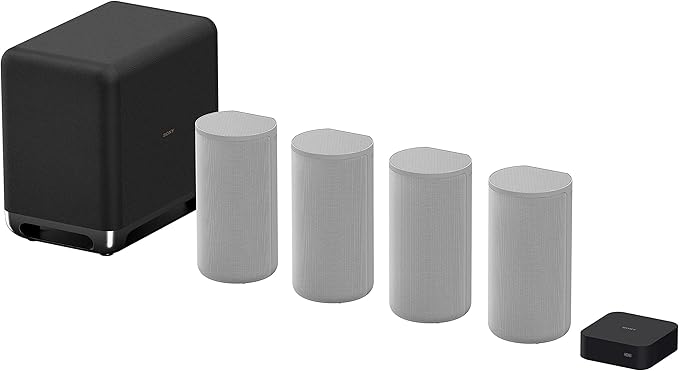
Sony vs Acoustic Audio: Overview & Brand Philosophy
When evaluating the landscape of modern home theater systems, few names carry the historical weight and technical pedigree of Sony. Founded on a philosophy of acoustic purism and relentless innovation, the Japanese tech titan has spent decades shaping industry standards, from the development of high-resolution audio formats to cutting-edge digital cinema equipment. In the consumer space, Sony approaches home theaters as integrated cinematic ecosystems, blending proprietary acoustic hardware with sophisticated digital signal processing such as 360 Spatial Sound Mapping. Sony caters to discerning consumers who demand seamless integration with modern display technologies, reference-grade Dolby Atmos staging, and premium materials designed to deliver Hollywood-standard playback in residential environments.
Conversely, Acoustic Audio—a brand operating under the parent umbrella of Goldwood Sound Inc.—pursues a radically different market objective. Engineered in the United States and manufactured overseas, Acoustic Audio focuses on democratizing multi-channel sound. Its brand philosophy centers on high-utility, budget-conscious audio solutions that bypass the high price tags of legacy high-end audio engineering. Rather than competing directly in the premium object-based audio arena, Acoustic Audio targets consumers seeking immediate, multi-channel immersion, basement entertainment setups, or simple architectural speaker arrays (such as in-wall and in-ceiling installations) without the requirement of a multi-thousand-dollar audio-video receiver (AVR) investment.
This fundamental divergence in corporate philosophy dictates every facet of how these brands design and deliver home theater systems. While Sony prioritizes acoustic fidelity, cutting-edge video-passthrough protocols, and digital spatial accuracy, Acoustic Audio emphasizes accessibility, standalone functionality, and raw feature count per dollar. Understanding this distinction is essential for identifying which brand aligns with your entertainment priorities, installation constraints, and budget expectations.
Key Differences & Technological Comparison
The technical divide between Sony and Acoustic Audio is pronounced, spanning audio architecture, connectivity standards, digital signal processing (DSP), and enclosure construction.
Audio Processing and Spatial Formats: Sony stands at the vanguard of modern spatial audio. Higher-end Sony systems, including the BRAVIA Theater line and STR-series AV receivers, natively decode lossless object-based formats such as Dolby Atmos, DTS:X, and IMAX Enhanced. Furthermore, Sony utilizes Digital Cinema Auto Calibration (D.C.A.C.), employing calibrated microphones to map acoustic reflections and tailor delay times dynamically to room geometry. Acoustic Audio systems, by contrast, rely predominantly on legacy audio processing. Most of their all-in-one 5.1-channel systems decode standard multi-channel analog inputs, optical PCM, or utilize internal DSP upmixing to distribute stereo signals across five satellite speakers and a subwoofer. They lack native rendering for advanced 3D height channels and do not include automated microphone-based room correction.
Connectivity and Video Passthrough: Connectivity represents another major point of differentiation. Sony home theater receivers and active sound systems feature full HDMI 2.1 implementations, supporting eARC (Enhanced Audio Return Channel), 4K video at 120Hz, 8K passthrough, and variable refresh rates (VRR)—imperative for modern gaming consoles and flagship 4K OLED displays. Acoustic Audio all-in-one systems are designed around legacy and analog inputs: RCA auxiliary inputs, basic optical audio ports, 3.5mm jacks, and standard Bluetooth. They do not process or pass through modern 4K HDR video signals; rather, they serve strictly as audio endpoints that require the video display or an external switcher to handle source distribution.
Amplification and Transducer Build: Sony utilizes high-grade, low-resonance chassis materials, custom-designed transformers, and proprietary speaker driver materials such as Mica Reinforced Cellular (MRC) and foamed-mica cones, designed to prevent distortion under high excursion. Acoustic Audio relies on mass-manufactured, functional components: treated paper or polypropylene cones, butyl rubber surrounds, and lightweight magnet assemblies housed in budget MDF or molded plastic enclosures. While Acoustic Audio systems can produce substantial volume levels, Sony systems provide considerably superior signal-to-noise ratios, lower Total Harmonic Distortion (THD), and far greater dynamic headroom.
Pros & Cons Comparison
Sony Home Theaters
- Pros:
- Industry-leading spatial audio processing, including Dolby Atmos, DTS:X, and 360 Spatial Sound Mapping.
- Advanced HDMI 2.1 connectivity with eARC, 4K/120Hz, and 8K video passthrough for cutting-edge home theater and gaming integration.
- Precision acoustic calibration (D.C.A.C.) that tailors frequency response to specific room dimensions and layouts.
- Superior build quality, premium acoustic materials, and exceptionally low harmonic distortion across all volume bands.
- Ecosystem synergy with Sony BRAVIA televisions, allowing TVs to function as center channel speakers (Acoustic Center Sync).
- Cons:
- Substantially higher financial investment across all component tiers.
- Higher-end systems and component setups can introduce a steeper configuration learning curve for novice users.
Acoustic Audio Home Theaters
- Pros:
- Remarkably cost-effective entry point for complete multi-channel (5.1) surround sound arrays.
- Standalone plug-and-play functionality on powered systems without requiring a standalone AV receiver.
- Diverse utility features on active systems, including SD card slots, USB playback, integrated FM tuners, and Bluetooth streaming.
- Broad catalog of budget-friendly passive in-wall and in-ceiling speakers suited for distributed background audio.
- Cons:
- Lacks support for native object-based formats like Dolby Atmos, DTS:X, and lossless Dolby TrueHD.
- Absence of HDMI connectivity or eARC integration, complicating control via standard TV remotes (no HDMI-CEC).
- Basic plastic/thin MDF cabinet construction results in higher resonance and audible compression at elevated volumes.
- No automated room calibration, necessitating manual channel balance by ear.
Performance, Durability & Value Analysis
From an acoustic performance standpoint, Sony occupies an entirely different tier of engineering precision. When playing high-bitrate physical or streaming media, Sony home theaters reproduce a clinical, wide, and three-dimensional soundstage where subtle ambient cues and explosive dynamic shifts are accurately rendered without muddiness. Bass reproduction is tight and controlled, avoiding the mid-bass bloat that often plagues entry-level equipment. In terms of longevity, Sony's internal components—such as heat sinks, digital-to-analog converters (DACs), and power supplies—are rated for continuous duty cycles under thermal load, resulting in high multi-year reliability and continuous firmware support for evolving video standards.
Acoustic Audio provides a value proposition built on raw volume per dollar rather than micro-detail or acoustic accuracy. For casual movie watching, sports broadcasts, and party environments, an Acoustic Audio active 5.1 system creates an engaging, room-filling experience that noticeably surpasses internal television speakers. However, the durability profile reflects its budget positioning. Thin wiring harnesses, entry-level plate amplifiers within powered subwoofers, and basic rotary potentiometers show signs of wear and electrical noise earlier than high-tier gear. From a pure capital-outlay perspective, Acoustic Audio presents a high immediate return on investment for low-impact setups, but it lacks the long-term scalability and resale value of Sony's hardware.
Final Verdict: Which Brand Should You Choose?
Choosing between Sony and Acoustic Audio depends on your performance requirements, your existing television hardware, and your budgetary limits.
Choose Sony if: You are building a dedicated living room theater or media room and demand modern cinematic immersion. If you own a modern 4K or 8K TV, utilize modern gaming consoles, stream uncompressed spatial audio, and value acoustic transparency, Sony is unequivocally the correct investment. It offers the processing power, HDMI 2.1 integration, and dynamic fidelity required to deliver an authentic cinema experience at home.
Choose Acoustic Audio if: You are working with a strict budget, outfitting a secondary entertainment space (such as a garage, college dorm, or rental property), or need a simple, self-contained multi-channel system without purchasing a separate AV receiver. Acoustic Audio is also a viable candidate if you are seeking inexpensive passive in-wall or in-ceiling speakers for multi-room background audio where critical listening is not the primary objective.
Features
When evaluating the feature ecosystems of Sony and Acoustic Audio in the home theater domain, the technological divide between elite digital processing and budget-oriented utility becomes immediately apparent. Sony’s engineering prioritizes sophisticated signal processing, spatial acoustic modeling, and advanced codec compatibility. Across its mid-range to flagship home theater receivers and bundled systems, Sony integrates native decoding for immersive object-based formats such as Dolby Atmos and DTS:X, amplified by proprietary enhancements like 360 Spatial Sound Mapping. In stark contrast, Acoustic Audio by Goldwood caters to an accessible, plug-and-play segment of the market, typically relying on matrixed surround sound or legacy 5.1-channel analog discrete separation. Acoustic Audio units generally omit advanced digital decoders for high-bitrate, lossless audio formats, instead focusing on standard stereo-to-surround upmixing, basic digital optical inputs, and rudimentary operational displays, which inherently restricts their ability to deliver a true multi-dimensional cinematic soundfield.
The discrepancy is equally pronounced in connectivity architectures and calibration technologies. Sony home theater systems frequently function as comprehensive AV distribution hubs, outfitted with HDMI 2.1 ports capable of uncompressed eARC audio passthrough, 8K video transmission, and modern gaming provisions like 4K at 120Hz, Variable Refresh Rate (VRR), and Auto Low Latency Mode (ALLM). Furthermore, Sony incorporates sophisticated automated room correction—specifically its Digital Cinema Auto Calibration (D.C.A.C.) suite—which utilizes microphone feedback to optimize speaker delays, phase, and frequency response for uneven living environments. Acoustic Audio designs forgo HDMI infrastructure altogether, anchoring their connectivity in standard Bluetooth streaming, auxiliary 3.5mm inputs, RCA patch cables, and onboard media hubs like SD card slots, USB ports, and FM tuners. Calibration on Acoustic Audio hardware is completely manual, limited to channel-specific independent volume potentiometers or basic treble and bass shelving on a handheld infrared remote, shifting the acoustic tuning burden onto the end user.
Consequently, the practical trade-offs regarding features reflect fundamentally different user priorities. Sony delivers an integrated, future-proof feature set that seamlessly interfaces with modern smart home ecosystems—supporting Apple AirPlay 2, Google Assistant, Spotify Connect, and synchronized Bravia TV center-channel integration—albeit at a significantly higher price point and with a steeper setup curve. Acoustic Audio trades this cutting-edge audio fidelity and deep digital infrastructure for cost efficiency, uncomplicated deployment, and standalone versatility. For consumers needing an inexpensive surround-sound array for small-scale casual listening, retro gaming, or basic television amplification without navigating complex setup menus, Acoustic Audio offers baseline utility; however, for power users demanding high-fidelity decoding, room-optimized acoustics, and bleeding-edge video passthrough, Sony’s feature suite operates in an entirely superior technological tier.
Performance
When evaluating acoustic performance, Sony stands at the forefront of modern home theater engineering, offering sophisticated acoustic fidelity driven by cutting-edge digital signal processing (DSP) and proprietary spatial sound innovations. Sony systems—ranging from their discrete AV receivers to advanced multi-channel soundbars like the HT-A series—excel in dynamic range, high-resolution audio reproduction, and minimal total harmonic distortion (THD). The hallmark of Sony’s performance lies in its integration of object-based decoding (Dolby Atmos and DTS:X) alongside proprietary technologies like 360 Spatial Sound Mapping and Digital Cinema Auto Calibration (D.C.A.C.). These features create an expansive, seamless audio bubble where panning effects move with surgical precision, dialogue maintains distinct clarity through dedicated center channels, and subwoofers deliver tight, articulate low-end extension without muddying the mid-frequencies.
In contrast, Acoustic Audio by Goldwood operates primarily in the value-driven segment, prioritizing sheer volume and raw output over nuanced acoustic staging and high-end decoding. Acoustic Audio systems typically utilize standard analog or basic digital connections (such as optical and Bluetooth) powered by integrated sub-mounted amplifiers, frequently relying on passive satellite speakers with entry-level paper or poly cone drivers. While these systems can achieve considerable loudness suitable for small-to-medium entertainment spaces or casual party environments, their performance exhibits noticeable compromises. Dynamic range is noticeably compressed, crossovers between satellites and the subwoofer can feel abrupt, and high volumes often introduce cabinet resonance and distortion. Furthermore, Acoustic Audio systems lack native support for uncompressed audio formats and object-based spatial audio, instead using basic stereo matrixing to simulate surround sound across all channels.
The practical trade-offs regarding performance center around micro-detail and immersion versus raw affordability. Sony is engineered for audiophiles and cinephiles who demand authentic transient response, crystal-clear treble without sibilance, and intelligent room compensation that adapts to complex room layouts. Conversely, Acoustic Audio serves budget-conscious consumers who need functional 5.1 channel separation and punchy bass for television and casual media consumption without the high price tag of specialized audio components. Ultimately, for true cinematic depth, acoustic coherence, and reference-grade performance, Sony vastly outperforms Acoustic Audio, which trades acoustic refinement and advanced spatial processing for budget accessibility.
Design
Sony approach to home theater design emphasizes architectural minimalism and sophisticated industrial engineering, whereas Acoustic Audio prioritizes functional utilitarianism aimed at budget-conscious, traditional multi-channel utility. Sony’s contemporary design language—exemplified by products ranging from the monolithic HT-A series soundbars to the spatial HT-A9 system—relies on low-profile geometry, micro-perforated acoustic metal grilles, and premium matte composites designed to disappear into modern interior decor. In contrast, Acoustic Audio embraces a visibly mechanical, late-2000s consumer electronics aesthetic, often outfitting its subwoofers and satellites with high-gloss plastic bezels, exposed front-facing LED readouts, and ambient lighting accents. Where Sony conceals hardware behind muted, acoustically transparent textiles to enhance living room elegance, Acoustic Audio’s designs are inherently more conspicuous, relying on standard black-ash vinyl-wrapped MDF cabinets that function adequately but lack refined styling.
From an internal engineering and chassis construction standpoint, the two manufacturers occupy entirely different tiers of technical sophistication. Sony invests heavily in custom acoustic architectures, such as its proprietary X-Balanced driver units, which utilize non-circular diaphragms to maximize surface area without increasing the system’s vertical footprint, effectively eliminating cabinet resonance through rigid, internally ribbed unibody structures. Acoustic Audio relies on standardized driver formats—primarily standard paper or treated-composite cones paired with conventional dome tweeters housed in lightweight plastic satellite casings. While Acoustic Audio’s use of dense MDF for its subwoofer enclosures provides solid baseline acoustic deadening and structural rigidity for bass reproduction, the overall fit-and-finish features wider panel tolerances and less sophisticated internal baffling compared to Sony's precision-molded acoustic chambers.
In terms of practical installation and spatial integration, the structural design choices of each brand dictate distinctly different user trade-offs. Sony designs around seamless integration, leveraging low-profile vertical clearance to sit beneath thin-bezel televisions, paired with proprietary wireless link protocols that eliminate physical interconnects between the primary console, surround channels, and subwoofers. Acoustic Audio retains a traditional tethered architecture, relying largely on spring-clip wire terminals, RCA harness outputs, and passive satellite wiring that necessitate intricate cable management along baseboards and through walls. However, the trade-off favors Acoustic Audio for users seeking physical flexibility: its discrete, modular satellite enclosures can be easily swapped, wall-mounted via standard keyhole slots, or repositioned using universal speaker stands, whereas Sony’s highly integrated form factors often require specific, sometimes costly proprietary wall-mount brackets and structured placement to optimize directional firing angles.
Compare current retail pricing, active promotions, and verified stock availability directly from authorized stores: