Acoustic Audio vs Bose: Overview
Comparing Acoustic Audio and Bose helps you determine which brand is best suited for your needs in Home Theaters. Both brands offer strong choices depending on your budget and key feature requirements.
Key Features & Comparison
Evaluate factors such as build quality, warranty, customer satisfaction, and total value before making your final purchase choice between Acoustic Audio and Bose.
Features
The feature ecosystems of Acoustic Audio and Bose highlight the evolution of home theater connectivity over the past two decades. Acoustic Audio leans heavily into traditional wired analog configurations, typically relying on spring-clip or standard binding post terminals, standard RCA inputs, and basic Bluetooth receivers on their powered units. While some of their powered 5.1 systems include auxiliary inputs, SD card slots, and integrated FM tuners, they generally omit modern digital standards such as HDMI eARC, Dolby Atmos decoding, and network-based streaming. This makes Acoustic Audio best suited for integration with external AV receivers or straightforward plug-and-play budget setups where complex decoding is handled upstream.
Bose establishes a technological standard with an extensive suite of advanced digital features designed for modern, smart-home entertainment. Current Bose systems, such as the Smart Soundbar family, come standard with HDMI eARC, optical inputs, integrated voice assistants (Amazon Alexa and Google Assistant), and multi-room wireless protocols like Apple AirPlay 2, Spotify Connect, and Wi-Fi. Furthermore, Bose employs sophisticated proprietary technologies, such as ADAPTiQ room calibration, which automatically analyzes room dimensions and reflective surfaces to tune acoustics dynamically. Bose also offers seamless wireless expansion, allowing users to pair wireless surround speakers and dual subwoofers with minimal cabling, providing an infinitely more versatile and future-proof feature set than Acoustic Audio.
Performance
Acoustic Audio’s acoustic performance is characterized by high SPL (sound pressure level) potential and straightforward, high-efficiency output. Because their speaker configurations typically utilize traditional paper-cone woofers, direct-radiating tweeters, and ported enclosures, they can produce considerable volume and punchy mid-bass suitable for casual movie watching and high-energy gatherings. However, critical listening reveals the limitations of their budget crossover components and cabinet damping; audio fidelity often suffers from elevated total harmonic distortion (THD) at higher volumes, along with a somewhat compressed dynamic range and uneven frequency response across the mid-range and treble registers.
Bose operates on an entirely different level of acoustic refinement, utilizing complex psychoacoustics, proprietary transducers, and active digital signal processing (DSP) to achieve clarity, presence, and spatial dispersion that defy cabinet sizes. Through technologies like PhaseGuide, Bose projects discrete sound beams across the room, simulating an expansive soundstage with articulate height and surround effects even from a single bar enclosure. Dialogue clarity is exceptionally crisp due to active center-channel tuning, while Bose bass modules utilize custom multi-chamber port geometries to deliver tight, musical, and low-distortion low frequencies without cabinet rattle. While an audiophile purist might note Bose's active tone shaping, its fidelity, tonal accuracy, and micro-detail resolution decisively outclass Acoustic Audio.
Design
From an aesthetic and industrial design standpoint, Acoustic Audio adheres strictly to functional, utilitarian principles. Their floor-standing, bookshelf, and powered satellite speakers largely feature standard medium-density fiberboard (MDF) cabinets wrapped in basic black woodgrain vinyl, accompanied by plastic bezels and classic cloth grilles. While their architectural in-wall and in-ceiling lines offer paintable magnetic grilles that blend passably into drywall, the overall finish and tactile quality reflect manufacturing focused on cost efficiency rather than luxury. They occupy noticeable physical space and require deliberate cable routing, yielding a classic, utilitarian home theater presence.
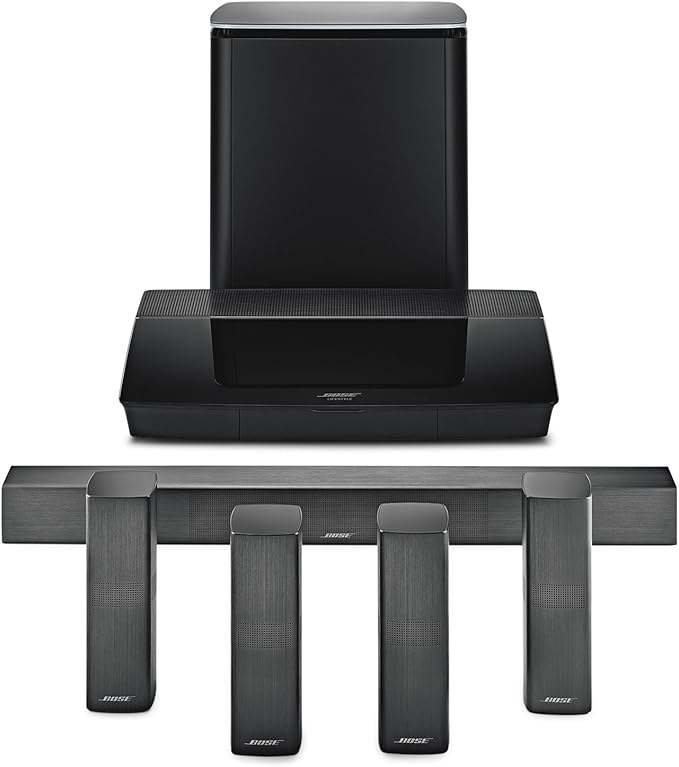
Bose approaches industrial design as a core brand pillar, producing sleek, minimalist audio hardware that enhances modern interior decor rather than competing with it. Bose products feature premium materials including seamless extruded metal grilles, impact-resistant matte polymers, and elegant tempered glass top plates that convey structural durability and sophistication. Their hardware footprints are remarkably compact, designed to sit unobtrusively below ultra-thin televisions or mount cleanly to walls without visual clutter. By marrying compact enclosures with high aesthetic standards, Bose caters to discerning consumers who demand world-class home theater performance wrapped in an elegant, contemporary package.
Compare current retail pricing, active promotions, and verified stock availability directly from authorized stores: