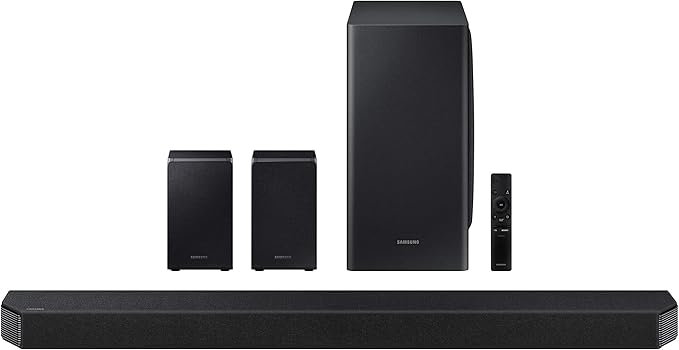
Samsung vs SVS: Overview
Comparing Samsung and SVS helps you determine which brand is best suited for your needs in Home Theaters. Both brands offer strong choices depending on your budget and key feature requirements.
Key Features & Comparison
Evaluate factors such as build quality, warranty, customer satisfaction, and total value before making your final purchase choice between Samsung and SVS.
Features
From a feature and technology perspective, Samsung leads in automated spatial processing and digital interconnectivity, while SVS focuses on precision acoustic tuning and active driver management. Flagship Samsung soundbar packages come equipped with extensive wireless connectivity, including Wi-Fi, Apple AirPlay 2, Bluetooth, and wireless Dolby Atmos transmission. Samsung also features proprietary technologies like SpaceFit Sound Pro for automated room calibration and Q-Symphony, which synchronizes soundbar drivers with compatible Samsung television speakers. These systems incorporate dedicated up-firing and side-firing physical drivers designed to bounce spatial metadata off walls and ceilings to simulate an immersive soundfield with minimal wiring.
Conversely, SVS approaches features through the lens of electroacoustic optimization rather than consumer IoT integrations. The standout feature across SVS's active subwoofers is the proprietary SVS Soundpath/Subwoofer DSP Smartphone App, which allows users to control volume, low-pass filters, phase, polarity, room gain compensation, and parametric EQ settings via Bluetooth from the listening position. Rather than relying on rigid automated algorithms, SVS provides granular control over crossover points and acoustic behavior to overcome real-world room modes. While SVS systems require an AV receiver to handle format decoding, HDMI switching, and room correction like Audyssey or Dirac Live, this modularity grants users access to higher-tier processing than any integrated soundbar can achieve.
Performance
In pure acoustic performance, SVS stands in a league of its own, particularly regarding dynamic headroom, low-frequency capability, and soundstage imaging. SVS speakers—such as the Prime and Ultra series—employ high-grade crossover networks, FEA-optimized drivers, and structurally braced cabinets that resist unwanted cabinet coloration. When paired with SVS subwoofers driven by Sledge Class-D amplifiers, the system achieves linear bass extension down to 16Hz or lower with virtually zero thermal compression. This delivers genuine subterranean tactile impact, pristine transient response, and transparent dialogue clarity capable of pressurizing large, dedicated theater spaces at reference playback levels.
Samsung delivers an impressive acoustic output relative to its physical form factor, but it encounters distinct physical and acoustic limitations when placed against discrete components. Flagship Samsung soundbar setups leverage psychoacoustic digital signal processing and multi-channel driver arrays to deliver convincing surround envelopment and clear, distinct vocal articulation. However, because their subwoofers feature smaller enclosures and lower-excursion drivers, they struggle to reproduce true infra-bass below 30Hz without distortion or aggressive digital limiter engagement. Samsung excels at medium-volume, room-filling spatial effects for movies and streaming television, but SVS outclasses it in sustained dynamic range, musical fidelity, and low-end authority.
Design
The industrial design of SVS products prioritizes acoustic performance, structural rigidity, and classic component aesthetics. SVS speakers and subwoofers feature dense medium-density fiberboard (MDF) cabinets, non-parallel internal baffling to minimize standing waves, and heavy-gauge driver surrounds. Visual finishes often include premium piano gloss black or rich black ash wood veneers, which convey high-end craftsmanship. However, this level of engineering requires substantial physical volume, thick speaker grilles, and deliberate cable management, making SVS systems visually prominent centerpieces that demand dedicated floor space and strategic placement.
Samsung adopts a contemporary, lifestyle-oriented design ethos engineered to integrate seamlessly into modern residential spaces. Their soundbars, wireless rear satellites, and companion subwoofers emphasize low-profile geometries, dark acoustic fabric or metal mesh grilles, and minimal cable clutter. Designed to sit unobtrusively below flat-panel TVs or flush-mount against a wall, Samsung hardware sacrifices physical cabinet volume in favor of compact elegance and ease of installation. While Samsung's construction utilizes lighter composite plastics and smaller enclosures, it successfully addresses the lifestyle demand for powerful domestic entertainment without dominating the visual decor of the living environment.