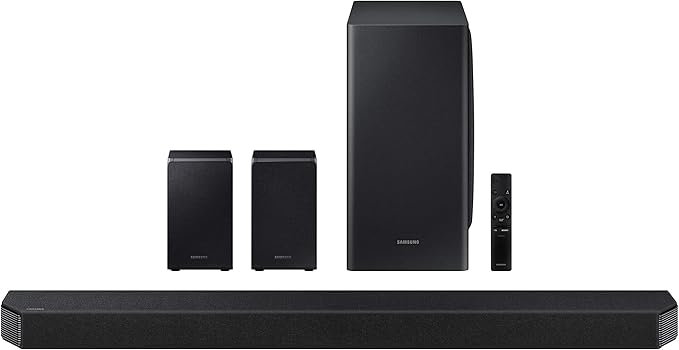
Samsung vs Acoustic Audio: Overview
Comparing Samsung and Acoustic Audio helps you determine which brand is best suited for your needs in Home Theaters. Both brands offer strong choices depending on your budget and key feature requirements.
Key Features & Comparison
Evaluate factors such as build quality, warranty, customer satisfaction, and total value before making your final purchase choice between Samsung and Acoustic Audio.
Features
Samsung’s feature set is built upon cutting-edge connectivity and automated audio intelligence. High-end Samsung home theater packages incorporate true object-based spatial audio with upward- and side-firing drivers, HDMI eARC passthrough, Wi-Fi streaming, Apple AirPlay 2, and voice assistant support. Furthermore, proprietary ecosystems such as Q-Symphony enable synchronized playback between Samsung televisions and sound systems, while features like SpaceFit Sound use internal microphones to continuously analyze room boundaries and automatically tune equalization curves for optimal resonance and clarity.
Acoustic Audio focuses on functional essentials, generally omitting high-tier digital decoders and automated acoustic calibration. Their standalone systems typically rely on standard Bluetooth streaming, optical inputs, analog RCA connections, and auxiliary jacks, alongside integrated FM tuners or USB media players on select hub units. While Acoustic Audio lacks advanced spatial formats like DTS:X or Dolby Atmos, it compensates by providing high-output passive and active multi-speaker configurations, giving users access to discrete multi-point audio distribution and traditional speaker wire installations that allow for flexible component matching on a strict budget.
Performance
From an acoustic engineering perspective, Samsung systems deliver precise, dynamic, and cohesive sound reproduction. The brand’s California-based Audio Lab develops custom wide-range tweeters and balanced drivers that maintain vocal intelligibility through dedicated center channels even amidst chaotic, high-volume action sequences. Subwoofers in Samsung packages are tuned to eliminate cabinet rattle while delivering deep, articulate sub-bass that integrates smoothly into the mid-range, resulting in an immersive three-dimensional soundstage capable of rendering subtle directional cues in modern film mixes.
Acoustic Audio systems excel primarily in sheer volume and raw output per dollar. With high-efficiency cone drivers and ported subwoofers, their setups can fill medium-to-large spaces with energetic sound. However, technical analysis reveals limitations in crossover precision and frequency linearity compared to Samsung. High frequencies can occasionally lean toward brightness or sibilance, and low-end bass notes, while punchy and impactful, can lack the tight transient response and sub-bass depth required for critical listening, making them better suited for casual media consumption and energetic gathering environments rather than audiophile-grade fidelity.
Design
Samsung’s industrial design is sleek, minimalist, and thoroughly aligned with modern living room aesthetics. Utilizing acoustically transparent textiles, premium matte finishes, and low-profile form factors, Samsung hardware is intended to sit unobtrusively beneath ultra-thin televisions. Their wireless rear satellite speakers and wireless subwoofers reduce visible cable clutter, requiring only localized power connections. Additionally, subtle LED displays and intuitive low-profile remotes contribute to a sophisticated, unified aesthetic that complements high-end interior spaces.
Acoustic Audio embraces a more utilitarian, traditional aesthetic characterized by classic speaker cabinets, visible driver cones, and durable MDF enclosures finished in black vinyl or ash textures. In their home theater in-a-box sets, satellite units often feature exposed speaker wire terminals and integrated mounting brackets designed for utility rather than invisible luxury. While functional and durable, Acoustic Audio components occupy more visual and physical real estate, demanding careful cable management due to their tethered speaker wire architecture, but offering a classic hi-fi appearance that many traditional home theater hobbyists appreciate.