Onkyo vs Klipsch: Overview
Comparing Onkyo and Klipsch helps you determine which brand is best suited for your needs in Home Theaters. Both brands offer strong choices depending on your budget and key feature requirements.
Key Features & Comparison
Evaluate factors such as build quality, warranty, customer satisfaction, and total value before making your final purchase choice between Onkyo and Klipsch.
Features
Onkyo stands as a technological tour de force when it comes to feature integration, heavily driven by its expertise in audio-video receiver architecture. Modern Onkyo systems boast extensive multi-zone capabilities, advanced HDMI 2.1 support capable of 4K/120Hz and 8K passthrough, and expansive wireless streaming ecosystems encompassing AirPlay 2, Chromecast built-in, DTS Play-Fi, and Works with Sonos certifications. A standout technical inclusion in higher-tier Onkyo gear is the integration of Dirac Live room correction, a studio-grade acoustic calibration tool that algorithmically resolves room anomalies, standing waves, and phase alignment with surgical precision, offering power users granular control over their sound field.
Klipsch approaches features from a predominantly electro-acoustic angle, concentrating on physical engineering innovations rather than digital processing. In their active systems, such as the Cinema soundbar series or the Fives/Sevens/Nines powered monitors, Klipsch includes essential modern features like HDMI eARC, optical inputs, and high-resolution Bluetooth with LDAC, but typically avoids bloated software interfaces. Features in the Klipsch ecosystem are manifested in structural hardware: proprietary Tractrix horns for controlled directivity, spun-copper Cerametallic woofers for rigidity and low distortion, and built-in phono preamps. While Onkyo wins on digital connectivity, app integration, and room-tuning customization, Klipsch excels in mechanical and electro-acoustic features designed to optimize pure sound delivery without unnecessary signal manipulation.
Performance
In terms of acoustic performance, Klipsch is universally celebrated for its signature high-sensitivity, low-distortion sound profile. The brand’s hallmark Tractrix horn loading maximizes acoustic energy transfer, enabling Klipsch speakers to deliver explosive dynamic range, crystalline high frequencies, and startling realism even when driven by modest power outputs. Movie soundtracks benefit immensely from this design, as subtle Foley details and sudden percussive explosions are rendered with near-zero compression and exceptional transient speed. However, this forward, bright acoustic signature can sometimes verge on fatiguing for sensitive listeners during prolonged playback of poorly mastered music or aggressive audio mixes.
Onkyo’s performance strengths are concentrated in its robust power stages and signal accuracy rather than transducer brilliance. Onkyo’s Dynamic Audio Amplification (DAA) utilizes high-current, low-noise transformers and custom capacitors to deliver high instantaneous current, which maintains control over speaker drivers during intense, bass-heavy cinema sequences. When evaluating Onkyo's bundled satellite speakers, the performance is balanced and clean, but inevitably lacks the visceral low-end impact, imaging depth, and scale delivered by Klipsch drivers. Onkyo achieves its sonic excellence through precise surround-sound steering, clean digital-to-analog conversion, and neutral frequency reproduction, whereas Klipsch captures the raw, theatrical impact that defines high-end cinema immersion.
Design
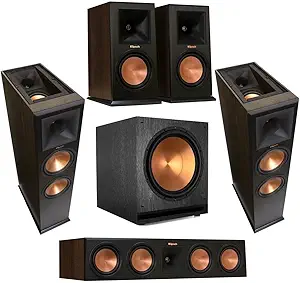
The aesthetic identities of Onkyo and Klipsch reflect their disparate origins in consumer electronics versus artisanal hi-fi manufacturing. Klipsch designs are immediately recognizable, iconic, and unapologetically bold, distinguished by their signature spun-copper woofers, textured wood-grain vinyl or real wood veneers, and exposed horn geometries. Whether integrated into a dedicated screening room or a modern living area, Klipsch speakers make a definitive visual statement with high industrial build quality, reinforced MDF internal bracing, and magnetic grilles that allow users to showcase the striking copper drivers. Their design language blends vintage Americana with rugged, contemporary acoustic industrialism.
Onkyo exhibits a much more utilitarian, functional design aesthetic characterized by understated, black brushed-aluminum faceplates, centralized display screens, and pragmatic front-panel control layouts. Onkyo’s packaged satellite speakers and subwoofers tend to lean toward minimalist, compact plastic or compressed wood housings designed to blend inconspicuously into living room decor rather than serve as focal design centerpieces. While Onkyo’s receivers are praised for intuitive ergonomics, clear back-panel labeling, and robust chassis ventilation, their overall visual footprint is pragmatic and electronic, whereas Klipsch designs celebrate the speaker cabinet as an enduring piece of visual and tactile furniture.