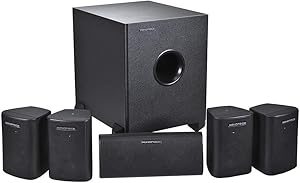
Monoprice vs Logitech: Overview
Comparing Monoprice and Logitech helps you determine which brand is best suited for your needs in Home Theaters. Both brands offer strong choices depending on your budget and key feature requirements.
Key Features & Comparison
Evaluate factors such as build quality, warranty, customer satisfaction, and total value before making your final purchase choice between Monoprice and Logitech.
Features
Monoprice stands out technically through its adherence to industry-standard audio protocols, modular connectivity, and support for high-resolution formats. Because Monoprice primarily designs individual passive speakers, active subwoofers, and separates, their gear seamlessly pairs with modern AV receivers supporting Dolby Atmos, DTS:X, eARC, and 8K HDMI switching. Their specialized product lines, such as the Monolith series, feature balanced XLR inputs, high-grade binding posts, and sophisticated internal crossovers. Furthermore, Monoprice offers dedicated in-ceiling and upward-firing elevation speakers, granting users the technical freedom to build modern spatial audio setups tailored precisely to the architectural acoustics of their listening room.
Logitech, by contrast, relies on proprietary, all-in-one connectivity centered around a master console or powered subwoofer hub. Their feature set is anchored by legacy digital formats, typically featuring onboard hardware decoding for standard Dolby Digital and DTS 5.1 tracks via optical (TOSLINK) and digital coaxial inputs, alongside multi-channel analog 3.5mm inputs. While Logitech systems like the Z906 boast THX certification and convenient wireless remotes, they lack modern HDMI passthrough, eARC connectivity, and support for lossless audio codecs like Dolby TrueHD or DTS-HD Master Audio. For consumers who value cutting-edge spatial audio and broad AV integration, Monoprice is far more feature-rich, whereas Logitech offers a simpler, legacy-oriented feature set tailored for quick plug-and-play operation.
Performance
From an acoustic engineering perspective, Monoprice thoroughly outclasses Logitech across the frequency spectrum, particularly within its Monolith and premium speaker lines. Monoprice emphasizes linear frequency response, low distortion at high output levels, and robust dynamic range. Their subwoofers, frequently engineered with massive voice coils and high-excursion drivers, reach deep into infrasonic territory (often below 20Hz) with tight, musical articulation rather than boomy resonance. The midrange presence in Monoprice speakers provides clean, intelligible movie dialogue and accurate instrument separation, creating a wide, immersive soundstage that convincingly replicates the dynamic punch of a commercial cinema.
Logitech delivers performance that is undeniably loud and punchy, but it is distinctly tuned with a consumer V-shaped sound profile rather than audiophile neutrality. The compact satellite speakers rely heavily on small full-range drivers that can struggle with complex mid-range frequencies, resulting in dialogue that occasionally sounds thin or boxed-in. To compensate, Logitech subwoofers are tuned to produce substantial upper-bass impact, which works well for action games and explosive movie sequences but lacks the pitch precision, speed, and ultra-low extension found in Monoprice woofers. While Logitech punches well above its weight class for its footprint, Monoprice delivers a vastly more refined, articulate, and acoustically authentic listening experience.
Design
The industrial design of Monoprice home theater equipment is rooted in traditional, utilitarian hi-fi aesthetics. Products in their catalog—ranging from the standard entry-level satellites to the heavyweight Monolith towers—favor dense MDF enclosures, premium wood veneers or matte black finishes, and acoustically transparent magnetic grilles. The physical heft of Monoprice components reflects substantial internal bracing and high-mass magnet structures, designed to eliminate cabinet resonance. While their appearance can be somewhat boxy and visually dominant in a minimalist living space, the design prioritizes acoustic performance and structural integrity above decorative trends, seamlessly fitting into traditional entertainment centers and media consoles.
Logitech embraces a sleek, modern, and compact design language that reflects its desktop and consumer electronics pedigree. The satellite speakers are small, lightweight, and molded from durable ABS plastic, making them exceptionally easy to place on desks, bookshelves, or mount discreetly onto walls. The compact footprint is a major advantage for space-constrained apartments or multipurpose rooms where massive floorstanding towers or bulky subwoofers are impractical. However, the reliance on lightweight plastic enclosures makes them more susceptible to unwanted cabinet coloration at maximum volumes. While Logitech easily wins on compact versatility and unobtrusive styling, Monoprice offers superior physical build quality tailored for dedicated, resonance-free acoustic performance.
Compare current retail pricing, active promotions, and verified stock availability directly from authorized stores: