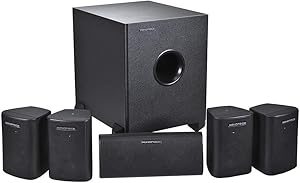
Monoprice vs Enclave: Overview
Comparing Monoprice and Enclave helps you determine which brand is best suited for your needs in Home Theaters. Both brands offer strong choices depending on your budget and key feature requirements.
Key Features & Comparison
Evaluate factors such as build quality, warranty, customer satisfaction, and total value before making your final purchase choice between Monoprice and Enclave.
Features
From a feature and functional capability perspective, Monoprice offers expansive technical versatility dictated by the breadth of its hardware lineup. Its flagship Monolith subwoofers and speaker suites feature balanced XLR inputs, variable crossover switches, boundary compensation tuning, and robust internal bracing designed to withstand massive acoustic pressures. Furthermore, Monoprice's modern active soundbars and preamplifiers include support for cutting-edge codecs such as Dolby Atmos, DTS:X, and 4K HDR passthrough via eARC. However, because much of Monoprice's traditional home theater lineup relies on passive architecture, the user must rely on external AV receivers for processing, room calibration, and network streaming capabilities.
Enclave, by comparison, embeds its intelligence directly into its CineHub wireless transmitter, prioritizing autonomous synchronization and minimal setup friction. By utilizing WiSA technology, Enclave transmits uncompressed 24-bit/48kHz audio across a dedicated 5GHz wireless spectrum, circumventing home Wi-Fi congestion and virtually eliminating latency (under 5 milliseconds). The system natively decodes Dolby Digital Plus, DTS Digital Surround, and PCM, managing individual channel delays, speaker calibration, and sound modes directly through an intuitive mobile application. While Enclave lacks the object-based height virtualization (Dolby Atmos) and comprehensive analog connectivity offered by high-end Monoprice/AVR combinations, its automated pairing and wireless plug-and-play architecture deliver unmatched modern usability.
Performance
In acoustic performance, Monoprice—particularly within its Monolith division—consistently punches far above its weight class, delivering reference-level dynamics and low-frequency extension. Engineered with premium components like silk dome tweeters, carbon fiber cones, and massive magnetic assemblies, Monoprice speakers exhibit high power handling, exceptional transient response, and minimal harmonic distortion even at extreme sound pressure levels. Their subwoofers are celebrated in home theater communities for reaching subsonic frequencies below 20Hz with authoritative, linear output, making Monoprice the clear victor for dedicated, acoustically treated theater spaces where visceral impact and reference SPLs are paramount.
Enclave counters with a refined, highly coherent sonic presentation engineered specifically for typical residential living spaces. Because each Enclave speaker contains custom-tuned internal Class-D amplification perfectly matched to its respective drivers, the system exhibits remarkable balance, clear vocal articulation, and broad, uniform dispersion. Low-end performance from Enclave's down-firing wireless subwoofers is tight, musical, and sufficient for moderate rooms, though it naturally cannot compete with the bone-rattling SPL of Monoprice's larger ported subwoofers. Enclave prioritizes pristine dialogue intelligibility and balanced surround dispersion over sheer raw power, resulting in a cohesive soundstage that excels in everyday domestic listening environments.
Design
Design and aesthetics reflect the divergent design targets of these two manufacturers. Monoprice embraces an industrial, utilitarian aesthetic characterized by hefty MDF enclosures, black ash or satin vinyl wraps, and substantial physical footprints. Products like the Monolith series prioritize acoustic inertia and internal volume over living-room-friendly ergonomics; cabinets are intentionally deep, heavy, and imposing to eliminate unwanted chassis resonance. While this no-nonsense, functional styling appeals to enthusiasts who appreciate visible acoustic engineering, it can pose spatial and interior-decor challenges in multi-use living rooms or modern minimalist apartments.
Enclave, on the other hand, embraces contemporary lifestyle industrial design, constructing compact, low-profile satellite cabinets that easily blend into modern home decor. Finished with acoustically transparent fabric grilles and clean, rounded edges, Enclave speakers are engineered to sit unobtrusively on bookshelves, console tables, or slim speaker stands. The CineHub transmitter itself is exceptionally discreet, designed to tuck behind an ultra-thin TV or inside a shallow media console. By eliminating speaker-to-receiver cabling—requiring only a standard power cord for each module—Enclave delivers a vastly cleaner visual footprint, making it significantly more acceptable in shared, design-conscious residential spaces.
Compare current retail pricing, active promotions, and verified stock availability directly from authorized stores: