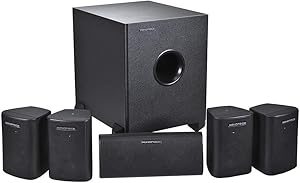
Monoprice vs Acoustic Audio: Overview
Comparing Monoprice and Acoustic Audio helps you determine which brand is best suited for your needs in Home Theaters. Both brands offer strong choices depending on your budget and key feature requirements.
Key Features & Comparison
Evaluate factors such as build quality, warranty, customer satisfaction, and total value before making your final purchase choice between Monoprice and Acoustic Audio.
Features
From a feature and connectivity standpoint, Acoustic Audio leans heavily into integrated, all-in-one functionality within its active surround systems. Many of their flagship budget home theater in-a-box solutions feature built-in amplification integrated directly into the subwoofer cabinet, eliminating the requirement for an external AV receiver. These packages routinely incorporate Bluetooth streaming, digital optical inputs, SD card readers, USB ports, and basic FM tuners, accompanied by compact infrared remotes. This makes Acoustic Audio packages exceptionally versatile for dorms, bedrooms, or casual spaces where buyers want comprehensive multimedia playback without the expense and footprint of separate AV components.
Conversely, Monoprice features are characterized by modern industry standards, high-power handling, and architectural sophistication intended for traditional multi-channel workflows. Rather than packaging novelty connectivity options into their enclosures, Monoprice equips their home theater systems with features that audio purists demand: Dolby Atmos-enabled upward-firing modules, bi-ampable gold-plated 5-way binding posts, and sophisticated THX-certified components on select lines. Monoprice's active subwoofers feature parametric EQ functionality, balanced XLR connections, and variable phase control, reflecting an engineering ethos geared toward seamless integration into dedicated multi-channel AV receiver environments rather than self-contained, entry-level multimedia hubs.
Performance
Acoustic Audio systems provide sufficient acoustic energy and vocal intelligibility for modest media rooms and casual movie watching, but they encounter clear physical limitations under demanding dynamic conditions. Because many of their bundled systems rely on smaller micro-satellite enclosures paired with lightweight down-firing subwoofers powered by modest multi-channel chip amps, they tend to exhibit a pronounced 'U-shaped' frequency response. While the midrange dialogue is clear enough at low-to-moderate listening levels, pushing Acoustic Audio systems toward reference volumes often introduces port turbulence, harmonic distortion, and a noticeable frequency gap between the satellites' low-end cut-off and the subwoofer's upper crossover point.
Monoprice, particularly within their premium speaker suites and Monolith subwoofers, stands in an entirely different performance tier characterized by linear frequency responses, expansive dynamic headroom, and low distortion. Monoprice utilizes advanced motor assemblies, rigid cone materials like composite fiber or woven carbon, and meticulously voiced second- and third-order crossovers. This translates to expansive soundstaging, surgical channel steering, and remarkably smooth off-axis dispersion. In the lower octaves, Monoprice’s subwoofers deliver subterranean, authoritative low-frequency output capable of flat reproduction down past 20Hz, providing the visceral tactile impact critical for authentic cinematic impact.
Design
Acoustic Audio embraces an aesthetic that emphasizes consumer technology flash and utility over understated minimalism. Many of their self-powered units feature exposed high-gloss plastic baffles, active LED display readouts on the front face of the subwoofer, and illuminated volume dials. Their satellite enclosures are predominantly lightweight molded ABS plastic or thin MDF covered in synthetic vinyl wrap. While their architectural in-wall and in-ceiling series maintain a cleaner, paintable profile with low-profile magnetic grilles, their standalone surround sets prioritize a visible tech aesthetic that may clash with sophisticated living room or dedicated theater interior decor.
Monoprice adheres to a functional, restrained industrial design philosophy that emphasizes structural rigidity and acoustic inertness. Cabinet enclosures—particularly within the higher-tier lines—are constructed from heavy, internally braced high-grade MDF to suppress unwanted internal resonances and colorations. Finishes are typically matte black, fine-textured powder coatings, or high-grade simulated wood veneers that absorb ambient light rather than reflecting it back onto projection screens or televisions. The design ethos prioritizes acoustical physics over ornamental flair, utilizing flush-mounted drivers, computer-modeled waveguides, and substantial magnetic cloth grilles that seamlessly blend into high-end audio installations.