Logitech vs Nakamichi: Overview
Comparing Logitech and Nakamichi helps you determine which brand is best suited for your needs in Home Theaters. Both brands offer strong choices depending on your budget and key feature requirements.
Key Features & Comparison
Evaluate factors such as build quality, warranty, customer satisfaction, and total value before making your final purchase choice between Logitech and Nakamichi.
Features
In terms of feature sets, Logitech keeps its offerings pragmatic, direct, and firmly rooted in legacy audio standards. The standard Logitech surround system features optical TOSLINK, digital coaxial, and multi-channel 3.5mm direct inputs, alongside standard stereo RCA connections. Onboard processing typically includes hardware-level Dolby Digital and DTS decoding, supplemented by basic stereo 3D spatial upmixing. However, Logitech systems lack modern digital AV backbone technologies; you will find no HDMI inputs, no eARC/ARC support, no pass-through for 4K HDR or Dolby Vision video, and no native compatibility with object-based audio formats like Dolby Atmos. The controls rely on a wired desktop console combined with a simple infrared remote, providing basic master and individual channel volume adjustments without room-correction algorithms or networked smart connectivity.
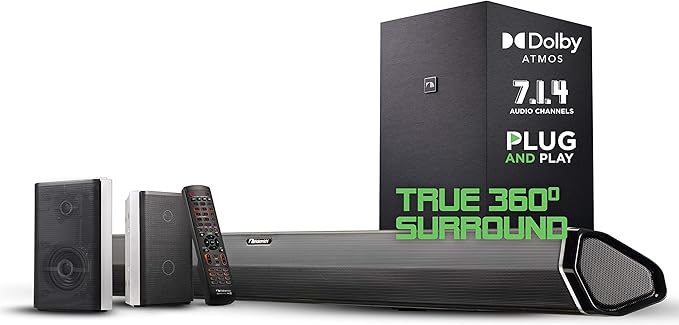
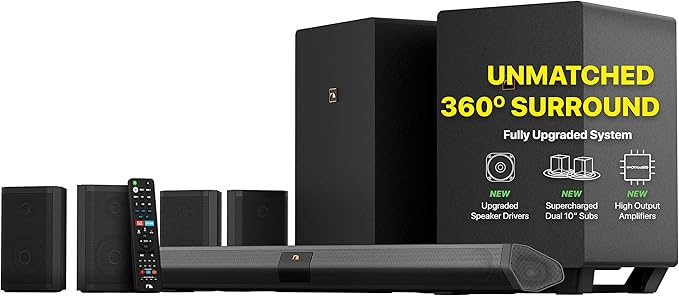
Nakamichi, by comparison, provides an exhaustive suite of bleeding-edge audio and connectivity features designed for contemporary premium entertainment centers. Its systems incorporate full HDMI 2.1 architecture with eARC, allowing uncompressed Dolby Atmos, DTS:X, and high-resolution multi-channel PCM delivery alongside 4K 120Hz and 8K HDR passthrough. Nakamichi’s flagship models integrate dual or quad wireless subwoofers with custom spatial surround satellite speakers, driven by sophisticated digital signal processing (DSP) engines such as their proprietary Spatial Surround Elevation (SSE) architecture. Additionally, Nakamichi incorporates comprehensive calibration controls, advanced Bluetooth with Qualcomm aptX HD codecs, and extensive EQ tweaking options that allow users to fine-tune sound dispersion based on specific room acoustics and ceiling heights, far surpassing Logitech's utilitarian connectivity.
Performance
From an acoustic performance standpoint, Logitech excels at providing raw decibel output, punchy low-frequency bursts, and immediate clarity suited for gaming and near-field action sequences. Its compact satellite speakers feature single full-range drivers that manage midrange and upper frequencies adequately, while the ported, high-excursion subwoofer delivers room-shaking bass that easily satisfies casual listeners and gamers. However, Logitech's technical limitations become apparent during critical listening or highly dynamic cinematic sequences. The lack of dedicated tweeters in the satellites results in a rolled-off high-frequency response and a somewhat congested upper-midrange, while the crossover transition between the subwoofer and satellites can exhibit noticeable acoustic gaps, leading to a distinct 'boom and sizzle' sound signature rather than linear audio reproduction.
Nakamichi delivers performance in an entirely different acoustic class, characterized by immense dynamic range, exceptional spatial imaging, and visceral tactile impact. By utilizing multi-driver soundbar arrays with silk dome tweeters, extended-range mid-drivers, and multiple independent subwoofers, Nakamichi systems achieve an expansive, seamless soundstage with pinpoint directional accuracy. The implementation of multiple subwoofers completely eliminates low-frequency standing waves and room nodes, delivering clean, distributed, subterranean bass that never overpowers the crystal-clear dialogue and subtle atmospheric cues. Whether handling the nuanced placement of vertical sound effects in a Dolby Atmos track or rendering complex musical orchestrations, Nakamichi provides audiophile-adjacent transient response, low distortion at extreme volumes, and a truly authentic theater-grade dynamic headroom.
Design
The industrial design of Logitech home theater systems reflects a practical, PC-centric aesthetic where functionality and durability take precedence over visual luxury. The satellite enclosures are compact, angular, and molded from dense matte plastic, designed to perch inconspicuously on a computer desk, attach to generic speaker stands, or mount via small rear keyhole slots. The primary subwoofer is a boxy, utilitarian unit with a heavy metal front grille, built to be tucked underneath a workstation or against a wall. A defining element of Logitech's ecosystem is the separate desktop control pod, which features an industrial knob and LED readouts indicating input status and volume levels. While rugged and highly functional for small spaces, the aesthetic is undeniably dated when placed in a contemporary, design-forward living room.
Nakamichi takes an ambitious, premium approach to product styling and material integration, purposefully designed to complement large-format OLED and laser projection displays. The main soundbars feature sleek, brushed metal and premium grille finishes, engineered with angled end-caps that physically project height and surround cues. Satellite speakers and dual subwoofers are crafted with heavy internal bracing to suppress cabinet resonances, featuring a sophisticated, modern silhouette that integrates seamlessly into dedicated home theater rooms. Cable management is well-considered, with wireless linkages between the main soundbar and rear subwoofers significantly reducing cable clutter across the room. From the premium backlit remote control to the imposing presence of the driver arrays, Nakamichi’s design language unmistakably conveys high-performance audio craftsmanship.
Compare current retail pricing, active promotions, and verified stock availability directly from authorized stores: