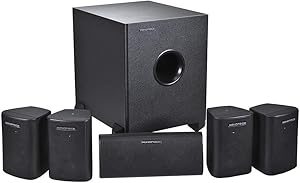
Klipsch vs Monoprice: Overview
Comparing Klipsch and Monoprice helps you determine which brand is best suited for your needs in Home Theaters. Both brands offer strong choices depending on your budget and key feature requirements.
Key Features & Comparison
Evaluate factors such as build quality, warranty, customer satisfaction, and total value before making your final purchase choice between Klipsch and Monoprice.
Features
Klipsch outfits its home theater systems with technologies refined over decades, centered around their proprietary Tractrix horn geometry and spun-copper Cerametallic or TCP (Thermoformed Crystalline Polymer) woofers. A major feature advantage for Klipsch is its integrated ecosystem versatility, offering dedicated Dolby Atmos-enabled elevation speakers, seamless bi-wiring and bi-amping terminal configurations, and innovative wireless modular ecosystems like the Klipsch Reference Wireless WiSA systems. Furthermore, Klipsch subwoofers across the Reference Premiere line integrate front-firing slot ports, advanced digital amplification, and optional wireless transmitter kits that allow optimal room placement without running lengthy RCA cables through living spaces.
Monoprice counters by packing high-end, pro-grade specifications into its enthusiast Monolith home theater line that are typically reserved for boutique audiophile equipment. Many Monolith speakers and subwoofers boast formal THX Select, Ultra, or Certified Ultra status, guaranteeing strict standards for frequency response, output ceiling, and low distortion. Monoprice subwoofers feature massively overbuilt multi-magnet motor assemblies, variable DSP tuning modes (such as ported versus sealed switchability using physical port plugs), and fully balanced XLR inputs and outputs for noise-free signal transmission over long distances. While Klipsch excels in user-friendly ecosystem integration and specialized form factors like slim on-wall solutions, Monoprice delivers more objective, heavy-duty calibration and connectivity features per dollar.
Performance
Acoustically, Klipsch is celebrated for its remarkable efficiency and dynamic headroom. Because of the Tractrix horn-loaded titanium or aluminum LTS (Linear Travel Suspension) tweeters, Klipsch speakers convert electrical wattage into acoustic energy far more effectively than standard dome designs. This high sensitivity translates to effortless micro-dynamics, crystal-clear dialogue projection, and transient attack that brings explosive cinematic sequences to life without straining standard AV receivers. However, this forward presentation can occasionally border on bright or fatiguing in acoustically untreated rooms with hard, reflective surfaces, necessitating careful receiver calibration or room dampening.
Monoprice, particularly within the Monolith series, targets acoustic neutrality, uniform dispersion, and linear precision. Monolith speakers employ silk dome tweeters or planar magnetic drivers paired with rigid woofers that yield a smooth, uncolored midrange and non-fatiguing high-frequency response, making them equally adept at high-resolution multi-channel music and cinema. Where Monoprice truly dominates performance benchmarks is in the low-frequency realm; Monolith subwoofers consistently set industry performance standards for subterranean extension, delivering clean output down to 16Hz or lower with negligible harmonic distortion. While a Klipsch setup delivers visceral impact and effortless output at lower power, a Monoprice Monolith setup provides reference-grade neutrality, clinical accuracy, and deeper, more controlled low-end pressurization.
Design
Klipsch has established one of the most recognizable and visually aggressive industrial designs in consumer electronics. Defined by brushed black polymer or real wood veneer cabinets, exposed metallic fasteners, and brilliant spun-copper woofer cones, Klipsch systems are designed to make an assertive visual statement when grilles are removed. Beyond aesthetics, Klipsch's structural design emphasizes acoustic optimization through internal bracing, cast aluminum feet to minimize floor resonance, and Tractrix rear-firing or front-firing reflex ports designed to minimize air turbulence. The overall fit and finish across the Reference Premiere line feel distinctly premium, blending high-end living room furniture aesthetics with high-performance audio hardware.
Monoprice prioritizes functional, utilitarian, and acoustically inert design over decorative flair. The entry-level Monoprice systems feature basic, pragmatic plastic or lightweight MDF enclosures designed strictly for budget practicality. Moving up to the Monolith tier, the design shifts to monolithic, heavy-gauge HDF (High-Density Fiberboard) construction with extensive internal dado bracing to eliminate cabinet resonance completely. Finished in understated satin black paint or modest wood veneers, Monolith speakers and massive subwoofers do not seek attention, often presenting a heavy, boxy, and austere aesthetic. While Klipsch blends striking industrial style with domestic elegance, Monoprice focuses structural mass purely on eliminating acoustic coloration, resulting in equipment that prioritizes structural physics over interior décor harmony.
Compare current retail pricing, active promotions, and verified stock availability directly from authorized stores: