Klipsch vs Energy: Overview & Brand Philosophy
When curating a dedicated home theater experience, the choice of loudspeaker brand dictates not just sonic fidelity, but the entire emotional engagement of cinema within your living space. Klipsch, founded in 1946 by acoustic pioneer Paul W. Klipsch in Hope, Arkansas, has long stood as an iconic titan in American audio engineering. The brand is fundamentally anchored to the principle of horn-loaded design, striving to reproduce the high efficiency, broad dynamic range, and visceral impact of a live performance or commercial movie theater. Klipsch home theater systems are unabashedly expressive, engineered to extract every transient detail with minimal amplifier power, making them a perennial favorite among enthusiasts seeking thunderous impact and articulate vocal clarity.
Energy, conversely, traces its pedigree back to the Canadian acoustic research initiatives of the late 1970s and 1980s, primarily developing out of the National Research Council (NRC) studies in Ottawa. Energy established its reputation by prioritizing scientific measurement, ultra-wide dispersion, flat frequency response, and exceptionally low distortion. Their philosophy centers on the "Convergent Source Module" (CSM) and the concept of an expansive sweet spot, where sound envelopes the listener uniformly regardless of seating position. Historically, Energy built systems designed to disappear into a room, offering warm, cohesive, and fatigue-free playback tailored for those who split their usage evenly between cinematic surround tracks and multi-channel music.
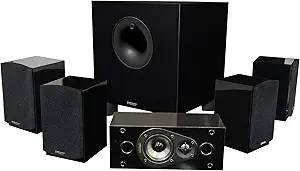
Notably, both brands share an interconnected corporate history, as Energy was acquired by the Klipsch Group in 2006, which was subsequently absorbed by Voxx International. While Energy operates today with a dramatically narrowed catalog primarily focused on value-oriented compact satellite packages like the Take Classic series, its engineering DNA remains starkly differentiated from the copper-accented, high-octane philosophy that Klipsch continues to develop aggressively across both budget and ultra-premium architectural tiers.
Key Differences & Technological Comparison
The core technological divide between Klipsch and Energy lies within their high-frequency driver implementations and acoustic dispersion strategies. Klipsch utilizes its proprietary Tractrix® Horn technology, mating titanium or aluminum compression drivers to a 90x90 degree silicone composite horn throat. This mechanical amplification yields remarkably high sensitivity ratings (often exceeding 95–98 dB @ 2.83V/1m), allowing Klipsch speakers to deliver massive volume levels with virtually zero power compression. The trade-off is directional control: Tractrix horns meticulously direct sound waves toward the primary listening zone, cutting down on early room reflections but narrowing the off-axis listening window.
In contrast, Energy centers its design architecture on wide-dispersion dome tweeters, famously utilizing its patented Hyperbolic aluminum dome and Ribbed Elliptical Surround technology. Instead of funneling sound outward through a controlled acoustic horn, Energy drivers are engineered to broadcast energy across a wide physical angle, creating an expansive, room-filling soundfield. Energy’s ribbed surrounds are molded to eliminate distortion and expand excursion, allowing their smaller midrange drivers to handle high acoustic pressure without bottoming out or losing linearity.
From a driver material perspective, Klipsch relies heavily on its signature spun-copper Cerametallic™ or thermoformed crystalline polymer (TCP) woofers, which are exceptionally stiff and lightweight, designed for blistering transient response and visceral mid-bass impact. Energy systems typically feature poly-titanium or composite fiber cones tuned for lower-order harmonic dampening, yielding a smoother, slightly warmer midrange that tames harsh dialogue spikes, though lacking the ultimate dynamic punch and slam of Klipsch's high-efficiency architecture.
Build and catalog diversity represent another stark divergence. Klipsch offers a colossal ecosystem spanning budget entry-level sets (Reference Series) to audiophile-grade theater towers (Reference Premiere) and high-end THX-certified architectural solutions. Their cabinets are heavily braced with MDF, internal dampening chambers, and premium scratch-resistant vinyl or real wood veneers. Energy, having receded from producing full-sized floorstanding towers in recent years, focuses almost exclusively on micro-satellite packages and budget compact setups, utilizing molded composite polymers or dense, scaled-down MDF boxes that excel at space-saving convenience rather than elite acoustic resonance management.
Pros & Cons Comparison
Klipsch
- Pros:
- Class-leading sensitivity allows for immense dynamic range, even with entry-level AV receivers.
- Tractrix Horn design produces exceptional dialogue articulation and surgical micro-detail.
- Broad, highly active product lineup ranging from accessible bookshelves to flagship Dolby Atmos towers.
- Iconic visual aesthetic featuring spun-copper cones and premium cabinet finishes.
- High resale value and massive global community support for setup optimization.
- Cons:
- Horn-loaded tweeters can induce listener fatigue if paired with overly bright room acoustics or electronics.
- Directional dispersion creates a smaller optimal sweet spot compared to wide-dispersion domes.
- Premium lines command a significantly higher price investment.
Energy
- Pros:
- Ultra-wide dispersion creates an immersive, seamless 360-degree acoustic envelope.
- Smooth, non-fatiguing high-frequency response suitable for prolonged listening sessions.
- Extremely compact form factor (e.g., Take Classic series) ideal for apartments and small spaces.
- Highly competitive pricing in the entry-level sub/sat market segment.
- Subtle, unobtrusive industrial designs that blend cleanly into minimalist room decors.
- Cons:
- Extremely limited modern product lineup with minimal expansion options.
- Low sensitivity ratings demand more substantial power amplification to achieve cinema-level volume.
- Small driver diameters inherently struggle with lower midrange authority and mid-bass punch.
- Largely absent from the premium floorstanding and dedicated Atmos-integrated tier.
Performance, Durability & Value Analysis
When examining long-term acoustic performance and durability, Klipsch establishes a clear edge in component resilience and structural integrity. Because horn loading does the heavy lifting of acoustic amplification mechanically, Klipsch voice coils undergo significantly less thermal stress over extended, high-output home theater sessions. This low-strain operation preserves crossover components and prevents driver failure over decades of aggressive usage. Klipsch subwoofers historically faced minor plate-amplifier reliability concerns in past budget iterations, but their current-generation digital amplification architectures have substantially stabilized. In terms of value, while Klipsch requires a greater upfront capital commitment—especially within the Reference Premiere lineup—the modular scalability and legendary longevity of the components yield a remarkably low cost of ownership over a 10-to-20-year home theater lifecycle.
Energy systems represent a masterclass in budget space-to-performance ratio, particularly for modest physical footprints. The longevity of their drivers is commendable, thanks to durable rubber surrounds that resist dry rot and humidity far better than legacy foam variants. However, because small satellite designs rely on steep crossover slopes (often passing tasks to the subwoofer at 100Hz–120Hz), the system relies heavily on the subwoofer to perform mid-bass heavy lifting. If the compact subwoofer fails, the acoustic envelope of the entire theater collapses. From a value standpoint, Energy delivers exceptional out-of-the-box convenience for under-budgeted media rooms, but the ceiling for dynamic performance is strictly limited by basic physics.
Final Verdict: Which Brand Should You Choose?
Your decision between Klipsch and Energy ultimately hinges on your dedicated room footprint, budget constraints, and the sonic profile you prioritize for your cinematic entertainment.
Choose Klipsch if: You are constructing a serious, dedicated home theater or a high-output living room system where dynamic impact, vocal intelligibility, and visceral excitement are paramount. Klipsch is the definitive choice if you want to reproduce reference-level Hollywood audio mixes, plan to integrate upward-firing or in-ceiling Dolby Atmos channels, or want the flexibility to build a bespoke system incrementally with high-grade floorstanders and center channels.
Choose Energy if: You are outfitting a small apartment, bedroom, or secondary media den with strict space limitations and a tight budget. Energy is ideal for users who prioritize a seamless, wide-field surround experience without having giant floorstanding enclosures dominating their living space, or for listeners who are notoriously sensitive to bright treble and prefer a forgiving, warm acoustic character straight out of the box.
Features
When evaluating the feature ecosystems of Klipsch and Energy within the home theater category, the contrast centers on proprietary acoustic technology versus space-conscious functional engineering. Klipsch distinguishes its feature set through its signature acoustic hardware: the proprietary Tractrix Horn paired with Linear Travel Suspension (LTS) aluminum or titanium tweeters, and spun-copper Cerametallic or TCP (Thermoformed Crystalline Polymer) woofers. These engineering choices provide an exceptionally high sensitivity rating—often exceeding 95 dB—allowing Klipsch systems to produce immense dynamic range with minimal amplifier power. Furthermore, modern Klipsch lineups (such as the Reference Premiere series) feature advanced architectural perks like integrated, up-firing Dolby Atmos channel connections concealed within the cabinet binding posts, bi-amping/bi-wiring dual terminals, and magnetic, scratch-resistant grilles that protect premium aesthetics without dampening acoustic output.
Energy, historically celebrated for its research-driven Canadian audio engineering under the Athena and Mirage umbrella, takes a fundamentally different approach focused on wide dispersion and small-footprint integration. The cornerstone of Energy’s feature set is the patented Convergent Source Module (CSM), which places the tweeter and midrange drivers in close proximity to act as a single point-source, alongside their patented Ribbed Elliptical Surround technology. This unique surround geometry dramatically reduces cone distortion while increasing excursion. Instead of Klipsch’s high-efficiency directional horns, Energy prioritizes an ultra-wide soundstage and a larger acoustic sweet spot via their Hyperbolic aluminum dome tweeters. However, while modern Klipsch systems continuously evolve with active wireless subwoofers, WiSA-certified options, and native Dolby Atmos modules, Energy’s feature offerings remain decidedly traditional and passive, catering primarily to compact, sub-and-satellite 5.1 setups like the classic Energy Take Classic series rather than modular, cutting-edge flagship theater towers.
From a practical and technical trade-off perspective, Klipsch delivers a feature set aimed at high-impact, customizable home cinema installations, whereas Energy prioritizes unobtrusive, turnkey consistency. Klipsch's horn-loaded design gives users incredible micro-detail, pinpoint imaging, and effortless volume, but it introduces a forward, bright sound signature that can be fatiguing in acoustically untreated or highly reflective rooms. Conversely, Energy’s wide-dispersion features make physical speaker placement far more forgiving, ensuring even frequency distribution across off-axis seating. The trade-off for Energy’s smooth, cohesive dispersion is significantly lower sensitivity (typically hovering around 86–89 dB), necessitating beefier amplification to reach cinematic peaks. Ultimately, consumers seeking state-of-the-art modern home theater features, native height-channel integration, and sheer acoustic efficiency will find Klipsch vastly superior, while those requiring space-efficient, room-forgiving integration with cohesive mid-band clarity will appreciate Energy’s focused, traditional acoustic engineering.
Performance
When evaluating raw acoustic performance, Klipsch and Energy showcase fundamentally divergent engineering philosophies despite operating in overlapping home theater markets. Klipsch is legendary for its proprietary horn-loaded technology, anchored by the iconic Tractrix horn and aluminum or titanium compression drivers paired with spun-copper Cerametallic woofers. This engineering produces remarkably high sensitivity ratings—often exceeding 95 dB—which translates to staggering dynamic range, ultra-low distortion, and cinema-grade micro-detail even when driven by modest AV receivers. Klipsch delivers high-impact, visceral transients that make modern Hollywood soundtracks come alive with sharp, articulate highs and punchy, tight mid-bass. Conversely, Energy utilizes its Convergent Source Module (CSM) architecture and patented Ribbed Elliptical Surround technology, which actively minimizes cone distortion while enhancing excursion. The result is a much warmer, balanced, and forgiving acoustic signature that prioritizes vocal intelligibility, linear mid-range dispersion, and broad, room-filling soundscapes over sheer sonic attack.
In terms of practical listening trade-offs, the choice between these two performance envelopes hinges heavily on room acoustics and user sensitivity. Klipsch systems offer unrivaled precision and spatial localization, giving them a distinct advantage in dedicated theater rooms requiring pinpoint surround placement, Atmos height effects, and reference-level volume output. However, their signature brightness and aggressive high-frequency extension can induce ear fatigue over extended listening sessions if placed in acoustically untreated rooms with hard surfaces. Energy speakers counteract this with wide, non-directional dispersion and ultra-smooth crossover integration, creating an exceptionally large "sweet spot" that makes them ideal for multi-seat living rooms and mixed-use spaces where off-axis listening is standard. While Energy lacks the earth-shaking, raw dynamic headroom and crystalline transient response that Klipsch effortlessly produces, it compensates by delivering a natural, cohesive, and lush soundstage that rarely sounds harsh, making it a more versatile and fatigue-free option for combined music playback and casual media consumption.
Design
In the home theater landscape, Klipsch and Energy approach industrial and acoustic design from fundamentally divergent philosophies. Klipsch is iconic for its bold, aggressive aesthetic defined by spun-copper Cerametallic woofers, brushed polymer veneer cabinets, and its signature Tractrix horn technology. This horn-loaded architecture is the cornerstone of Klipsch’s engineering, physically shaping high-frequency dispersion to maximize efficiency and dynamic output while minimizing distortion. The cabinets are built with substantial internal bracing and medium-density fiberboard (MDF) to suppress cabinet resonance, creating an imposing, heritage-rich presence. In contrast, Energy—originally an innovative Canadian brand later acquired by Klipsch's parent company, Voxx International—champions a clean, understated, and functional aesthetic. Energy’s acoustic design centers around its proprietary Convergent Source Module (CSM) and the patented Elliptical Surround technology, which engineers a flat frequency response and wide, uniform dispersion without the visual assertiveness of exposed waveguides. Energy enclosures often feature softer, rounded edges, high-gloss baffles, and compact footprints designed to integrate invisibly into modern living spaces rather than dominate them.
When assessing feature sets, technical strengths, and user practicalities, the trade-offs between the two brands depend heavily on room architecture and interior preference. Klipsch’s high-efficiency horn design means their speakers require significantly less amplifier power to produce high sound pressure levels, making them a technical triumph for large, dedicated home theater rooms where dynamic punch is paramount. However, their visually prominent drivers and industrial styling can be polarizing in multipurpose or minimalist living rooms, and their rear-firing Tractrix ports necessitate careful boundary placement away from walls to prevent bass bloat. Conversely, Energy’s technical strength lies in its wide-dispersion capability, providing an expansive "sweet spot" that serves wider seating arrangements exceptionally well. Compact satellite systems like the Energy Take Classic utilize smaller, magnetically shielded sub-enclosures that excel in spatially constrained environments, though they naturally lack the raw cabinet volume and visceral low-end authority native to Klipsch's larger floorstanding structures. Ultimately, Klipsch engineers for dynamic scale and unapologetic visual impact, whereas Energy prioritizes acoustic neutrality, spatial forgiveness, and lifestyle-friendly integration.