JBL vs Bose: Overview
Comparing JBL and Bose helps you determine which brand is best suited for your needs in Home Theaters. Both brands offer strong choices depending on your budget and key feature requirements.
Key Features & Comparison
Evaluate factors such as build quality, warranty, customer satisfaction, and total value before making your final purchase choice between JBL and Bose.
Features
JBL’s feature architecture is uniquely defined by its commitment to true physical surround sound through clever hardware modularity. Flagship soundbar packages, such as the JBL Bar series, feature detachable, battery-powered wireless rear satellites that physically separate from the main soundbar to provide true channel separation without trailing speaker wires. Combined with multi-beam acoustic calibration, extensive eARC capabilities, dual HDMI pass-throughs with 4K Dolby Vision support, and open ecosystem integration—including Apple AirPlay 2, Google Cast, and Spotify Connect—JBL prioritizes hardware versatility and broad connectivity options for the power user.
Bose approaches feature engineering through proprietary digital signal processing (DSP) and intelligent room adaptation. Utilizing ADAPTiQ spatial analysis, Bose systems measure room boundaries, furnishings, and ambient reflective surfaces to acoustically optimize the output stage for consistent performance across listening positions. Bose emphasizes the proprietary Voice4Video architecture alongside Amazon Alexa and Google Assistant, allowing voice control over televisions, cable boxes, and streaming devices simultaneously. While Bose restricts native HDMI inputs to a single eARC port, pushing users toward television-based source switching, its multi-room ecosystem, SimpleSync headphone pairing, and cohesive Bose Music app yield an exceptionally streamlined, user-friendly software environment.
Performance
From an acoustic output perspective, JBL relies on robust amplification stages and expansive driver real estate to generate unmatched kinetic energy. The brand’s active subwoofers—frequently packing 10- to 12-inch down-firing drivers backed by high-wattage Class-D amplifiers—reproduce low-frequency effects (LFE) down to 25 Hz with profound weight, transient speed, and tactile punch. Dolby Atmos and DTS:X reproduction benefits from JBL’s dedicated upward-firing drivers, which produce distinct acoustic reflections off ceilings for convincing three-dimensional height channels. However, during nuanced passages or classical playback, JBL can occasionally tilt toward an aggressive sound signature where upper mids are slightly masked by foundational low-end energy.
Bose counters with exceptional clarity, precise mid-range separation, and expansive virtual soundstages. Utilizing engineered PhaseGuide arrays and proprietary dipole transducers, Bose soundbars project pinpoint directional cues across the room, creating a soundstage that dramatically exceeds the physical chassis of the speaker. Dialogue performance is where Bose systematically outpaces much of the market; dedicated center channels paired with active voice-enhancement algorithms ensure that whispered conversations cut cleanly through complex background scores. While Bose's bass modules are surprisingly robust given their compact volume, they prioritize controlled, musical low-frequency transients over the visceral, seismic floor-shake inherent to JBL's acoustic design.
Design
The industrial design of JBL home theater equipment reflects its performance-driven, functional ethos. JBL components feature durable matte-black plastics, full-coverage metal speaker grilles, and utilitarian physical profiles designed to sit comfortably beneath large-screen panels without drawing undue attention. The engineering genius of their design lies in the magnetic docking mechanisms and recharging pins for their wireless surround speakers, which blend seamlessly into the primary soundbar when not deployed. While functional, robust, and well-constructed, JBL designs carry a slightly industrial aesthetic that may feel heavy or utilitarian in meticulously curated minimalist interiors.
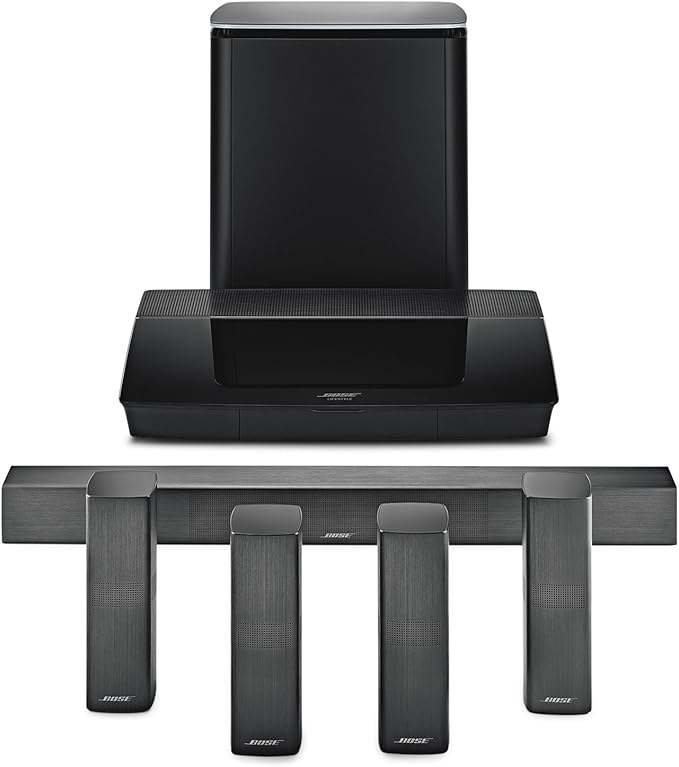
Bose systems, on the other hand, are masterpieces of modern consumer product design, functioning as striking aesthetic complements to high-end home furnishings. Utilizing seamless, thermally tempered glass tops, precision-drilled wraparound aluminum grilles, and exceptionally low-profile heights, Bose soundbars and companion subwoofers are crafted to be displayed rather than hidden. Their ultra-thin profiles easily clear the lower bezels and infrared receivers of modern OLED panels, and the wireless surround units remain minuscule in comparison to standard satellite speakers. For consumers who prioritize interior design harmony, luxurious materials, and an uncluttered physical environment, Bose represents the pinnacle of home audio industrial refinement.