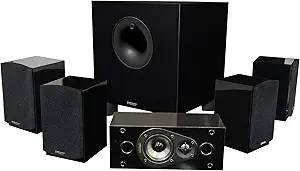
Energy vs Enclave: Overview
Comparing Energy and Enclave helps you determine which brand is best suited for your needs in Home Theaters. Both brands offer strong choices depending on your budget and key feature requirements.
Key Features & Comparison
Evaluate factors such as build quality, warranty, customer satisfaction, and total value before making your final purchase choice between Energy and Enclave.
Features
From a feature and connectivity standpoint, Enclave stands far ahead in technological integration, while Energy adheres to fundamental analog audio principles. Enclave systems, particularly the CineHome II and CineHome PRO lines, are equipped with modern digital I/O such as HDMI eARC/ARC, optical inputs, and integrated Bluetooth streaming via their hub transmitters. Because Enclave leverages WiSA protocols, it broadcasts 24-bit/48kHz or 24-bit/96kHz uncompressed wireless audio across 5.1 or 5.1.2 channels with imperceptible 5.2ms latency. This eliminates the need for a bulky audio/video receiver (AVR) entirely, streamlining control through standard TV remotes via HDMI-CEC and allowing room-level calibration through mobile application interfaces.
Energy, conversely, provides almost no built-in digital features, smart control, or wireless protocol support on its traditional theater packages. Instead, an Energy system acts strictly as an acoustic load; its feature set is defined entirely by the external AV receiver you connect to its five-way binding posts. While this means you must purchase and configure a separate receiver, it also yields feature flexibility that Enclave cannot inherently match, such as compatibility with bleeding-edge spatial audio formats (Dolby Atmos, DTS:X, and Auro-3D) and advanced room correction suites like Audyssey or Dirac Live. Enclave delivers unmatched ease of setup through native digital wireless features, whereas Energy provides a blank slate for external feature scalability.
Performance
In terms of acoustic performance, Energy leverages decades of research into psychoacoustics, dispersion, and driver integration. Famous for its Convergent Source Module (CSM) and hyperbolic aluminum dome tweeters, Energy speakers deliver exceptionally coherent midrange response and low-distortion high frequencies. When powered by quality discrete amplification, an Energy system excels at rendering dialogue clarity, micro-dynamics, and a seamless front-to-back surround bubble. The bass response from paired Energy subwoofers (often utilizing patented Ribbed Elliptical Surrounds) tends to offer tight, musical bass with articulate decay, outperforming typical all-in-one solutions when properly calibrated within a room's acoustics.
Enclave counters with a digitally tuned, active architecture where each driver is coupled to a dedicated, DSP-tuned class-D amplifier. The CineHome PRO series, for example, is THX Certified, which guarantees specific output levels, dynamic headroom, and low distortion thresholds within medium-to-large listening spaces. Because Enclave exercises end-to-end control over the digital signal path and crossover points, the system avoids passive crossover losses and achieves remarkable clarity out of the box. However, dynamic impact during intense theatrical transients can occasionally feel slightly restrained compared to an Energy setup driven by a high-current, discrete external amplifier. Energy offers higher ultimate dynamic ceiling for audiophiles, whereas Enclave delivers precise, DSP-optimized fidelity with zero tuning guesswork.
Design
The industrial design of both brands reflects their functional priorities and intended listening environments. Energy speakers generally feature classic cabinet geometries made from high-density fiberboard (MDF) with high-gloss piano black or woodgrain finishes. Their compact satellite systems are engineered to pack high acoustic output into diminutive, bookshelf-friendly footprints with keyhole slots for wall mounting. However, integrating an Energy system requires routing traditional two-conductor copper wire to every speaker location in the room, which can disrupt contemporary interior design unless wires are routed through walls or beneath baseboards during construction.
Enclave redefines modern living room aesthetics by eliminating the clutter of speaker wire runs across baseboards and under rugs. While each Enclave speaker still requires an individual power cord to a wall outlet, the absence of interconnect cables to a central unit offers dramatic aesthetic versatility. Enclave's enclosures boast a sleek, contemporary lifestyle design with rounded baffles and acoustically transparent wrap-around grilles that blend seamlessly into minimalist spaces. The primary design trade-off centers on wall outlets: Enclave frees your floors from signal wire at the cost of requiring localized AC power near every speaker position, whereas Energy requires traditional speaker wiring anchored back to a centralized equipment rack or AV cabinet.
Compare current retail pricing, active promotions, and verified stock availability directly from authorized stores: