Acoustic Audio vs Nakamichi: Overview
Comparing Acoustic Audio and Nakamichi helps you determine which brand is best suited for your needs in Home Theaters. Both brands offer strong choices depending on your budget and key feature requirements.
Key Features & Comparison
Evaluate factors such as build quality, warranty, customer satisfaction, and total value before making your final purchase choice between Acoustic Audio and Nakamichi.
Features
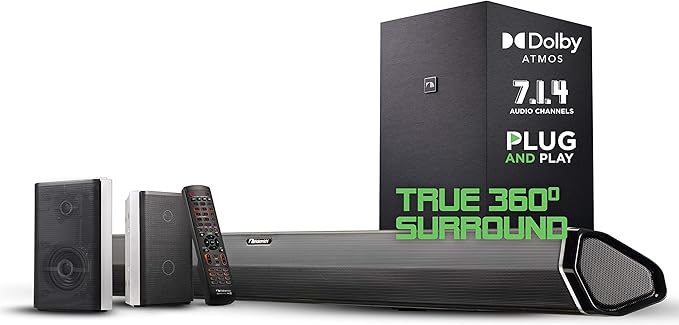
In terms of feature sets and technological integration, Nakamichi holds a commanding advantage over Acoustic Audio. Nakamichi's flagship ecosystems are engineered around cutting-edge digital signal processing, boasting native support for object-based 3D audio formats including Dolby Atmos, DTS:X, and their proprietary Spatial Surround Elevation (SSE) Max architecture. Furthermore, Nakamichi offers extensive modern connectivity, including HDMI eARC, 4K HDR passthrough with Dolby Vision compliance, multiple digital inputs, and robust Bluetooth codec integration, allowing these systems to serve as comprehensive AV hubs for next-generation gaming consoles and 4K media streamers.
Acoustic Audio systems, by contrast, feature comparatively spartan, legacy-oriented feature arrays. Most self-powered Acoustic Audio packaged systems rely on basic stereo RCA inputs, low-bitrate Bluetooth connections, standard optical digital links, and internal analog processing matrices like basic Pro Logic simulation rather than native uncompressed discrete decoding. While their passive architectural speakers allow users to supply external AV receivers with advanced features, the brand’s proprietary plug-and-play home theater packages lack HDMI connectivity, advanced room calibration routines, and modern spatial audio processing, confining them to basic legacy TV connections and non-critical multimedia playback.
Performance
Acoustic Audio provides adequate acoustic performance for secondary living spaces, casual gaming, or small footprint listening environments, but it lacks the dynamic headroom and tonal neutrality demanded by cinephiles. Their systems frequently utilize lightweight paper or treated composite cones paired with entry-level tweeters that can struggle with harmonic distortion when pushed past moderate sound pressure levels. Subwoofers in Acoustic Audio kits often display higher total harmonic distortion (THD) and roll off substantially below 40Hz, resulting in mid-bass resonance rather than true, tactile infrasonic extension, while upper-frequency dispersion can occasionally sound brittle during dense cinematic action sequences.
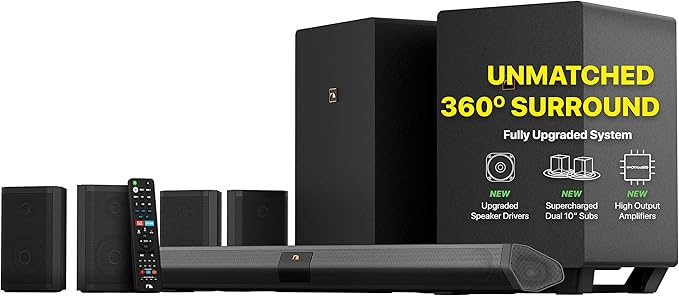
Nakamichi delivers an entirely different tier of acoustic precision, dynamic authority, and visceral impact. By employing a dual-subwoofer architecture in many of their flagship arrays, Nakamichi effectively mitigates standing room modes, eliminating acoustic dead zones to supply uniform, punchy low-frequency energy down into the true sub-bass spectrum (frequently dipping near 20Hz-30Hz with authority). Their discrete satellite speakers incorporate custom-tuned extended-range drivers and dedicated high-frequency tweeters that articulate crisp dialogue and pinpoint spatial panning. The sheer dynamic range, lower distortion thresholds, and coherent 360-degree sonic bubble achieved by Nakamichi make it far superior for high-impact film soundtracks and complex multichannel media.
Design
The aesthetic and physical engineering of Acoustic Audio products emphasizes utility and standard form factors. Their traditional satellite speakers and subwoofers employ utilitarian medium-density fiberboard (MDF) or plastic enclosures with basic vinyl veneers and black mesh grilles. While these designs are functional and easily blended into standard media consoles, their structural build tolerances, internal damping, and connector terminals (often spring clips rather than high-end binding posts) betray their budget-oriented manufacturing. Acoustic Audio's architectural in-wall series does, however, provide discreet visual integration for users willing to perform physical wall modifications.
Nakamichi focuses on high-end industrial design, merging the streamlined profile of a soundbar with the presence of high-output surround components. The central soundbars, dual subwoofers, and rear satellites feature brushed metal accents, acoustically transparent honeycomb grilles, and robust, vibration-resistant enclosures designed to eliminate chassis buzz at high volumes. Nakamichi’s design also cleverly tackles the logistics of cable management; satellite speakers wire directly into the wireless subwoofers, eliminating the need to run long copper runs from the front of the room to the back. This hybrid wireless approach strikes a masterful balance between physical elegance and acoustic performance that vastly outclasses Acoustic Audio's utilitarian hardware.
Compare current retail pricing, active promotions, and verified stock availability directly from authorized stores: