Highlights
Features (8.8)
Performance (8.4)
Design (7.9)
Devolo Wi-Fi Extenders: Overview & Reputation
Founded in Aachen, Germany, in 2002, Devolo has established itself as one of the most respected European innovators in home networking solutions. While many global networking giants treat Wi-Fi extenders as secondary accessories to their core router businesses, Devolo built its foundational reputation specifically on conquering signal dead zones in challenging residential architecture. The company gained early international prominence by pioneering Powerline Communication (PLC) technology, utilizing a home’s existing electrical wiring to transmit data without degradation. Over the decades, Devolo has successfully transitioned this core expertise into modern hybrid ecosystems and standalone Wi-Fi extenders, earning a strong reputation for rugged build quality, high data privacy standards, and advanced German engineering.
In the competitive Wi-Fi extender market, Devolo occupies a premium, enthusiast-friendly tier. It is particularly revered in European markets where thick brick, concrete, and stone construction render traditional wireless repeaters ineffective. Rather than focusing on budget-oriented, disposable hardware, Devolo is recognized for producing robust, long-lasting networking gear that emphasizes low latency, high throughput, and seamless integration. Although often commanding a higher price point than mass-market competitors, Devolo’s hardware is widely trusted by consumers and professional reviewers alike for its stability, consistent firmware updates, and intuitive management interfaces.
Key Strengths & Features
Devolo Wi-Fi extenders and hybrid repeaters distinguish themselves through intelligent technology that bridges traditional wireless extension with high-performance home networking architecture, offering several core advantages over conventional alternatives.
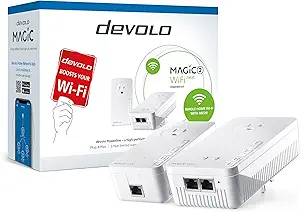
- Hybrid G.hn Powerline Integration: Many flagship Devolo extenders utilize advanced G.hn Powerline standards, transmitting data through home electrical circuits as a wired backhaul before broadcasting high-speed Wi-Fi 6 signals, completely bypassing thick structural walls.
- Smart Mesh Roaming: Equipped with Access Point Steering, Band Steering, and Fast Roaming, Devolo devices dynamically switch your mobile devices to the strongest available node without dropping calls or causing stream buffering.
- Rigorous Security and Privacy: Adhering to strict European data privacy standards, Devolo hardware features robust WPA3 encryption, guest network isolation, and firmware that does not rely on invasive cloud tracking.
- Devolo Home Network App: An exceptionally polished and user-friendly mobile application simplifies installation, visualizes network topology, and offers granular controls such as parental time limits and automated Wi-Fi scheduling.
- Integrated Pass-Through Sockets: A staple of Devolo’s physical design is the integrated electrical socket on many models, ensuring that installing an extender does not cost you a vital wall outlet.
Buying Advice & Verdict
Devolo Wi-Fi extenders represent an exceptional investment for users living in multi-story houses, older properties with thick masonry, or sprawling apartments where standard wireless repeaters fail to deliver reliable signal penetration. While buyers looking for simple, low-cost coverage for a small open-plan space might find more economical options elsewhere, Devolo is the definitive choice for challenging environments that demand both high-speed data transmission and low-latency stability. If your home layout prevents direct line-of-sight wireless repeating, choosing one of Devolo’s hybrid Magic or Wi-Fi 6 repeater systems is one of the most reliable and future-proof networking decisions you can make.
Features
8.8 /10
Devolo stands out by integrating advanced Powerline (G.hn) backbone technology alongside mesh Wi-Fi 6, multiple Gigabit Ethernet ports, and an intuitive management app. However, deeper advanced networking configurations remain somewhat limited for power users.
Performance
8.4 /10
By utilizing home electrical wiring to bypass thick walls, it delivers remarkably stable latency and strong throughput where traditional wireless repeaters fail. Real-world speeds can still fluctuate based on the age and layout of the household electrical circuitry.
Design
7.9 /10
The units are well-constructed and thoughtfully include integrated passthrough power sockets so wall outlets aren't lost. Nonetheless, the adapters are relatively bulky and can look obtrusive in open living spaces.