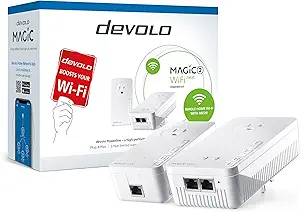
Rock space vs Devolo: Overview
Comparing Rock space and Devolo helps you determine which brand is best suited for your needs in Wi-Fi Extenders. Both brands offer strong choices depending on your budget and key feature requirements.
Key Features & Comparison
Evaluate factors such as build quality, warranty, customer satisfaction, and total value before making your final purchase choice between Rock space and Devolo.
Features
Rock space concentrates its feature set on essential, straightforward functionality aimed at the plug-and-play market. Most Rock space extenders incorporate dual-band radios (2.4 GHz and 5 GHz), smart LED signal indicators to assist in optimal socket placement, and single or dual Fast Ethernet/Gigabit ports for wiring a stationary client such as a smart TV or game console. While their units occasionally support access point (AP) modes and basic guest networks, the software management via browser UI or basic mobile apps remains barebones, offering minimal traffic shaping, limited parental controls, and rare firmware updates once a product generation matures.
Conversely, Devolo excels with an enterprise-grade suite of network management and transmission features. Its flagship Magic series harnesses advanced mesh routing with seamless roaming (802.11k/v/r protocols), beamforming, band steering, and airtime fairness to dynamically allocate bandwidth to the most capable devices. Devolo's hybrid architecture frequently marries Wi-Fi with multi-port Gigabit Ethernet backed by 2400 Mbps G.hn powerline backhauls. Furthermore, the Devolo Home Network app and web interfaces provide extensive diagnostic utilities, robust parental controls, automated firmware scheduling, and phase-coupling capabilities to optimize data flow across independent household electrical phases.
Performance
Performance benchmarks highlight a distinct divergence in throughput retention and latency stability between the two manufacturers. Rock space extenders, operating on traditional wireless repeating principles, inevitably suffer from the half-duplex throughput penalty unless configured in a dedicated access point mode via Ethernet cabling. In environments with clear line-of-sight and light network utilization, Rock space devices reliably extend 4K streaming and video conferencing capabilities. However, when faced with multiple drywall layers or structural obstacles, speeds drop noticeably, and packet jitter increases, making them less suitable for low-latency gaming or simultaneous multi-user loads.
Devolo achieves superior throughput and significantly lower jitter, particularly in challenging architectural settings. By offloading the primary backhaul traffic to electrical copper wiring via G.hn technology, Devolo bypasses the atmospheric attenuation and wall interference that cripple standard wireless extenders. The resulting Wi-Fi broadcast retains a much higher percentage of the router's base broadband speed with remarkably stable ping rates. While electrical noise from heavy appliances can occasionally cause transient throughput dips on powerline circuits, Devolo's advanced error correction and MIMO (Multiple Input, Multiple Output) filtering consistently outperform Rock space in both peak speed retention and sustained heavy-bandwidth transfers.
Design
From an industrial design standpoint, Rock space products feature functional, utilitarian aesthetics dominated by external articulating antennas and compact wall-plug form factors. The chassis are typically molded from lightweight white plastic with prominent ventilation grilles to dissipate heat generated by compact transformer circuitry. The multi-colored LED arrays on the front fascia serve an explicitly utilitarian purpose, providing real-time feedback on signal strength relative to the host router. However, the presence of multiple protruding external antennas means these devices draw visual attention and can occasionally block adjacent AC wall outlets.
Devolo adopts a sophisticated, European industrial design ethos that blends discreet minimalism with superior thermal engineering. Rather than relying on external antennas, Devolo designs incorporate internal, high-gain antenna arrays within sleek, matte-white monolithic enclosures that mount flush against walls. A critical engineering advantage of many Devolo units is the integrated pass-through electrical socket, which ensures that installing the extender does not sacrifice a usable wall outlet—a feature vital for both electrical convenience and reducing noise filtering issues. The plastic composition feels denser and more durable, and the thermal management is tuned to handle sustained, high-load operation without throttling.