







Amazon vs Devolo: Overview
Comparing Amazon and Devolo helps you determine which brand is best suited for your needs in Wi-Fi Extenders. Both brands offer strong choices depending on your budget and key feature requirements.
Key Features & Comparison
Evaluate factors such as build quality, warranty, customer satisfaction, and total value before making your final purchase choice between Amazon and Devolo.
Features
In terms of feature sets, Amazon's eero family is heavily focused on software-driven intelligence and smart home synergy. Amazon hardware doubles as an IoT hub, frequently integrating Zigbee, Thread, and Matter border routers directly alongside standard Wi-Fi bands. The companion mobile application is arguably the most streamlined in the consumer market, offering automated channel selection, band steering, and seamless integration with Alexa for voice-guided controls. However, much of Amazon's advanced utility—such as content filtering, historical telemetry, ad blocking, and cellular backup—is locked behind the subscription-based eero Plus tier, which can be a recurring cost deterrent for power users who expect these utilities to be locally hosted and free.
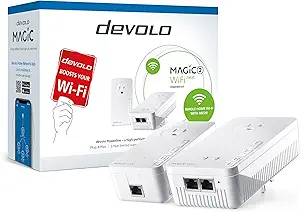
Devolo counters with an open, utility-focused feature ecosystem tailored to advanced home networking without recurring paywalls. Devolo’s flagship products rely on the G.hn standard, the latest generation of powerline data transmission, offering gigabit-class theoretical speeds across electrical conduits. Devolo’s firmware features robust local management interfaces alongside a capable mobile app, giving networking enthusiasts granular control over VLANs, guest networks, and physical transmission phases without requiring an active cloud connection. Furthermore, Devolo units frequently feature integrated pass-through electrical sockets and multiple physical Gigabit Ethernet ports, providing immense utility for stationary hardware like desktop PCs, NAS drives, and gaming consoles without sacrificing a wall outlet.
Performance
Amazon excels in pure over-the-air throughput, low-latency client handoffs, and managing high-density environments. Utilizing Wi-Fi 6, 6E, and Wi-Fi 7 standards across dual- and tri-band hardware, Amazon eero nodes leverage intelligent multi-channel routing to ensure minimal packet loss between wireless jumps. When positioned within optimal line-of-sight or moderate range of each other, Amazon extenders deliver blistering raw speeds capable of saturating gigabit broadband connections. The proprietary TrueMesh protocol continuously monitors environmental interference, rerouting active client sessions proactively. However, if an eero extender is forced to connect through reinforced concrete or heavy timber, performance drops sharply due to the inherent physical limitations of high-frequency wireless attenuation.
Devolo’s performance profile is engineered around baseline stability and overcoming wireless obstacles through its hybrid G.hn PLC architecture. By transmitting high-frequency data signals over standard mains copper wiring, Devolo effectively creates a wired connection to remote rooms, upon which it broadcasts localized Wi-Fi. This results in remarkably stable latency and jitter profiles in environments where purely wireless repeaters fail entirely. The practical limitation for Devolo, however, lies in electrical circuit cleanliness; older wiring, electrical noise from heavy appliances, or crossing separate electrical phases can introduce physical interference that throttles the powerline backhaul. While its peak wireless speeds rarely match the sheer multi-gigabit throughput of top-tier eero nodes under ideal conditions, Devolo provides higher reliability in structurally challenging domestic environments.
Design
From an industrial design standpoint, Amazon champions modern minimalism that blends unobtrusively into high-end home decor. Whether opting for the standard desktop pucks or compact wall-plug nodes, Amazon units feature smooth, matte-finish polycarbonate shells with soft curves and clean geometric lines. Amazon actively designs its hardware to be placed out in the open—on shelves, credenzas, and side tables—which directly aids radio wave propagation by discouraging users from hiding the units behind furniture. The physical interface is intentionally spartan, featuring minimal LED status indicators and concealed, recessed port layouts to maintain a clutter-free aesthetic.
Devolo adopts a purely pragmatic, utilitarian European design language dominated by functional engineering. Because the majority of Devolo devices are direct wall-plug units, they are bulkier than Amazon’s wall-mount accessories, largely due to the internal heatsinks, power supply transformers, and integrated mains pass-through sockets. While visually more industrial, this design ensures that users do not lose valuable wall receptacles in rooms where power points are scarce. The inclusion of passive cooling ventilation slots and prominent front-facing Ethernet ports underscores Devolo’s engineering focus on utility and thermal dissipation over decorative minimalism, prioritizing longevity and practical connectivity over subtle interior integration.
Compare current retail pricing, active promotions, and verified stock availability directly from authorized stores:
Compare current retail pricing, active promotions, and verified stock availability directly from authorized stores: