TP-Link vs Devolo: Overview
Comparing TP-Link and Devolo helps you determine which brand is best suited for your needs in Wi-Fi Extenders. Both brands offer strong choices depending on your budget and key feature requirements.
Key Features & Comparison
Evaluate factors such as build quality, warranty, customer satisfaction, and total value before making your final purchase choice between TP-Link and Devolo.
Features
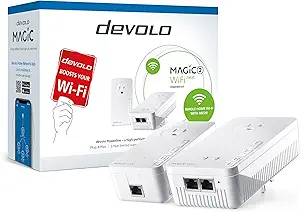
Feature distribution highlights distinct operational priorities between the two manufacturers. Devolo leans heavily into its G.hn powerline backbone integration, combining modern Wi-Fi 6 radios with high-speed electrical wiring backhauls. Its Magic series stands out with features like Access Point Steering, Fast Roaming (802.11k/v/r), and ConfigSync, which automatically replicates network credentials and operational bands across all deployed nodes. Additionally, Devolo units often provide multiple Gigabit Ethernet ports on single adapters and integrate pass-through power sockets, ensuring users do not sacrifice wall outlets. However, its software ecosystem, driven by the Devolo Home Network app and Cockpit software, is functional and technical rather than visually sleek.
TP-Link retaliates with a feature-rich, user-friendly software environment led by its intuitive Tether application and unified cloud architecture. TP-Link extenders frequently incorporate advanced management perks such as built-in Access Point modes, aggressive parental controls, LED scheduling, and seamless OneMesh compatibility, which allows an extender to form a unified network with supported TP-Link routers without creating split SSIDs. TP-Link is also noticeably quicker to deploy bleeding-edge wireless enhancements, such as tri-band operational modes, 160 MHz channel bandwidth support, and beamforming arrays on even mid-tier extenders, providing power users with comprehensive wireless configuration switches that Devolo sometimes abstracts away.
Performance
Performance benchmarks between these brands depend heavily on environmental architecture. Devolo consistently outperforms conventional extenders in environments with substantial physical barriers because its primary transport layer bypasses free-air attenuation entirely. By utilizing the home's electrical grid via modern G.hn wave-2 protocols, Devolo delivers exceptionally low latency and jitter consistency, which is vital for uninterrupted 4K streaming, video conferencing, and online gaming across distant rooms. However, its maximum theoretical wireless throughput often peaks lower than top-tier pure wireless repeaters, and performance can occasionally be subject to electrical interference from heavy appliances running on the same circuit phase.
TP-Link, on the other hand, dominates in pure wireless transmission speed under favorable direct line-of-sight and moderate-range conditions. Leveraging high-gain external antennas and powerful internal amplifiers, TP-Link Wi-Fi 6 extenders can push massive local bandwidth across clean wireless paths, maximizing gigabit internet connections more effectively than powerline-hybrid systems. The trade-off is susceptibility to distance degradation: as TP-Link units are placed further from the primary gateway through dense structural materials, throughput drops sharply and latency spikes, demonstrating that TP-Link offers higher peak speeds while Devolo offers greater baseline stability under harsh physical constraints.
Design
From an industrial design standpoint, Devolo adheres to a utilitarian, European minimalist aesthetic. Most Devolo units feature clean, rectangular white chassis designed to blend quietly into residential baseboards. A standout design hallmark is the inclusion of an integrated pass-through electrical socket on nearly all of their main units, an engineering triumph that prevents the bulky adapter from rendering a wall receptacle useless. The build quality feels dense and thermally well-managed, utilizing internal heatsinks that manage powerline and wireless chip thermals without resorting to noisy active cooling, though the units themselves can be physically heavy and wide enough to crowd adjacent outlets.
TP-Link embraces a more diverse, modern consumer electronics styling that ranges from discreet miniature plug-in units to high-performance extenders adorned with multiple external, articulated antennas. While these external antennas offer directional flexibility for signal optimization, they can look obtrusive and tech-heavy in modern living spaces. TP-Link rarely includes power pass-through sockets on its dedicated Wi-Fi extenders, effectively monopolizing wall outlets. Nonetheless, TP-Link units often feature helpful external LED signal meters directly on the chassis face, which provide real-time physical feedback on optimal placement distance from the host router, greatly simplifying user setup.