Netgear vs Devolo: Overview
Comparing Netgear and Devolo helps you determine which brand is best suited for your needs in Wi-Fi Extenders. Both brands offer strong choices depending on your budget and key feature requirements.
Key Features & Comparison
Evaluate factors such as build quality, warranty, customer satisfaction, and total value before making your final purchase choice between Netgear and Devolo.
Features
Netgear Wi-Fi extenders shine with broad feature parity aimed at tech-savvy consumers and multimedia enthusiasts. Many of their mid-to-high-end units include tri-band configurations, providing a dedicated 5 GHz backhaul channel that eliminates the 50% throughput penalty historically associated with single-radio repeaters. Netgear's Smart Roaming and FastLane technology intelligently balance bands between the router and client devices under a unified SSID. Furthermore, management via the Nighthawk app offers an intuitive interface for parental controls, guest network setups, and basic security metrics, appealing directly to users who prioritize software-level granular control over their wireless environment.
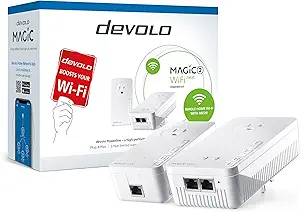
Devolo counters with an integrated hardware ecosystem tailored for structural reliability and seamless handover via its proprietary Magic series. Devolo’s flagship strength lies in its implementation of G.hn powerline technology paired with Wi-Fi 6, complete with mesh features such as Fast Roaming (802.11r/k/v), Airtime Fairness, and Band Steering. Instead of relying on a fragile chain of wireless repeaters, Devolo units feature multiple physical Gigabit LAN ports on satellite adapters and integrated passthrough power sockets, ensuring electrical outlets are not sacrificed. While Devolo's management suite is more utilitarian than Netgear's polished app, it excels in network stability and multi-node synchronization over challenging physical mediums.
Performance
In terms of sheer raw throughput over line-of-sight and medium distances, Netgear frequently outpaces Devolo. Netgear's high-tier Wi-Fi 6 and Wi-Fi 6E extenders boast massive multi-gigabit wireless link rates that excel at high-bandwidth tasks such as simultaneous 4K/8K video streaming, virtual reality data transport, and heavy local file transfers. However, because Netgear depends heavily on ambient RF propagation, its real-world performance is prone to rapid attenuation when encountering brick chimneys, dense insulation, or structural steel, occasionally leading to elevated latency or packet drops during competitive online gaming.
Devolo takes a performance hit on maximum theoretical wireless bursts, but it dramatically outclasses traditional wireless extenders in latency consistency and structural penetration. By transmitting data packets over high-frequency electrical circuits, Devolo bypasses interior walls entirely, delivering steady, ping-spike-free connections to distant rooms and basements where Netgear's wireless backhaul would struggle to connect. The trade-off is that Devolo's absolute throughput is constrained by the quality and age of the home's electrical wiring, as well as line noise from heavy appliances, making it moderately lower in absolute peak megabits than Netgear under optimal conditions.
Design
Netgear's industrial design language is modern, aggressive, and clearly derived from the gaming-centric aesthetic of the Nighthawk pedigree. Their extenders range from compact wall-plug models with external, high-gain dipole antennas to substantial desktop form-factors that resemble standalone routers. While the desktop models provide superior heat dissipation and larger antenna arrays for better beamforming, they demand dedicated shelf space and external power bricks. The wall-plug variants, conversely, are often bulky enough to obscure adjacent electrical outlets, a minor annoyance in homes with limited wall sockets.
Devolo favors an understated, functional aesthetic typical of northern European engineering. Its Magic adapters are predominantly wall-mount units finished in minimalist, glossy white plastics designed to blend into baseboards and utility spaces without drawing attention. Crucially, Devolo incorporates pass-through electrical sockets on nearly all of its flagship devices, solving one of the most persistent consumer pain points associated with wall-plug extenders. Thermal management is cleanly integrated into subtle passive venting, resulting in discreet, robust enclosures that emphasize quiet, permanent integration into the home's infrastructure.