Linksys vs Devolo: Overview
Comparing Linksys and Devolo helps you determine which brand is best suited for your needs in Wi-Fi Extenders. Both brands offer strong choices depending on your budget and key feature requirements.
Key Features & Comparison
Evaluate factors such as build quality, warranty, customer satisfaction, and total value before making your final purchase choice between Linksys and Devolo.
Features
The feature sets of Devolo and Linksys highlight divergent approaches to home networking versatility and expansion. Linksys extenders focus heavily on wireless protocol optimization, integrating technologies like Spot Finder to guide physical placement, seamless roaming protocols (802.11k/v/r), and multi-band operation that dynamically assigns devices to either 2.4 GHz or 5 GHz bands to avoid bottlenecks. High-end Linksys repeaters often boast dedicated backhaul bands and support for their Intelligent Mesh ecosystem, allowing an extender to function naturally as an additional mesh node. Furthermore, their modern iterations support Wi-Fi 6 technologies like MU-MIMO, beamforming, and OFDMA, offering strong performance for high-concurrency environments.
Devolo counters this with an advanced suite of hardware-integrated features, most notably the integration of G.hn Powerline standards in its flagship models. This allows their extenders to utilize a home’s copper wiring as a gigabit backbone, bypassing the typical bandwidth halving seen in traditional single- or dual-band wireless extenders. Devolo’s management utility, the Home Network app and cockpit software, offers granular control over network parameters, parental controls, guest networks, and automated phase-coupling adjustments. While Linksys excels in user-friendly app workflows and automated wireless steering, Devolo delivers a richer technical toolkit for addressing complex physical constraints.
Performance
Performance benchmarks between the two brands reveal fundamental differences in transmission media and latency management. Linksys delivers blistering short-to-medium-range wireless speeds, particularly with its Wi-Fi 6 range extenders (such as the RE7000 or RE7350 series), which excel at broadcasting high throughput across open spaces and light drywall. When paired with a compatible router, Linksys systems offer low latency and high bandwidth capacity, ideal for 4K streaming and low-ping gaming. However, because standard Linksys extenders rely entirely on wireless signals for both client communication and backhaul, their throughput can drop sharply if placed too far from the base station or behind dense barriers.
Devolo exhibits exceptional performance consistency in environments that typically throttle standard Wi-Fi repeaters. By utilizing Powerline backhauls alongside Wi-Fi transmission, Devolo extenders preserve data integrity over long distances and through heavy walls, maintaining steady throughput and minimal packet loss. While pure line-of-sight speeds may not always peak as high as premium tri-band Linksys units, Devolo’s sustained speeds and low jitter provide superior reliability over distance. In homes with older electrical wiring, Devolo's throughput may see some variance, but it generally outperforms wireless-only Linksys solutions in challenging structural environments.
Design
From an industrial design standpoint, both brands adopt distinct visual and functional formats. Linksys typically favors clean, functional white-enclosure aesthetics designed to blend into modern home decors. Many of their extenders feature a wall-plug form factor, though several higher-end performance units adopt mini-tower designs with external antennas that maximize signal reception at the cost of floor or shelf space. Thermal management on Linksys units is generally well-executed with passive ventilation grilles, though some high-output models can run relatively warm under sustained heavy loads.
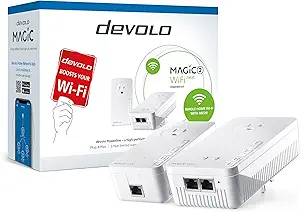
Devolo leans into practical, robust European industrial styling characterized by minimalist, boxy chassis and discreet, unflashy LED status indicators. A significant design advantage of Devolo’s wall-plug extenders is the frequent inclusion of an integrated, passthrough electrical socket (filtered to reduce line noise), ensuring users do not lose valuable outlet access—a common annoyance with larger Linksys wall-wart devices. Devolo’s hardware feels dense and built to last, with heavy shielding designed to isolate internal circuitry from electrical noise, making their physical footprint slightly bulkier but practically superior in utility-conscious households.