Google vs Netgear: Overview
Comparing Google and Netgear helps you determine which brand is best suited for your needs in Wi-Fi Routers. Both brands offer strong choices depending on your budget and key feature requirements.
Key Features & Comparison
Evaluate factors such as build quality, warranty, customer satisfaction, and total value before making your final purchase choice between Google and Netgear.
Features
Google's feature set is deliberately streamlined and consolidated within the Google Home application, emphasizing automated maintenance and smart home cohesion. Key functionalities include cloud-based automated channel switching, effortless guest network isolation, and straightforward parental controls that allow scheduling screen-time pauses by user profile. Furthermore, select Google Nest points double as smart speakers integrated with Google Assistant, creating a multi-functional device footprint. However, this minimalist approach comes at the cost of advanced networking tools; users cannot manually split 2.4 GHz and 5 GHz SSIDs, configure dynamic DNS, or set up bespoke VPN servers directly on the hardware.
In stark contrast, Netgear equips its routers with comprehensive, enthusiast-grade feature suites accessed via mobile apps or detailed web-based graphical user interfaces. Netgear routers frequently incorporate multi-gigabit WAN/LAN ports, link aggregation, and dedicated backhaul channels on tri-band and quad-band Orbi models. Advanced consumers benefit from deep packet inspection, robust QoS engines tailored for latency-sensitive gaming, port forwarding, and VPN client/server capabilities. While Netgear has shifted some advanced security features into its subscription-based Netgear Armor (powered by Bitdefender) platform, the sheer depth of local configuration options vastly outstrips the basic toggles provided by Google's ecosystem.
Performance
Performance benchmarks reveal clear divergence in raw speed, range, and latency handling between the two brands. Google Nest routers deliver exceptionally stable, consistent throughput optimized for typical household demands such as 4K video streaming, standard teleconferencing, and responsive IoT operation. Its dynamic mesh algorithm handles client roaming gracefully, ensuring smooth handoffs between nodes. However, because Google typically relies on dual-band architecture with shared backhaul—and adopts newer Wi-Fi standards more conservatively—peak speeds drop noticeably at extended range or when multiple clients execute heavy, simultaneous local network transfers.
Netgear, particularly through its Orbi and Nighthawk lines, dominates in pure speed, bandwidth density, and architectural performance. By heavily investing in dedicated wireless backhauls (tri-band and quad-band systems) and high-power internal antenna arrays with multi-stream MU-MIMO, Netgear maintains gigabit-adjacent speeds across massive square footage. Gamers and high-bandwidth households benefit from Netgear's superior processing hardware, which minimizes bufferbloat and latency spikes under heavy concurrent network loads. For multi-gigabit internet tiers and ultra-dense client environments, Netgear's raw physical layer throughput consistently outperforms Google's software-managed hardware.
Design
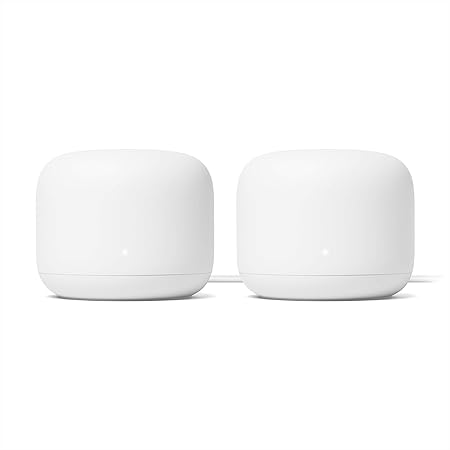
In terms of physical design, Google revolutionized the consumer networking space by treating routers as home decor rather than utilitarian telecom appliances. Nest Wifi and Nest Wifi Pro units feature soft curves, matte ceramic-like finishes, and warm, unobtrusive color palettes engineered to sit openly on bookshelves, countertops, and side tables. This design strategy serves a critical technical purpose: keeping nodes out of closed cabinets and behind entertainment centers significantly improves RF signal propagation. Google's minimalist aesthetic extends to its status indicators, using subtle, dimmable LEDs that blend quietly into any domestic environment.
Netgear embraces a more traditional, high-tech industrial aesthetic that prioritizes thermal management and functional engineering over discreet camouflage. The Nighthawk series leans aggressively into a stealth-fighter visual identity, featuring sharp angular chassis, external high-gain antennas, and visible status LEDs suited for home offices and gaming setups. Meanwhile, Netgear's premium Orbi systems take a more refined, architectural pillar approach, but they remain substantially larger than Google's pucks to accommodate expansive heat sinks and complex internal antenna arrays. While less discreet than Google's designs, Netgear's bulkier forms provide the necessary airflow and internal volume to sustain high-performance, high-draw internal components.
Compare current retail pricing, active promotions, and verified stock availability directly from authorized stores: