Google vs Amazon: Overview
Comparing Google and Amazon helps you determine which brand is best suited for your needs in Wi-Fi Routers. Both brands offer strong choices depending on your budget and key feature requirements.
Key Features & Comparison
Evaluate factors such as build quality, warranty, customer satisfaction, and total value before making your final purchase choice between Google and Amazon.
Features
In terms of software intelligence and smart home features, Google and Amazon integrate vastly different peripheral strengths into their networking gear. Google differentiates itself by converging smart audio and mesh routing into single devices, with select Nest Wifi points serving as fully functional Google Assistant smart speakers and Matter-compatible Thread border routers. Network management occurs directly inside the Google Home application, creating a centralized dashboard for lights, cameras, and internet controls. However, Google's advanced network settings are somewhat Spartan, lacking granular controls like port forwarding flexibility, dynamic DNS customization, or deep multi-gigabit traffic monitoring.
Amazon counters with a feature-rich, dedicated eero application centered around connectivity, network security, and IoT bridging. Most eero models act as Zigbee and Thread smart home hubs, seamlessly linking with Alexa for automatic device onboarding through Amazon Frustration-Free Setup. Furthermore, Amazon offers 'eero Plus,' a subscription tier that introduces network-level ad blocking, content filtering, dynamic threat protection, and DDNS capabilities. While some users may balk at putting security analytics behind a monthly paywall, Amazon's underlying software features—like TrueMesh dynamic routing and localized client steering—render its feature set more dynamic for pure networking performance.
Performance
Performance benchmarks reveal distinct engineering priorities, with Amazon’s eero portfolio generally outpacing Google across throughput, latency under heavy load, and band management. Amazon has aggressively updated its lineup to support tri-band Wi-Fi 6E (eero Pro 6E) and high-speed Wi-Fi 7 (eero Max 7), providing wider channel widths, higher QAM modulation, and 2.5 Gbps to 10 Gbps Ethernet ports. Eero’s proprietary TrueMesh software actively routes traffic around interference and network bottlenecks in real time, making it exceptionally reliable for high-density environments packed with 4K streaming, multi-user teleconferencing, and competitive online gaming.
Google’s Nest Wifi and Nest Wifi Pro deliver admirable, stable performance tailored for typical consumer workloads, but they tend to fall behind in pure throughput and coverage efficiency in sprawling multi-story residences. While Nest Wifi Pro added Wi-Fi 6E support, real-world tests often show conservative band steering and relatively limited wired backhaul flexibility due to its reliance on basic gigabit Ethernet ports. Google provides rock-solid consistency for standard browsing, streaming, and light smart home traffic, but power users with gigabit-plus broadband tiers will extract significantly higher real-world speeds and lower inter-node latency from Amazon's higher-tier eero systems.
Design
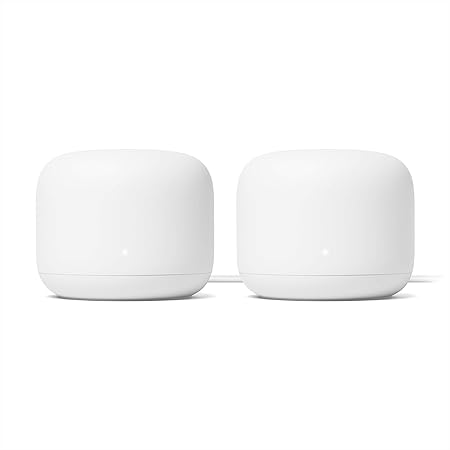
Google sets the benchmark for aesthetic design in consumer networking, deliberately crafting devices that resemble decorative ceramic decor rather than functional technology. Designed to be placed openly on shelves rather than hidden in cabinets, Nest Wifi units feature soft curves, matte finishes, and warm, nature-inspired colorways. This aesthetic-first approach has direct performance benefits: routers and mesh points perform far better when positioned in unobstructed, open spaces. The physical construction feels premium, and Google's use of post-consumer recycled plastics aligns well with modern eco-conscious design standards.
Amazon’s eero systems prioritize functional minimalism, favoring clean, compact, and glossy white squares with softly rounded corners. While eero nodes are discreet enough to blend into any modern living space, their design is noticeably more utilitarian compared to Google's artistic approach. However, Amazon excels in thermal dissipation and physical port layout across its varying models. Higher-end eero devices incorporate internal passive heatsinks to sustain maximum throughput without throttling, alongside versatile Ethernet options that make physical cable management and wired backhaul installations considerably more practical than Google’s port-limited units.
Compare current retail pricing, active promotions, and verified stock availability directly from authorized stores: