Asus vs Netgear: Overview
Comparing Asus and Netgear helps you determine which brand is best suited for your needs in Wi-Fi Routers. Both brands offer strong choices depending on your budget and key feature requirements.
Key Features & Comparison
Evaluate factors such as build quality, warranty, customer satisfaction, and total value before making your final purchase choice between Asus and Netgear.
Features
Feature-set divergence between these two giants highlights fundamentally different corporate monetization strategies. Asus shines brightest in this arena, offering AsusWRT—an exceptionally powerful, highly customizable operating system that provides enterprise-grade traffic management, comprehensive dual-WAN support, integrated VPN fusion (allowing concurrent client and server configurations per device), and AiProtection Pro powered by Trend Micro with lifetime-free security updates. Furthermore, Asus’s proprietary AiMesh technology allows users to repurpose older Asus routers into extended mesh nodes, substantially enhancing hardware longevity and reducing electronic waste.
Netgear’s software feature implementation is markedly more conservative and monetization-driven. While its Orbi and Nighthawk administrative consoles cover essential functions like port forwarding, basic QoS, and guest networks, advanced management is intentionally streamlined or hidden behind the mobile application. Premium capabilities, including Bitdefender-powered Netgear Armor network security and comprehensive Smart Parental Controls, require ongoing annual subscriptions after a brief trial period. While Netgear’s dedicated backhaul configurations in their Orbi mesh lines represent top-class network engineering, the brand’s restrictive firmware architecture offers significantly less native utility to users who demand deep network telemetry and customizable routing rules without recurring costs.
Performance
From a raw performance perspective, both manufacturers consistently push the envelope with the latest Wi-Fi standards, including cutting-edge Wi-Fi 6E and Wi-Fi 7 silicon. Netgear has historically dominated sustained throughput benchmarks at medium-to-long ranges, particularly within its Orbi mesh lineup. By utilizing dedicated, unshared wireless backhaul bands and precision-tuned internal antenna arrays, Netgear systems often achieve superior whole-home coverage and lower packet drop rates across expansive multi-floor floorplans. Their standalone Nighthawk routers also leverage enterprise-grade radio amplifiers that excel at penetrating dense construction materials with minimal signal attenuation.
Asus counters with elite, low-latency performance that specifically caters to real-time applications such as competitive gaming, high-bitrate media streaming, and simultaneous heavy downloads. Asus routers typically feature adaptive QoS and packet prioritization engines that actively mitigate bufferbloat far more effectively than standard Netgear consumer presets. While Netgear occasionally edges out Asus in raw downstream throughput at extreme line-of-sight distances, Asus maintains remarkably consistent latency curves under heavy localized congestion. For users running multiple high-bandwidth devices concurrently, Asus’s efficient memory management and aggressive packet routing deliver an exceptionally responsive network environment.
Design
The industrial design philosophies of Asus and Netgear showcase contrasting aesthetic ideals that cater to different household environments. Netgear focuses heavily on architectural integration and lifestyle elegance, especially within its Orbi family, which favors sleek, minimalist columnar chassis with internal antennas that blend seamlessly into modern living room decor. Even Netgear's performance-oriented Nighthawk routers, which feature aggressive, stealth-aircraft-inspired angular shells, maintain a clean, monochromatic exterior that avoids overly juvenile tropes while optimizing thermal dissipation through strategically hidden vents.
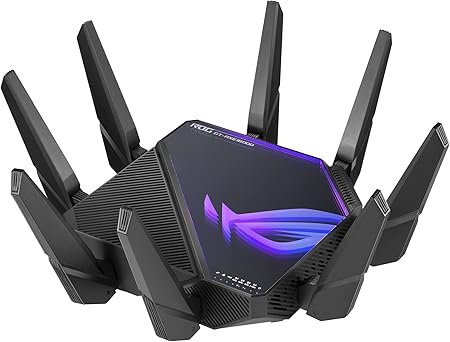
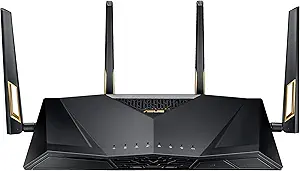
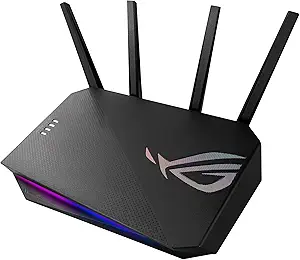
Asus, conversely, embraces a bold, aggressively functional design language that unapologetically signals high-performance computing. Particularly in its RT and ROG Rapture series, Asus hardware features external arrays of prominent, articulated antennas, striking geometric heatsinks, and customizable Aura RGB lighting that appeal directly to the PC gaming aesthetic. From an engineering standpoint, this exterior prioritization of mechanical ventilation and external antenna articulation allows Asus hardware to sustain lower internal operating temperatures under heavy compute loads, though it results in footprint-heavy devices that are significantly harder to conceal in formal living spaces compared to Netgear’s refined enclosures.