Google vs TP-Link: Overview
Comparing Google and TP-Link helps you determine which brand is best suited for your needs in Wi-Fi Routers. Both brands offer strong choices depending on your budget and key feature requirements.
Key Features & Comparison
Evaluate factors such as build quality, warranty, customer satisfaction, and total value before making your final purchase choice between Google and TP-Link.
Features
Google approaches networking features through the lens of smart home integration and automated maintenance. Managed almost entirely through the Google Home app, Nest Wifi devices prioritize family safety features, such as intuitive content filtering and scheduled device pausing, alongside effortless guest network creation. Furthermore, select Google points integrate smart speakers with Google Assistant, effectively doubling as smart home hubs with support for Matter and Thread protocols. However, this minimalist approach leaves out foundational networking capabilities; users cannot split 2.4 GHz and 5 GHz bands, configure a VPN client directly on the router, customize dynamic DNS settings, or access deep port-forwarding controls.
TP-Link delivers a dramatically richer and more flexible feature set tailored to a wide range of user proficiencies. Through web-based graphical user interfaces and the Tether or Deco applications, TP-Link provides extensive administrative access, including granular Quality of Service (QoS) rules, OpenVPN and WireGuard server/client support, multi-SSID broadcasting, and separate IoT networks for enhanced security. Additionally, TP-Link offers the HomeShield security suite for automated vulnerability scanning and parental controls. While premium HomeShield tiers require a subscription, the baseline software gives network administrators significantly more control over bandwidth allocation, channel selection, and local security configurations than Google's streamlined ecosystem allows.
Performance
In real-world performance assessments, Google delivers reliable, stable, but ultimately conservative throughput. Nest Wifi systems utilize proprietary software algorithms to intelligently manage band steering and backhaul traffic, minimizing packet loss and providing smooth transitions between nodes as users move through a property. However, Google's hardware often lags behind industry benchmarks regarding raw link rates and high-bandwidth capabilities. With limited multi-gigabit Ethernet WAN/LAN ports across most models and a slow transition into tri-band and quad-band Wi-Fi 7 technology, Google routers can act as a bottleneck for multi-gigabit fiber connections and local network data transfers.
TP-Link outclasses Google in raw throughput, latency reduction, and hardware-level performance scalability. By incorporating high-gain external antennas, powerful multi-core processing chipsets from Qualcomm and Broadcom, and cutting-edge 160 MHz and 320 MHz channel widths, TP-Link routers routinely post higher top-end speeds across medium and long distances. TP-Link also integrates multi-gigabit (2.5 Gbps and 10 Gbps) ports across an extensive portion of its mid-range and premium portfolio, making it far better suited for environments with high concurrent device loads, competitive gaming, and heavy local NAS traffic. For sustained wireless speeds under heavy loads, TP-Link provides a clear technical advantage.
Design
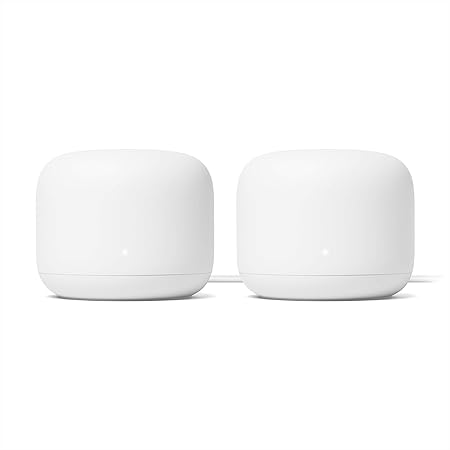
Google's industrial design ethos is rooted in unobtrusive, domestic aesthetics. Designed under the premise that routers perform best when not hidden inside closets or behind furniture, Nest Wifi units feature soft curves, matte ceramic-like finishes, and a complete absence of external antennas. The hardware blends effortlessly into modern home decor, frequently resembling high-end ceramic vases or minimalist smart speakers rather than networking equipment. Google also integrates subtle status lights that dim or extinguish entirely to avoid visual pollution in bedrooms and living spaces, reflecting an exceptional attention to interior design ergonomics.
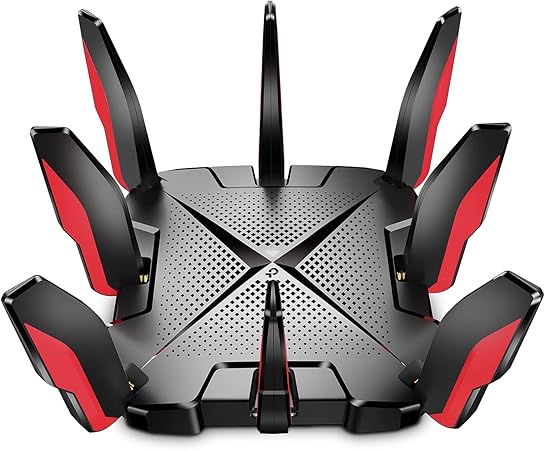
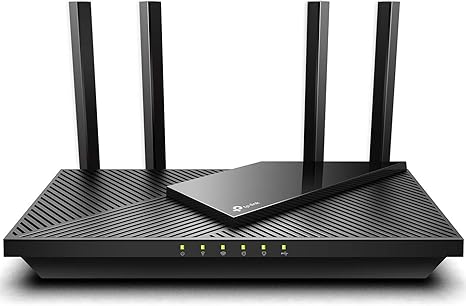
TP-Link embraces a functional, bifurcated design strategy that prioritizes thermal management and mechanical efficiency over domestic disguise. Its Deco mesh units adopt clean, cylindrical aesthetics that rival Google’s unobtrusiveness, but the traditional Archer and gaming lines lean heavily into utilitarian visuals characterized by aggressive angles, ventilation grilles, and multiple external beamforming antennas. While these external antennas may appear industrial and clutter residential spaces, they allow for physical articulation to optimize directional signal propagation and provide superior passive heat dissipation, ensuring internal components operate safely under sustained compute loads.