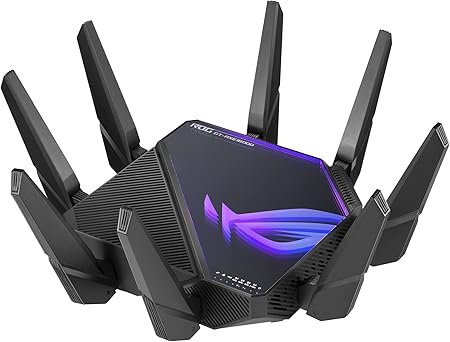
Asus vs Amazon: Overview
Comparing Asus and Amazon helps you determine which brand is best suited for your needs in Wi-Fi Routers. Both brands offer strong choices depending on your budget and key feature requirements.
Key Features & Comparison
Evaluate factors such as build quality, warranty, customer satisfaction, and total value before making your final purchase choice between Asus and Amazon.
Features
From a feature standpoint, Asus offers an overwhelmingly deep suite of built-in networking tools powered by their proprietary Asuswrt operating system. Out of the box, Asus includes commercial-grade AiProtection powered by Trend Micro, sophisticated Quality of Service (QoS) engines—including specialized gaming packet prioritization—and native VPN client and server support covering WireGuard, OpenVPN, and IPSec. Additionally, Asus routers frequently feature USB 3.0 ports that allow users to configure network-attached storage, run media servers, or plug in a 4G/5G cellular dongle for automatic failover WAN. Crucially, virtually all of these high-level tools are integrated into the device permanently with zero recurring subscription fees.
Amazon approaches feature architecture through a minimalist, service-oriented framework centered around the eero ecosystem. The eero mobile application is exceptionally polished, providing straightforward device management, guest network provisioning, and integrated smart home hub features, such as acting as a Thread Border Router or Zigbee coordinator. However, Amazon reserves many advanced features—such as deep network security analytics, ad blocking, historical bandwidth insights, and automated cellular backup—behind its paid eero Plus subscription tier. Advanced routing functionalities like manual port forwarding, custom DNS, and static DHCP are present, but granular options like separate SSID broadcasting per frequency band, dedicated VPN servers, or third-party firmware support are intentionally excluded to protect the simplicity of the mesh system.
Performance
In terms of raw performance and peak bandwidth delivery, Asus consistently demonstrates superior numbers, particularly in single-device throughput, low latency, and range from a primary node. By utilizing top-tier Broadcom and Qualcomm chipsets equipped with high-gain external antennas and massive heatsinks, Asus routers excel at pushing multi-gigabit boundaries. Whether deploying flagship Wi-Fi 6E or Wi-Fi 7 units, Asus maximizes spatial streams (often up to 4x4 or 8x8 configurations) to sustain intense workloads such as 4K/8K local streaming, concurrent low-ping gaming, and large local file transfers. For users with Gigabit-plus fiber internet, Asus provides dedicated 2.5GbE and 10GbE WAN/LAN ports that eliminate wired bottlenecks entirely.
Amazon eero models are engineered for distributed coverage rather than sheer node-to-device brute force. In multi-node configurations, eero’s proprietary TrueMesh software algorithms dynamically route traffic to prevent congestion and minimize packet loss across expansive floorplans. While eero units (such as the eero Pro 6E and eero Max 7) offer impressive real-world throughput, their thermal design constraints and internal omnidirectional antenna arrays mean that single-node performance and range typically fall short of a comparable standalone Asus router. Furthermore, unless you opt for the premium Pro or Max hardware tiers with dedicated backhaul bands or multi-gig ports, wireless mesh hops on entry-level eero nodes can result in halving throughput speeds, making Asus the more capable choice for raw, uncompromised speed.
Design
The industrial design of Asus routers is unapologetically aggressive and function-first, leaning heavily into a futuristic, gamer-centric aesthetic. Characterized by sharp angular chassis, visible ventilation grilles, external beamforming antennas, and frequently RGB accent lighting, Asus hardware commands desk or shelf space. While these designs may clash with refined interior decor, they are engineered for thermal efficiency; the substantial footprint allows for passive cooling over large internal heatsinks, preventing thermal throttling during prolonged, high-load operations. Asus units also emphasize physical utility, presenting an array of multi-gigabit Ethernet ports, power toggles, LED on/off buttons, and USB expansions directly on the rear panel.
Amazon champions an architectural philosophy that is the polar opposite, prioritizing discreet home integration above all else. Eero devices sport soft, curved puck silhouettes clad in glossy or matte white, designed to blend invisibly into living spaces, bookshelves, and kitchen countertops without drawing attention. By eliminating external antennas, LED arrays, and large arrays of physical ports in favor of internal antenna matrices, Amazon ensures high spouse-approval factor and effortless placement throughout a residence. The practical trade-off of this compact form factor is thermal density and limited physical I/O; eero units typically offer only two Ethernet ports per node and operate at noticeably warm surface temperatures due to reliance on compact passive convection cooling.
Compare current retail pricing, active promotions, and verified stock availability directly from authorized stores: