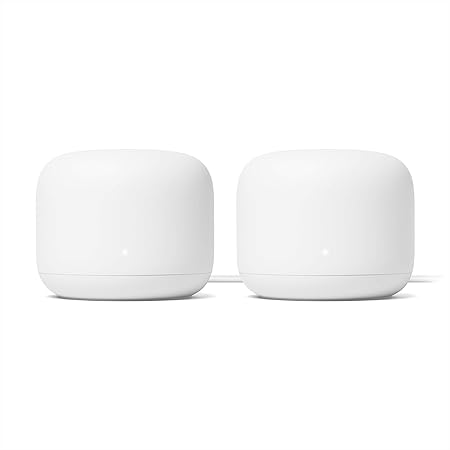
Google vs Google Nest: Overview
Comparing Google and Google Nest helps you determine which brand is best suited for your needs in Wi-Fi Routers. Both brands offer strong choices depending on your budget and key feature requirements.
Key Features & Comparison
Evaluate factors such as build quality, warranty, customer satisfaction, and total value before making your final purchase choice between Google and Google Nest.
Features
From a feature perspective, the legacy Google hardware focused squarely on basic mesh mechanics, network prioritization, and robust parental controls managed through a lightweight architecture. Every Google Wifi puck functioned identically, offering dual Gigabit Ethernet ports that allowed for easy wired backhaul or local wired device connections. Google Nest, on the other hand, bifurcates and diversifies its feature set across different nodes and generations. The flagship Nest Wifi ecosystem introduced integrated Google Assistant smart speakers directly into its access points, along with advanced radio technologies like Thread and Bluetooth Low Energy, turning the home mesh into a connective fabric for smart bulbs, locks, and sensors under the Matter umbrella.
However, this transition introduced pragmatic trade-offs that frustrated traditional networking enthusiasts. Standard Nest Wifi points famously eliminated physical Ethernet ports entirely, requiring users to rely purely on wireless backhaul unless they purchased multiple primary router units. While the later Nest Wifi Pro addressed this by restoring dual multi-gigabit Ethernet jacks to every pod and adding Wi-Fi 6E functionality, the Google Nest feature set undeniably prioritizes smart home centralization over granular networking controls. Neither platform offers the deep configuration tools of competitive enterprise brands—such as complex VPN configurations, VLAN tagging, or advanced dynamic DNS management—yet Google Nest delivers a vastly superior modern IoT feature stack compared to its pure-networking predecessor.
Performance
In terms of raw throughput, latency, and spectrum handling, the Google Nest lineup demonstrates a distinct generational leap over the original Google Wifi platform. The original Google hardware was strictly limited to AC1200 dual-band Wi-Fi 5 performance, which, while capable of providing stable baseline coverage for moderate internet tiers, rapidly struggles under the congestion of modern multi-gigabit connections, 4K streaming demands, and high-density device environments. Google Nest products elevate this baseline significantly, moving from AC2200 topologies in the Nest Wifi to tri-band AXE5400 architectures in the Nest Wifi Pro. This progression yields substantially lower latency, wider channel bandwidths (up to 160 MHz), and significantly faster top-end speeds across multi-story deployments.
Despite this marked jump in hardware ceiling, both platforms rely on Google’s proprietary cloud-based radio resource management to dynamically steer client devices to the cleanest frequency and optimal mesh node. Where Google Nest occasionally draws scrutiny is its reliance on pure wireless backhaul in mixed-point setups, which can exhibit performance degradation across thick walls compared to a hardwired legacy Google Wifi network. Nevertheless, when comparing apples-to-apples modern wireless speeds, the Nest generation—particularly the 6 GHz band enabled Nest Wifi Pro—massively outperforms the legacy Google hardware, delivering the requisite throughput and client density management required for modern smart households.
Design
The evolution from Google to Google Nest showcases a deliberate maturation in industrial design, moving from utilitarian consumer electronics to refined domestic décor. The original Google Wifi featured a modest, cylindrical plastic puck intersected by a subtle LED status band; it was intentionally discreet, but unmistakably looked like computer hardware meant to blend into an office shelf or entertainment console. Google Nest turned this aesthetic inside out by engaging internal lifestyle design teams to craft softer, organic, ceramic-like contours that invite users to place nodes out in the open—which incidentally optimizes RF antenna propagation by discouraging placement inside cabinets or behind furniture.
The Nest Wifi points integrated an acoustic fabric base to support smart speaker drivers and capacitive touch surfaces on top for physical media and volume control, shifting the hardware’s identity toward home audio. The Nest Wifi Pro further refined this aesthetic into a high-gloss, pebble-inspired sculpture available in earthy, decorator-inspired colorways. While the original Google aesthetic was durable, compact, and functional, Google Nest prioritizes premium sustainability and tactile design, utilizing high percentages of post-consumer recycled plastics and concealed heatsinks to deliver networking hardware that seamlessly complements modern interior architecture.
Compare current retail pricing, active promotions, and verified stock availability directly from authorized stores: