Google vs Linksys: Overview
Comparing Google and Linksys helps you determine which brand is best suited for your needs in Wi-Fi Routers. Both brands offer strong choices depending on your budget and key feature requirements.
Key Features & Comparison
Evaluate factors such as build quality, warranty, customer satisfaction, and total value before making your final purchase choice between Google and Linksys.
Features
Google approaches its feature set through the lens of ambient computing, natively embedding Google Assistant microphones and speakers into select satellite nodes and unifying network controls inside the primary Google Home app. Advanced management is intentionally streamlined into clean toggles for basic family safety, device prioritization, and speed testing. However, this minimalist approach leaves advanced users constrained: the Google platform lacks traditional web administrative portals, manual channel and band selection, VPN client/server configurations, and sophisticated Quality of Service (QoS) rule assignment.
Linksys delivers a substantially broader networking toolkit that appeals to technically demanding environments. The Linksys software suite, accessible via both dedicated mobile applications and robust browser-based GUI portals, grants access to dynamic QoS, advanced firewall configuration, multi-gig WAN/LAN port aggregation, and custom IP routing. Furthermore, select Linksys hardware retains compatibility with open-source firmware such as OpenWrt, giving technical enthusiasts total agency over their hardware to deploy network-level ad blocking, custom VLANs, and granular traffic management that Google actively prevents.
Performance
In standard residential environments, Google delivers remarkably consistent, low-latency coverage characterized by aggressive, intelligent band steering and seamless roaming. Google's mesh algorithms excel at dynamic channel switching and background self-healing to evade local radio interference. However, Google's top-end throughput often falls short during heavy local network transfers or gigabit internet saturation, largely because their hardware configurations historically lean on dual-band topologies or conservative backhaul channels that throttle maximum theoretical speeds across extended nodes.
Linksys decisively wins on raw throughput metrics, peak multi-user capacity, and range extension. By embracing cutting-edge Wi-Fi 6E and Wi-Fi 7 silicon, multi-gigabit Ethernet interfaces, and dedicated high-bandwidth tri-band/quad-band dynamic backhauls, Linksys routers effortlessly manage high-density client loads. For simultaneous 4K/8K video streaming, high-throughput LAN file movement, and jitter-sensitive competitive gaming, Linksys hardware delivers higher top-end data transfer rates and significantly less backhaul attenuation over physical square footage than comparable Google configurations.
Design
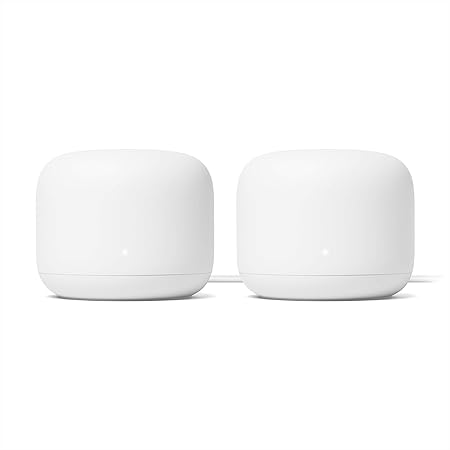
Google’s industrial design philosophy treats networking hardware as Scandinavian-inspired home decor rather than functional electronics. Nest Wifi routers and points feature smooth, pebble-like contours, matte ceramic-textured finishes, soft ambient underglow lighting, and completely concealed internal antennas. By designing units that homeowners willingly place on open tables and bookshelves rather than hiding inside cabinets, Google solves an inherent physical barrier to radio propagation through pure aesthetic integration.
Linksys balances utilitarian enterprise heritage with modern consumer styling across its hardware tiers. While their Velop mesh nodes adopt clean, monolithic pillar designs that blend into modern interiors, their performance and gaming lineups lean unapologetically functional with exposed external high-gain antennas, pronounced ventilation grilles, and distinct diagnostic LED arrays. While Linksys devices occupy a larger physical footprint and may clash with minimalist decor, the prioritization of thermal heat sinks, passive airflow channels, and orientation-adjustable antennas directly benefits long-term hardware longevity and peak radio frequency efficiency.
Compare current retail pricing, active promotions, and verified stock availability directly from authorized stores: