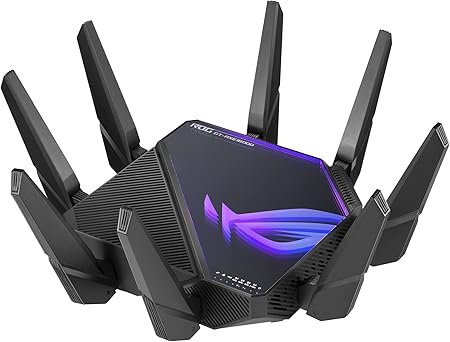
Asus vs Google Nest: Overview
Comparing Asus and Google Nest helps you determine which brand is best suited for your needs in Wi-Fi Routers. Both brands offer strong choices depending on your budget and key feature requirements.
Key Features & Comparison
Evaluate factors such as build quality, warranty, customer satisfaction, and total value before making your final purchase choice between Asus and Google Nest.
Features
When evaluating the feature ecosystem of Wi-Fi routers, Asus and Google Nest represent two diametrically opposed engineering philosophies: exhaustive granular control versus automated, ecosystem-driven simplicity. Asus positions itself as the gold standard for enthusiasts, gamers, and prosumers through its robust AsusWRT firmware. Across its portfolio, Asus integrates high-utility features such as commercial-grade AiProtection powered by Trend Micro, comprehensive VPN client and server functionality (including native WireGuard and OpenVPN configurations), multi-WAN aggregation, and Adaptive QoS with dedicated mobile gaming modes. Additionally, Asus's proprietary AiMesh technology offers exceptional hardware flexibility, allowing users to mix and match disparate Asus router models into a singular mesh network, while high-end models frequently boast multi-gigabit Ethernet ports (2.5G and 10G) and multi-functional USB ports for network-attached storage or 4G/5G mobile tethering.
Conversely, Google Nest deliberately strips away conventional networking complexity, trading deep administrative oversight for frictionless smart home convergence. Managed almost entirely via the Google Home mobile app, the Nest Wi-Fi feature suite centers around automated optimization—silently managing channel selection, dynamic band steering, and mesh node backhaul without requiring manual intervention. Nest devices double as smart home hardware: several generation points feature integrated Google Assistant smart speakers, while newer hardware acts as a Matter and Thread border router to anchor smart home appliances. Its consumer-facing features focus on daily household utility, offering intuitive family Wi-Fi controls that simplify scheduled internet pauses, safe-search filtering, and single-tap guest network generation. However, Nest significantly truncates technical features, omitting dedicated VPN server/client support, advanced firewall rules, custom DNS server assignment per device, and auxiliary wired connectivity options on mesh points.
Ultimately, the practical trade-off between the two brands centers on whether user agency or automation is valued. Asus offers an uncompromised, feature-rich sandbox where technical users can diagnose network bottlenecks, segment traffic with multi-SSID VLANs, and maximize local bandwidth for throughput-heavy tasks like media hosting and competitive gaming. Google Nest delivers a set-and-forget environment tailored for seamless lifestyle integration, eliminating the friction of network maintenance at the expense of advanced configuration. For consumers demanding high-performance flexibility and granular management, Asus represents an objectively superior technical toolkit, whereas Google Nest is ideal for mainstream households invested in the Google ecosystem seeking a reliable, low-maintenance connected home foundation.
Performance
When evaluating raw performance, Asus and Google Nest embody fundamentally divergent engineering philosophies: Asus leans into high-octane hardware and maximum throughput, while Google Nest optimizes for frictionless, automated mesh stability. Asus routers consistently lead benchmark tests for both peak speed and maximum coverage range, driven by high-performance multi-core processors, robust heatsinks, multi-gigabit WAN/LAN ports, and arrays of high-gain external antennas. By aggressively implementing cutting-edge standards—including Wi-Fi 6E and Wi-Fi 7 with 160MHz and 320MHz channel bandwidths—Asus hardware extracts the absolute ceiling of gigabit and multi-gigabit internet connections. In contrast, Google Nest systems (such as the Nest Wifi and Nest Wifi Pro) are engineered with discreet, internal omnidirectional antennas designed for ambient, whole-home distribution. While Nest hardware delivers reliable, consistent speeds sufficient for multi-stream 4K media consumption and typical smart homes, its peak wireless throughput and long-distance attenuation lag noticeably behind standalone, enterprise-adjacent Asus powerhouses.
Under heavy, simultaneous network loads, Asus maintains a distinct technical advantage due to its granular traffic-shaping capabilities and hardware acceleration. Enthusiasts and competitive gamers benefit from Asus's proprietary firmware (ASUSWRT), which includes Adaptive QoS, explicit packet prioritization, and specialized gaming ports engineered to virtually eliminate bufferbloat and latency spikes. Conversely, Google Nest automates performance management via cloud-assisted algorithms that handle band-steering and dynamic channel selection silently in the background. While this zero-configuration approach successfully prevents network crashes and mitigates basic RF interference for everyday users, it lacks user-definable controls and raw packet-processing muscle. Power users operating in dense environments will find that Google’s hands-off algorithm cannot prevent micro-stutters during concurrent stress scenarios—such as large local file transfers competing with low-latency gaming—as effectively as Asus's advanced traffic management.
The mesh performance dynamic further separates the two brands in practical, real-world deployment. Google Nest relies on tightly integrated, proprietary mesh software that delivers seamless node-to-node client handoffs, making it ideal for eliminating dead zones with minimal setup. However, its reliance on shared wireless spectrum without dedicated, high-capacity backhaul channels on standard models means speed degradation is inevitable as data hops from node to node. Asus approaches mesh performance through its flexible AiMesh architecture, which allows users to combine mixed router models and establish dedicated 5GHz or 6GHz wireless backhauls, or deploy multi-gigabit Ethernet backhauls with full control over operational bands. Consequently, Google Nest offers a stable, balanced floor of performance tailored for low-maintenance reliability, whereas Asus delivers an exponentially higher performance ceiling designed for bandwidth-saturated, latency-critical environments.
Design
From an industrial design standpoint, Asus and Google Nest embody diametrically opposed philosophies that cater to distinct consumer priorities: uncompromising hardware performance versus lifestyle-driven ambient computing. Asus treats the router as an unashamed piece of high-performance networking machinery. Whether analyzing their mainstream RT-series or aggressive ROG Rapture gaming lineups, Asus designs feature bold, angular geometric chassis, extensive passive ventilation grilles, and conspicuous external antenna arrays ranging from four to eight independently adjustable dipoles. In stark contrast, Google Nest prioritizes architectural harmony with the modern home. Devices like the Nest Wifi and Nest Wifi Pro are designed as soft, sculptural, organic objects with high-gloss or matte ceramic-like finishes and subtle pastel hues, engineered specifically to be placed out in the open on bookshelves or side tables rather than hidden away in cabinets.
The structural engineering beneath these exteriors reveals significant technical trade-offs, particularly regarding thermal management and RF propagation. Asus utilizes its sprawling footprints to house massive aluminum heatsinks and comprehensive ventilation channels, ensuring sustained multi-gigabit throughput and high-load packet processing without thermal throttling. The physical, external antennas allow users to mechanically adjust polarity and orientation to better blanket multi-story structures. Conversely, Google Nest relies on tightly integrated, omnidirectional internal antenna arrays paired with proprietary RF isolation shielding. While this internal configuration yields a remarkably compact footprint and eliminates visual clutter, it removes the ability to physically steer signals to overcome specific architectural dead zones. Furthermore, the tightly sealed, fanless enclosure of the Nest limits passive dissipation, causing the units to run noticeably warmer under sustained, heavy network strain.
Practical usability and physical I/O further illustrate the functional consequences of each brand's design choices. Asus views hardware utility as paramount, provisioning its routers with an expansive array of physical interfaces, including multi-gigabit (2.5GbE or 10GbE) WAN/LAN ports, multiple link-aggregation-capable Gigabit ports, and dual USB ports for cellular dongle failover or local NAS functionality, alongside tactile buttons for WPS, Wi-Fi toggling, and LED deactivation. Google Nest radically strips down physical connectivity to preserve its minimalist aesthetic, typically offering only a pair of Ethernet ports per node and entirely omitting USB expansion and dedicated status toggles. Consequently, while Google Nest achieves a visually invisible footprint that avoids domestic friction, it demands severe compromises in wired versatility, leaving Asus as the definitive design victor for prosumers who prioritize physical flexibility, thermals, and mechanical optimization over living-room decor synergy.
Compare current retail pricing, active promotions, and verified stock availability directly from authorized stores: