Asus vs Linksys: Overview
Comparing Asus and Linksys helps you determine which brand is best suited for your needs in Wi-Fi Routers. Both brands offer strong choices depending on your budget and key feature requirements.
Key Features & Comparison
Evaluate factors such as build quality, warranty, customer satisfaction, and total value before making your final purchase choice between Asus and Linksys.
Features
Asus routers are practically peerless when it comes to out-of-the-box software capabilities. Powered by AsusWRT, their interface offers deep traffic analysis, multi-WAN support, sophisticated port forwarding, dual VPN client and server configurations (including WireGuard and OpenVPN), and Trend Micro-backed AiProtection with lifetime complimentary updates. Enthusiasts also benefit from Asus’s active third-party firmware community, particularly Asuswrt-Merlin, which extends functionality even further. Gamers specifically get tailored features like mobile game boost, dedicated gaming ports, and dynamic Quality of Service (QoS) engines designed to minimize jitter and packet loss.
Linksys takes an intentionally minimalist, utility-first approach to its feature stack. Its ecosystem revolves heavily around simple parental controls, guest networks, and straightforward node steering within its mesh platforms, managed primarily through the Linksys mobile app. While Linksys does provide basic QoS prioritizing by device rather than by traffic packet type, it lacks the surgical diagnostic depth and configuration nuance found on Asus hardware. Furthermore, advanced security suites on select modern Linksys units often require premium cloud subscriptions, making the feature package less expansive and less cost-effective for technical administrators.
Performance
In real-world throughput and latency evaluations, Asus consistently leads at medium-to-long ranges, especially among its enthusiast-grade RT and ROG Rapture lineups. Equipped with high-clock multi-core processors, copious RAM, and well-tuned power amplifiers, Asus routers excel at handling heavily congested multi-client environments without thermal throttling or memory leak degradation. Furthermore, Asus’s granular band-steering and manual radio frequency controls allow users to fine-tune channel widths, preamble types, and transmit power, ensuring maximum speeds across dense Wi-Fi 6, 6E, and Wi-Fi 7 channels.
Linksys routers, particularly their Velop tri-band and quad-band mesh systems, maintain competitive peak throughput when deployed in optimal node topologies. Linksys leverages Intelligent Mesh technology to efficiently route backhaul traffic across bands, delivering seamless node-to-node roaming with minimal handoff dropouts. However, on standalone units or in structural setups requiring deep signal penetration through dense walls, Linksys occasionally exhibits steeper throughput drop-offs than comparable high-gain Asus models, making Asus the more potent performer for single-unit deployments and intensive bandwidth demands.
Design
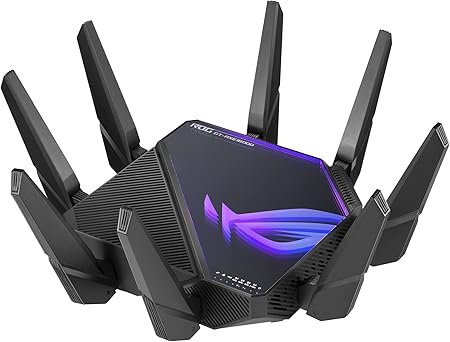
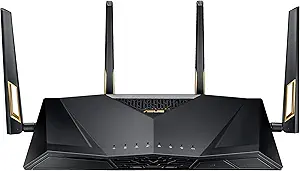
Aesthetic design reveals a sharp philosophical divergence between the two brands. Asus frequently leans into aggressive, stealth-inspired, and gamer-centric motifs characterized by sharp angular chassis, prominent external antenna arrays, and customizable Aura RGB lighting on its higher-tier models. While these designs prioritize optimal heat dissipation via extensive venting and mechanical flexibility through rotatable high-gain antennas, their overt tech-forward look can be difficult to integrate into traditional living room decor without attracting undue visual attention.
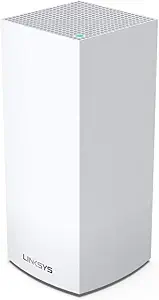
Linksys emphasizes architectural discretion and residential elegance, especially within its signature Velop vertical tower format. With clean, matte-white or matte-black monoliths concealing internal antenna arrays, Linksys units are purposefully engineered to sit inconspicuously on open shelves, console tables, and countertops—locations that naturally improve wireless propagation. While Asus delivers practical mechanical design oriented around thermal efficiency and physical port density (frequently including 2.5G and 10G Ethernet ports), Linksys wins decisively on modern living-space integration and refined, unobtrusive industrial styling.