Asus vs Arris: Overview
Comparing Asus and Arris helps you determine which brand is best suited for your needs in Wi-Fi Routers. Both brands offer strong choices depending on your budget and key feature requirements.
Key Features & Comparison
Evaluate factors such as build quality, warranty, customer satisfaction, and total value before making your final purchase choice between Asus and Arris.
Features
The feature sets of Asus routers are among the most comprehensive and flexible in the consumer networking industry, driven by the mature AsusWRT operating system. Power users gain out-of-the-box access to commercial-grade security via Trend Micro-powered AiProtection, advanced Adaptive QoS capable of application-specific prioritization, dual-WAN failover support, and integrated VPN client/server functionality supporting OpenVPN and WireGuard. Furthermore, Asus caters aggressively to the enthusiast community by supporting custom open-source firmware like Asuswrt-Merlin and offering dedicated mobile gaming optimization tools, dynamic port forwarding, and USB ports that support network-attached storage (NAS) and cellular backup dongles.
Arris, by comparison, takes a far more utilitarian and minimalist approach to feature integration, focusing primarily on seamless broadband delivery rather than deep local network manipulation. The SURFboard line is engineered with an emphasis on DOCSIS 3.1 channel bonding, solid OFDM/OFDMA support, and fundamental Wi-Fi 6/6E radio distribution. Software features are typically managed via streamlined mobile applications (such as the SURFboard Central app), which provide basic parental controls, network naming, client lists, and guest network creation. While Arris products lack the deep packet inspection, third-party firmware support, and complex routing tables offered by Asus, they provide essential features that execute reliably without requiring networking expertise or routine manual configuration.
Performance
In pure throughput metrics, latency mitigation, and multi-client handling under heavy concurrent loads, Asus standalone routers consistently outperform Arris alternatives. Asus equips its performance routers with high-clock multi-core processors, copious RAM, and multi-gigabit WAN/LAN ports (frequently offering 2.5Gbps and 10Gbps interfaces on mid-to-high tier units). This robust processing overhead prevents bufferbloat during intensive data transfers, simultaneous 4K/8K media streaming, and competitive low-latency gaming. Furthermore, Asus’s RF front-end implementation—often featuring high-power external amplifiers and beamforming matrices—delivers expansive range and maintains higher data rates at extended distances, especially in environments with heavy structural interference.
Arris routers and gateways perform admirably within standard residential consumption profiles, but their architecture is optimized for ISP throughput compliance rather than extreme internal switching speeds. Arris gateways deliver rock-solid downstream and upstream speeds directly from the coaxial line, showcasing excellent RF engineering at the DOCSIS physical layer to maximize subscribed bandwidth. However, under synthetic stress tests involving heavy local LAN-to-LAN file transfers or ultra-dense client environments, Arris hardware can exhibit higher jitter and less effective dynamic bandwidth throttling than Asus. While Arris handles typical whole-home streaming and teleconferencing flawlessly, Asus demonstrates clear performance superiority in edge-case, high-concurrency, and latency-sensitive deployments.
Design
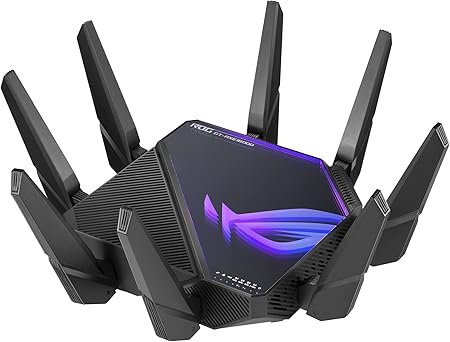
The aesthetic and physical design language of Asus routers leans heavily toward modern, aggressive tech styling, frequently influenced by their Republic of Gamers (ROG) and TUF Gaming hardware divisions. Asus products are characterized by sharp angles, matte black and textured plastics, customizable Aura RGB lighting, and an array of external, multi-directional antennas. From an engineering and thermal perspective, these enclosures prioritize extensive passive ventilation arrays and large internal heatsinks to dissipate heat generated by overclocked processing chips. While this design facilitates optimal antenna positioning and component longevity, the conspicuous aesthetic can feel visually disruptive in traditional home living spaces.
Arris approaches physical design with a conservative, appliance-like ethos intended to blend into home decor without drawing attention. The SURFboard lineup typically features compact, upright tower enclosures with smooth matte white or dark finishes, discreet LED status lights, and entirely internal antenna arrays. This monolithic vertical form factor minimizes desk and shelf footprint while leveraging natural convection for thermal management. Although the internal antennas slightly restrict the ability to physically direct Wi-Fi beams, the clean, professional, and unassuming industrial design of Arris hardware makes it significantly more palatable for mainstream users who prefer their network infrastructure to remain invisible.