Pioneer vs MTX : Overview
Comparing Pioneer and MTX helps you determine which brand is best suited for your needs in Subwoofers. Both brands offer strong choices depending on your budget and key feature requirements.
Key Features & Comparison
Evaluate factors such as build quality, warranty, customer satisfaction, and total value before making your final purchase choice between Pioneer and MTX .
Design/Look
When examining visual and structural aesthetics, MTX subwoofers are recognized for their unapologetic, aggressive, and industrial styling. Models such as the legendary JackHammer or the popular Terminator and 55 Series feature bold, raised-dustcap branding, massive rubber surrounds, and heavy-duty stamped or cast aluminum baskets finished in textured black crinkle paint. MTX leans heavily into the classic American muscle aesthetic, where the physical mass and mechanical brutality of the subwoofer are meant to be showcased through plexiglass enclosures or exposed trunk builds. Their heat sinks and motor structures are visually prominent, highlighting functional cooling systems like Spider Plateau Venting with a raw, purposeful finish that appeals to enthusiasts seeking a rugged, intimidating presence.
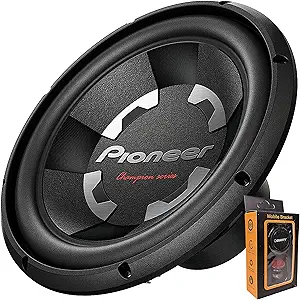
In contrast, Pioneer emphasizes a sleeker, more refined, and contemporary design philosophy that integrates seamlessly into modern vehicle interiors. Pioneer subwoofers, particularly within the Champion and D-Series lines, often incorporate continuous-profile cones made of composite materials like interlaced basalt and carbon-fiber reinforced IMPP (Injection Molded Polypropylene). The visual profile is clean and streamlined, frequently highlighted by subtle gunmetal accents, flush-mounted gaskets, and minimalist logos. Pioneer also places a high priority on versatile form factors, excelling in the shallow-mount (IB-Flat) category with low-profile stamped baskets designed to slip under truck seats without looking out of place. While MTX celebrates raw mechanical girth, Pioneer offers an engineered, space-efficient sophistication suited for seamless OEM integration.
Affordability
From a cost-to-performance perspective, both brands offer accessible entry points, but their value structures differ in execution and product tiering. MTX frequently dominates the extreme budget-bundle space, famously offering pre-loaded dual enclosures, such as the Terminator TNP212D2 system, paired with a matching amplifier at exceptionally low consumer price points. For entry-level buyers wanting a complete, high-output setup without spending time matching impedances or sourcing separate hardware, MTX provides an unbeatable turnkey economy. However, higher-end MTX models jump significantly in price due to their sheer physical mass, larger voice coils, and heavy magnet structures, which require substantial amplifier power that also increases the total system build cost.
Pioneer takes a more granular approach to affordability, providing exceptional individual component value across an extensive price ladder. Rather than focusing primarily on bundled systems, Pioneer optimizes standalone driver manufacturing through high-volume, automated production efficiencies. Drivers in the Champion Series routinely offer robust power handling—often 300 to 500 watts RMS—at price points that undercut much of the competition driver-for-driver. Furthermore, Pioneer's shallow-mount options deliver significant affordability relative to custom fabrication costs; because these drivers require minuscule air space, buyers save money on specialized custom fiberglass work or oversized timber boxes. Pioneer consistently delivers reliable individual components that offer better thermal and mechanical tolerances per dollar invested.
Reputation
MTX Audio has long cemented its reputation as a pioneer in the American SPL (Sound Pressure Level) and car audio boom of the 1980s and 1990s. Renowned for its "big bass, no compromises" ethos, MTX built a dedicated subculture around durability, brute-force engineering, and jaw-dropping SPL showpieces like the 300-pound JackHammer. Enthusiasts perceive MTX as a core, street-level bass brand that values raw power, chest-thumping volume, and rugged mechanical reliability over clinical acoustic measurement. This legacy grants MTX tremendous credibility among car audio traditionalists who equate bass performance with moving air, vibrating sheet metal, and surviving heavy thermal abuse at high outputs.
Pioneer carries a reputation anchored in global consumer electronics dominance, technical precision, and audio fidelity. Originating as a specialized audio speaker company in Japan, Pioneer has built decades of brand equity across home audio, professional DJ equipment, and mobile electronics. In the subwoofer arena, consumers and industry professionals associate Pioneer with consistency, cutting-edge composite material science, and clean industrial quality control. While MTX is viewed as an assertive bass specialist, Pioneer is perceived as an expansive engineering powerhouse whose products undergo rigorous environmental and computational testing. This broader reputation assures consumers of well-rounded, fail-safe performance, broad warranty support, and predictable acoustics.
Sound Quality
The acoustic output of MTX subwoofers is engineered primarily for impact, visceral punch, and low-end extension. These woofers excel at producing the resonant, high-decibel rumble characteristic of hip-hop, dubstep, and modern electronic tracks. Featuring soft surrounds, heavy moving mass, and extended voice coils, MTX drivers excel when placed inside ported enclosures tuned to hit hard and loud in the 35Hz to 55Hz spectrum. However, this focus on acoustic mass and excursion comes with trade-offs in clinical precision. During fast, transient-heavy tracks—such as complex double-kick drumming in metal or intricate jazz basslines—MTX woofers can exhibit slight overhang and group delay, resulting in a sound profile that is more boomy and room-filling than analytically articulate.
Pioneer subwoofers, conversely, prioritize linear frequency response, transient control, and musical articulation over sheer decibel delivery. Leveraging rigid, lightweight composite cones, Pioneer woofers rapidly respond to sudden input shifts, preserving the nuance and timbre of real instruments. While they can still achieve impressive output levels—especially in the Champion Series—Pioneer woofers tend to blend more transparently with mid-bass door speakers, delivering a cohesive front-stage image rather than drawing attention exclusively to the trunk. Pioneer's performance in compact sealed enclosures delivers tight, punchy, and controlled bass notes with minimal harmonic distortion, making them the preferred choice for critical listeners seeking balance, versatility, and musical realism across varied audio genres.