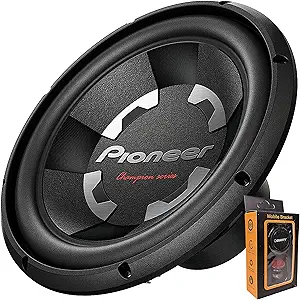
Pioneer vs KICKER: Overview
Comparing Pioneer and KICKER helps you determine which brand is best suited for your needs in Subwoofers. Both brands offer strong choices depending on your budget and key feature requirements.
Key Features & Comparison
Evaluate factors such as build quality, warranty, customer satisfaction, and total value before making your final purchase choice between Pioneer and KICKER.
Design/Look
KICKER embraces an aggressive, modern aesthetic characterized by bold geometries and high-impact branding. The brand is renowned for its iconic square subwoofers, most notably the Solo-Baric L7 series, which provides roughly 20% more surface area than a circular woofer of equal diameter while lending vehicles an industrial, performance-oriented look. Even KICKER's traditional round models feature prominent ribbed surrounds, high-contrast stitching, and thick, injection-molded polypropylene cones with signature red or grey accents. Their enclosures, whether shallow-mount truck boxes or dual ported systems, utilize thick MDF wrapped in rugged black carpeting with embroidered logos, signaling durability and raw power directly to car audio enthusiasts who want their audio hardware to be seen and admired.
Pioneer takes a significantly more understated, OEM-plus design route, leaning toward sleek, utilitarian minimalism that integrates effortlessly into stock vehicle interiors. Their consumer subwoofers feature clean, dark, mica-injected or carbon-reinforced IMPP (Injection Molded Polypropylene) composite cones with subtle, monochromatic debossed logos rather than loud badges. Pioneer excels exceptionally in the design of ultra-shallow, space-saving enclosures, utilizing innovative enclosed-basket structures and dual-spider layouts that maximize air displacement within extraordinarily low mounting depths. While Pioneer lacks the dramatic, competition-ready visual flair of KICKER's square cones, its clean industrial geometry and stealthy integration make it ideal for drivers seeking clean, invisible bass setups that don't monopolize trunk space.
Affordability
When analyzing price-to-performance across tiers, KICKER positions itself primarily in the upper-budget to premium enthusiast brackets. While their entry-level Comp and CompC lines offer accessible gateway points for budget-conscious buyers, KICKER's most desirable hardware—such as the CompQ and Solo-Baric L7S/L7T models—commands premium price tags due to specialized patented tooling, massive cast-aluminum baskets, and advanced thermal management systems. Furthermore, KICKER's high-excursion designs generally require robust, dedicated amplification and heavy-gauge wiring kits to run properly, driving up the total system investment for consumers who want to extract the hardware's full potential.
Pioneer firmly dominates the entry-level and mid-range affordability spectrum, making it one of the most cost-effective entry points into aftermarket car audio. Their Champion Series and A-Series subwoofers deliver formidable thermal handling and dependable continuous power handling (RMS) at price points noticeably below comparable KICKER models. Furthermore, Pioneer's shallow-mount pre-loaded enclosures offer exceptional value by combining driver, tuned box, and ease of installation into low-cost packages that do not require bespoke fabrication. For everyday commuters seeking impactful low-frequency reinforcement without a major financial layout, Pioneer consistently delivers a higher bass-per-dollar ratio.
Reputation
KICKER holds an iconic, near-legendary status within SPL (Sound Pressure Level) competition circuits and American bass culture. Founded in Oklahoma in 1980 with the invention of the original full-range mobile stereo enclosure, the company established a decades-long legacy centered on high-output bass, physical impact, and rugged, road-ready durability. Enthusiasts view KICKER as an uncompromising, bass-first manufacturer that prioritizes cone area, thermal resilience, and mechanical suspension limits designed to withstand sustained abuse. This gives the brand an intensely loyal following among truck owners, off-road enthusiasts, and car audio hobbyists who demand loud, visceral sound reinforcement.
Pioneer commands massive global prestige as an electronics and acoustic engineering titan, with over eight decades of innovations spanning home audio, DJ gear, and in-vehicle electronics. Rather than catering exclusively to bass-head culture, Pioneer is recognized as a dependable, highly versatile mainstream manufacturer whose car audio components are built to strict Japanese quality-control standards. Their reputation revolves around reliability, long product lifespans, and technical consistency across mass manufacturing. While some audiophiles view Pioneer as more commercial and less specialized than boutique bass brands, its engineering prowess and widespread OEM manufacturing partnerships ensure instant trust and consumer peace of mind worldwide.
Sound Quality
KICKER subwoofers are explicitly engineered to deliver physical, high-energy low end with immense punch and transient snap. With models tuned for expansive excursion and stiff suspension compliance, KICKER drivers produce a heavy, pressurized bass response that excels in genres like modern hip-hop, electronic dance music, and modern metal. However, this focus on maximum SPL and tactile impact sometimes leads to a slightly colored low end with an emphasis around the 45Hz to 60Hz resonant peaks, particularly when paired with the brand's pre-fabricated vented enclosures. While high-tier lines like the CompQ achieve admirable fidelity, the prevailing KICKER sound signature prioritizes aggressive slam and volumetric output over delicate nuance.
Pioneer emphasizes linearity, acoustic balance, and musical integration over pure, bone-jarring output. Utilizing rigid composite cones that resist unwanted flex and breakup under load, Pioneer subwoofers maintain tight control across upper bass and mid-bass transition frequencies, rendering rapid basslines in classic rock, jazz, and acoustic tracks with satisfying articulation. Their frequency response curves in sealed enclosures tend to be flatter, providing a more transparent reproduction of the original recorded material. Although Pioneer lacks the low-octave physical dominance and sub-30Hz theatrical rumble that high-end KICKER setups deliver, it provides a more cohesive, listener-friendly tonal balance for diverse listening habits.
Compare current retail pricing, active promotions, and verified stock availability directly from authorized stores:
Compare current retail pricing, active promotions, and verified stock availability directly from authorized stores: