Pioneer vs Bose: Overview
Comparing Pioneer and Bose helps you determine which brand is best suited for your needs in Subwoofers. Both brands offer strong choices depending on your budget and key feature requirements.
Key Features & Comparison
Evaluate factors such as build quality, warranty, customer satisfaction, and total value before making your final purchase choice between Pioneer and Bose.
Design/Look
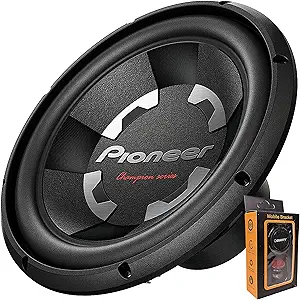
Pioneer embraces a utilitarian, industrial aesthetic that prioritizes functional durability and thermal management across its subwoofer lineup. Whether examining their aftermarket car audio enclosures or their home theater powered subwoofers, Pioneer designs favor robust MDF construction, hard-wearing textured vinyl or carpet wraps, and prominent grilles meant to withstand high excursion and physical abuse. The look is distinctly hardware-centric, often showcasing exposed driver surrounds, bold brand badging, and aggressive heat-sink fins on plate amplifiers. While this unpretentious engineering approach appeals to performance-focused enthusiasts who prefer seeing the mechanical muscle of their audio gear, it lacks the interior design cohesion required for upscale modern living spaces.
Conversely, Bose treats subwoofer design as an extension of contemporary luxury furniture, crafting ultra-compact, lifestyle-friendly enclosures like the Bass Module 700. Featuring seamless curved profiles, monolithic contours, and acoustically transparent or tempered-glass top panels, Bose subwoofers are intentionally engineered to blend invisibly into high-end living rooms or stand as understated design accents. Bose leverages proprietary acoustic waveguide technology and vibration-canceling dual opposed drivers, which mechanically eliminates cabinet resonance and allows the enclosures to be much smaller and sleeker without vibrating across the floor. Where Pioneer designs for rugged endurance and high thermal headroom, Bose focuses on high aesthetic integration and space-efficient form factors.
Affordability
Pioneer positions itself as a market leader in high-value, accessible performance, offering an exceptionally low barrier to entry across automotive, marine, and home audio segments. With a substantial portion of their passive driver catalog and entry-level powered subwoofers priced affordably, Pioneer allows budget-conscious consumers to assemble competent bass-reinforcement setups without significant capital investment. The brand maximizes price-to-performance efficiency by utilizing proven, cost-effective manufacturing techniques—such as stamped steel baskets, paper/polypropylene composite cones, and standardized Class D plate amplifiers—ensuring consumers get measurable acoustic output per dollar spent.
Bose operates exclusively in the premium consumer tier, attaching luxury price tags to its subwoofer systems that reflect specialized acoustic research and aesthetic development rather than sheer raw materials. Bose bass modules typically cost several times more than an equivalent Pioneer home subwoofer and are rarely sold as open-architecture, standalone components. Instead, they require investment into the broader Bose smart home ecosystem or soundbar framework, substantially elevating the total cost of ownership. While Pioneer rewards the consumer seeking maximum raw decibels and wattage per dollar, Bose targets the buyer willing to pay a heavy premium for compact miniaturization, industrial styling, and turnkey wireless ease of use.
Reputation
Pioneer holds an iconic reputation rooted in grassroots audio engineering, legacy consumer electronics, and automotive bass culture. Among DIY enthusiasts, car audio fabricators, and pragmatic home theater builders, Pioneer is venerated as a workhorse brand that delivers honest specifications, dependable build quality, and extreme reliability under continuous load. Their legacy spans decades of technological milestones—including their legendary TAD professional monitoring division and premier Elite series—which grants the brand immense credibility among technical audiophiles who evaluate equipment based on transducer dynamics, cone materials, and amplifier topology.
Bose carries a fundamentally different yet universally recognizable brand reputation, recognized globally as a pioneer in psychoacoustics and consumer-centric lifestyle convenience. Rather than courting traditional spec-sheet hobbyists, Bose has built decades of brand equity among the general public through intuitive consumer products and proprietary audio processing. While audiophile purists occasionally critique Bose for its closed ecosystems and lack of published technical specifications (such as frequency response curves and signal-to-noise ratios), the brand enjoys immense trust from mainstream consumers who value reliable plug-and-play usability, prestige marketing, and consistent customer support over technical customizability.
Sound Quality
Pioneer subwoofers deliver an acoustic signature characterized by physical presence, traditional low-end authority, and high output potential. Built around generous driver sizes and substantial box volumes, Pioneer units are capable of generating deep, visceral sub-bass frequencies and sharp mid-bass slam that is ideal for dynamic movie explosions and electronic music. In home theater settings, their ported designs move large amounts of air, providing tangible room pressurization. However, depending on the specific model and tuning, entry-level Pioneer subs can sometimes exhibit minor port chuffing or loose overhang during rapid acoustic bass passages, requiring careful crossover calibration and receiver equalization to achieve ideal transient speed.
Bose approaches sound reproduction through aggressive digital signal processing (DSP) and proprietary psychoacoustic algorithms, engineering a clean, tightly controlled bass response that defies the physical dimensions of its cabinets. Using dual-opposed driver configurations and QuietPort technology, Bose modules eliminate distortion, cabinet vibrations, and turbulent airflow, yielding smooth, musical bass that blends seamlessly into the soundstage. While Bose achieves remarkable tonal balance and eliminates harsh resonance at typical listening volumes, it cannot circumvent the laws of physics entirely; it relies on dynamic limiting circuits that compress the lowest sub-audible frequencies at extreme volumes, lacking the ultimate subterranean extension and raw SPL impact that larger Pioneer enclosures naturally provide.