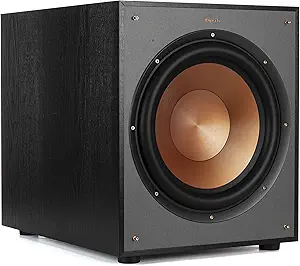





Klipsch vs KEF: Overview
Comparing Klipsch and KEF helps you determine which brand is best suited for your needs in Subwoofers. Both brands offer strong choices depending on your budget and key feature requirements.
Key Features & Comparison
Evaluate factors such as build quality, warranty, customer satisfaction, and total value before making your final purchase choice between Klipsch and KEF.
Design/Look
The aesthetic philosophies of Klipsch and KEF represent two entirely distinct approaches to home audio integration. Klipsch subwoofers are unapologetically bold, industrial, and theatrical, immediately recognizable by their signature spun-copper Cerametallic or thermoformed crystalline polymer (TCP) woofers offset against textured black wood-grain vinyl cabinets. The visible driver hardware, flared front- or rear-firing ports, and prominent retro-modern badges make Klipsch units stand out as aggressive centerpieces rather than understated room fixtures. While their Reference and Reference Premiere cabinets are sturdy and acoustically inert, their sheer physical footprint and masculine, home-theater-first visual design can easily overpower minimalist living spaces or clash with modern interior decor.
Conversely, KEF embraces a sophisticated, sculptural design language rooted in contemporary European minimalism. Renowned for architectural elegance, models in KEF's Kube series and the ultra-compact KC62/KF92 lines feature seamless unibody aluminum enclosures, curved acoustic baffles, and premium finishes in matte black, crisp white, or fabric-wrapped grilles. KEF specializes in micro-subwoofer engineering, utilizing technologies like Uni-Core force-canceling driver arrays to pack immense transducer surface area into footprint-saving cubes scarcely larger than a soccer ball. For homeowners seeking a high-performance subwoofer that discreetly blends into luxury living spaces or complements designer interiors, KEF’s refined, jewelry-like build quality stands in a completely different aesthetic tier than Klipsch's rugged utility.
Affordability
When evaluating pricing structures and raw output-per-dollar metrics, Klipsch decisively commands the high-value consumer market. Klipsch structures its catalog across accessible tiers, from the budget-friendly Reference series to the mid-tier Reference Premiere line, frequently offering massive seasonal discounts across major retail channels. For consumers working within strict budgetary constraints, a Klipsch 10-inch or 12-inch ported subwoofer delivers tremendous low-frequency SPL, robust internal amplification, and deep bass extension at an entry price point where KEF simply does not compete. This aggressive price-to-performance ratio makes Klipsch the perennial go-to brand for mainstream home theater builders who prioritize maximum cinematic impact without stretching into audiophile pricing.
KEF positions itself firmly in the premium and luxury audio brackets, reflecting its intensive acoustic engineering, proprietary digital signal processing, and high-end materials. Even entry-level offerings like the Kube series command a price premium over comparable Klipsch models, while technological showcases like the KC62 and KF92 require substantial four-figure investments. While KEF subwoofers rarely offer the raw cubic-foot air displacement or maximum decibel output per dollar that Klipsch effortlessly provides, their cost is justified through advanced DSP algorithms, smart room-placement equalization, dual-opposed driver mechanics, and near-zero cabinet resonance. Consequently, Klipsch wins decisively on pure economic accessibility, while KEF targets affluent enthusiasts willing to pay a premium for compact innovation and acoustic refinement.
Reputation
Klipsch holds a legendary, near-mythic status in the American audio pantheon, widely celebrated as a pioneer of high-efficiency sound and explosive cinematic realism. Founded by audio luminary Paul W. Klipsch, the brand has spent decades cementing its reputation among home theater enthusiasts and commercial cinema installations alike. In the subwoofer arena, consumers associate Klipsch with visceral, chest-thumping energy, uncompromising dynamic range, and rugged reliability. While early generations of budget Klipsch plate amplifiers faced scrutiny regarding long-term reliability, modern iterations—particularly the redesigned Reference Premiere RP-series subwoofers—have restored consumer confidence, reinforcing the brand's standing as an industry juggernaut for accessible, high-impact entertainment.
KEF commands a prestigious reputation anchored in British acoustic science, meticulous research, and audiophile-grade high fidelity. Born out of the Kent Engineering & Foundry in 1961, KEF is globally respected for its scientific approach to speaker design, pioneered by legendary partnerships with the BBC and ground-breaking work in computer-modeled acoustic analysis. In the subwoofer sector, KEF is renowned not for brutish theatrical volume, but for technological ingenuity, pinpoint musical precision, and architectural innovation. Discerning audiophiles and design-conscious consumers hold KEF in high esteem for its transparent low-end integration, award-winning DSP development, and the ability to extract subterranean bass notes from impossibly compact enclosures.
Sound Quality
The acoustic profile of a Klipsch subwoofer is tuned for visceral impact, tactile pressure, and dramatic low-frequency effects (LFE). Utilizing ported enclosure designs, high-excursion copper woofers, and potent Class D amplification, Klipsch excels at rendering cinematic climaxes—such as explosions, engine roars, and ambient cinematic rumbles—with massive acoustic energy and room-filling slam. The physical sensation of air movement is a hallmark of the Klipsch sound. However, this focus on dynamic slam can occasionally manifest as a slight mid-bass bloom or reduced transient speed, making lower-tier Klipsch models somewhat less suited for critical two-channel music listening where tightly controlled pitch definition, instrument separation, and zero overhang are paramount.
KEF approaches low-frequency reproduction with an uncompromising commitment to surgical precision, tonal accuracy, and micro-dynamic control. Leveraging sealed cabinet configurations, dual-opposed force-canceling drivers, and sophisticated Music Integrity Engine (MIE) DSP, KEF subwoofers deliver vanishingly low harmonic distortion and blistering transient response. Bass notes start and stop instantaneously, revealing the intricate pitch textures of double basses, kick drums, and synthetic electronic tones without cabinet coloration or port turbulence. While a compact KEF subwoofer may struggle to match the sheer, wall-shaking decibel output of a massive ported Klipsch cabinet in cavernous home theaters, its acoustic integration with high-end speakers and musical transparency remain virtually unmatched in the category.
Compare current retail pricing, active promotions, and verified stock availability directly from authorized stores: