












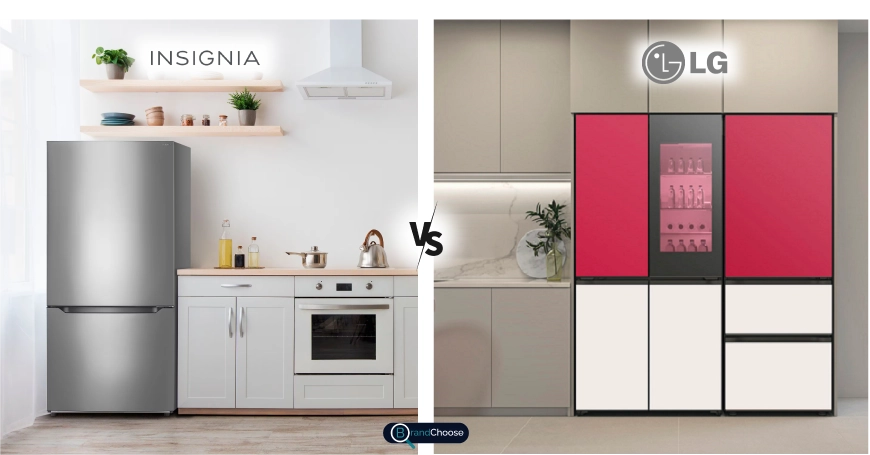
LG and Insignia cater to two very different consumer groups in the refrigerator market. LG is known for smart technology, energy efficiency, and premium cooling features, making it a go-to choice for homeowners who want cutting-edge innovation and reliability. On the other hand, Insignia—Best Buy’s in-house brand—focuses on affordable, no-frills refrigeration, designed for budget-conscious buyers who need a simple and functional appliance without extra features.
If you're in the market for a new refrigerator, should you opt for LG’s advanced cooling and smart capabilities or Insignia’s budget-friendly simplicity? Let’s break down how they compare across key aspects.
Features
When evaluating the feature ecosystems of LG and Insignia refrigerators, the comparison highlights a fundamental divide between cutting-edge smart innovation and utilitarian minimalism. LG positions itself as a technical pioneer, engineering its units with proprietary cooling architectures such as Door Cooling+ and Linear Cooling, which actively minimize internal temperature fluctuations to prolong food freshness. Higher-end LG models boast high-utility features including the InstaView glass panel, Dual Ice Makers with slow-melting Craft Ice, and integrated UVnano water disinfection. Furthermore, LG’s ThinQ platform integrates robust Wi-Fi capabilities, allowing consumers to remotely adjust temperatures, receive open-door alerts, and leverage proactive diagnostic monitoring, demonstrating a deep integration of hardware engineering and smart home connectivity.
Conversely, Insignia—Best Buy’s private-label house brand—approaches feature design with an emphasis on essential functionality and strict budget-friendliness. Rather than investing in multi-channel digital cooling or Wi-Fi microcontrollers, Insignia focuses on practical, mechanical conveniences. Their feature suite typically consists of humidity-controlled crisper bins, basic internal or external analog temperature dials, spill-proof glass shelving, and user-reversible doors that simplify installation in restricted kitchen spaces. While advanced perks like through-the-door crushed ice or smart diagnosis are virtually nonexistent across Insignia’s lineup, their engineering deliberately avoids proprietary software, resulting in lower component complexity and straightforward everyday usability that requires no learning curve.
Ultimately, the trade-off in features comes down to lifestyle requirements versus economic practicality. LG delivers a high-performance experience tailored for tech-forward households, bulk food storage, and entertainment-focused buyers who value exact climate precision and premium conveniences. However, this expansive feature set introduces higher manufacturing costs and more potential points of electronic failure over the appliance's lifespan. Insignia offers an unpretentious, bare-bones package that eliminates modern conveniences to achieve an accessible price floor, making it an ideal choice for rental properties, secondary utility spaces, or shoppers who prioritize basic preservation over connected functionality.
Performance
When evaluating refrigeration performance, LG operates in a substantially higher engineering tier than Insignia, largely driven by its proprietary cooling technology. LG outfits the majority of its lineup with advanced Smart Inverter and Linear Compressors designed to minimize internal temperature fluctuations to within roughly one degree Fahrenheit. Supported by multi-airflow vent architectures like Door Cooling+ and Linear Cooling, LG refrigerators maintain aggressive cold-air distribution, rapidly recovering baseline temperatures after the doors are opened and successfully preventing localized hot spots. In contrast, Insignia—Best Buy’s private-label house brand—relies on standardized, single-speed reciprocal compressors paired with conventional, single-evaporator static or basic forced-air systems. While Insignia units reliably achieve safe preservation baselines, their cooling cycles are subject to wider thermal swings, slower pull-down times, and less precise temperature zoning across different shelves.
The divergence in performance becomes even more pronounced when examining humidity control, freeze consistency, and recovery capacity under heavy loads. LG models frequently feature dual evaporators that isolate the airflow between the fresh food compartment and the freezer, eliminating odor transfer while maintaining optimal, elevated humidity levels in produce bins to extend food shelf life. Furthermore, LG’s freezer modules offer rapid-freeze functions and steady sub-zero retention that effectively curtails freezer burn. Insignia, engineered fundamentally for cost-efficiency, utilizes shared airflow between compartments; this often vents dry freezer air into the refrigerator cabin, leading to faster produce desiccation and higher rates of moisture-loss in perishables. Moreover, Insignia's mechanical or entry-level digital thermistors lack the granular calibration seen in LG’s multi-sensor digital networks, which actively adjust fan speeds and compressor output based on ambient room conditions and internal door-opening frequency.
Ultimately, the practical trade-off between the two brands centers on sophisticated climate stability versus utilitarian cooling. Insignia offers competent, no-frills refrigeration performance that satisfies secondary storage needs, budget apartments, or smaller households with straightforward food preservation habits. However, for demanding consumers requiring prolonged produce freshness, ultra-quiet mechanical operation, and rapid thermal recovery during frequent daily access, LG delivers a distinctly superior, high-performance platform engineered around strict thermodynamic precision.
Design
When evaluating architectural and aesthetic design in the refrigerator category, LG and Insignia represent fundamentally different engineering philosophies and target demographics. LG positions itself as an innovator in premium, lifestyle-driven industrial design, heavily investing in contemporary finishes, seamless integration, and advanced structural aesthetics. Their portfolio frequently features fingerprint-resistant PrintProof stainless steel, ultra-sleek flat door contours with pocket handles, and signature innovations like the InstaView door-in-door panel, which blends mirrored glass with internal LED illumination. Beyond external polish, LG’s internal architecture is meticulously engineered with edge-to-edge tempered glass cantilevered shelving, discreet ultra-thin ductwork (Door Cooling+), and high-efficiency recessed interior lighting that maximizes usable volume without sacrificing visual sophistication.
Conversely, Insignia—Best Buy’s proprietary house brand—champions utilitarian, function-first minimalist design engineered strictly for cost efficiency and spatial practicality. Insignia refrigerators prioritize straightforward ergonomics, typically relying on traditional top-freezer or basic French door silhouettes characterized by standard-gauge stainless steel, smooth white, or textured black finishes that lack the smudge-resistant coatings found in higher-end competitors. Internally, Insignia utilizes thick-bezel plastic-framed glass or basic wire shelving paired with bulkier, front-facing incandescent or basic LED light housings. While this structural layout foregoes the luxury feel and modular adjustability of LG, it presents an uncomplicated, robust design that is easy to wipe clean, cost-effective to produce, and intuitively laid out for rental properties, secondary garage installations, or budget-conscious primary kitchens.
The practical trade-offs between the two brands center on the balance between aesthetic ambition and mechanical simplicity. LG's design excellence comes with spatial sophistication, such as counter-depth alignments that sit flush with cabinetry and specialized compartments like the dual-ice maker Craft Ice system; however, these complex design elements introduce more potential mechanical and electronic failure points. Insignia trades away these high-tech design flourishes and micro-tolerances for mechanical simplicity, broader internal door-bin clearances, and standard dimensions that easily swap into legacy kitchen cutouts without custom cabinet modifications. Ultimately, consumers seeking a modern, statement-piece appliance with state-of-the-art spatial ergonomics will favor LG, whereas buyers prioritizing utilitarian durability, maximum clearance for tall items without motorized bins, and a no-frills physical footprint will find Insignia’s pragmatic design sufficient.
Conclusion
Choosing between LG and Insignia comes down to budget, long-term expectations, and feature preferences.
LG is the better choice for buyers who want advanced cooling technology, energy efficiency, and smart features. If you’re looking for a long-term investment with premium design and strong performance, LG provides better durability, more customization, and lower operating costs over time.
Insignia is best for budget-conscious buyers who just need a simple, functional refrigerator at the lowest possible price. It’s a great option for dorm rooms, small apartments, or secondary fridges, but it lacks advanced features and long-term durability.





