












KitchenAid and Sub-Zero are two of the most prestigious refrigerator brands, but they cater to very different audiences. KitchenAid offers a balance of premium quality and affordability, while Sub-Zero dominates the ultra-luxury segment with industry-leading food preservation technology.
If you're looking for a high-end refrigerator, should you go with KitchenAid’s practical luxury or Sub-Zero’s ultra-premium craftsmanship? Let’s break it down across key aspects.
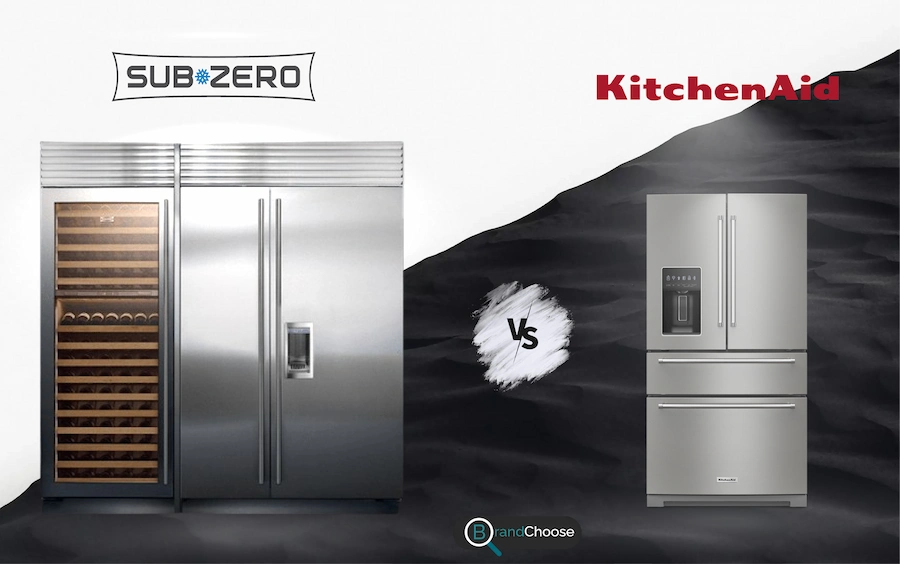
Features
When evaluating the feature ecosystems of KitchenAid and Sub-Zero, the comparison represents a divide between consumer-facing convenience technology and high-precision food preservation engineering. KitchenAid excels in experiential, lifestyle-driven features designed to enhance daily culinary workflows. Their upper-tier refrigerators frequently feature the Preserva Food Care System with dual evaporators, dedicated herb storage containers, self-close crisper drawers, and specialized temperature-controlled zones like full-extension pantry drawers with customizable presets for meats, cheeses, or cold beverages. Furthermore, KitchenAid integrates high-utility convenience tech such as measured water fills, sequential slide-away shelving to accommodate tall containers, and sophisticated LED lighting banks. These features focus primarily on organizational flexibility and everyday practical ergonomics for active home cooks.
Conversely, Sub-Zero eschews consumer novelty in favor of commercial-grade technical features engineered to dramatically extend the shelf life of food. At the heart of Sub-Zero’s feature set is their pioneer dual-refrigeration system, which employs separate, sealed compressors and evaporators for the fresh food and freezer compartments. This architectural decision prevents the transfer of odor and keeps refrigerator air humid while keeping freezer air bone-dry. Sub-Zero further outclasses mainstream luxury with its NASA-inspired ethylene gas and air purification scrubbing system, which cycles the interior air every twenty minutes to eliminate bacteria, mold spores, and food-spoiling gases. Additionally, Sub-Zero's magnetic door gaskets create a true vacuum seal, while their microprocessor controls hold temperatures within a remarkably precise one-degree variance of the set point.
The practical trade-offs regarding features boil down to accessibility versus uncompromising preservation mechanics. KitchenAid provides superior front-facing interactive technology—such as exterior through-the-door dispensing and infinitely adjustable interior hardware—at a dramatically lower price point, though its components rely more heavily on plastic assemblies and standardized cooling mechanics. Sub-Zero minimizes flashiness, often omitting exterior dispensers to preserve thermal efficiency and sleek panel-ready facades, while packing the interior with heavy-gauge metals, solid glass door options, and Wi-Fi-enabled diagnostics via their Sub-Zero Group Owner app. For consumers prioritizing modular convenience and everyday beverage access, KitchenAid’s feature architecture is exceptionally user-friendly; for those prioritizing clinical food preservation, zero-odor transfer, and robust appliance longevity, Sub-Zero’s engineering remains the industry's gold standard.
Performance
When evaluating core refrigeration performance, the fundamental difference between KitchenAid and Sub-Zero lies in their cooling architectures. KitchenAid, representing the premium-mass market, predominantly utilizes single-compressor systems with dual evaporators in its higher-end freestanding and built-in models, branded under its ExtendFresh Temperature Management System. This setup independently manages humidity and temperature across the fresh food and freezer compartments, successfully minimizing odor transfer and providing reliable everyday climate control. However, Sub-Zero represents the pinnacle of commercial-grade residential refrigeration by pioneering the dual-compressor, dual-evaporator system. By completely mechanically separating the sealed systems, Sub-Zero eliminates any shared air between the freezer's dry, arctic environment and the refrigerator's humid, cool climate, drastically outperforming KitchenAid in preventing freezer burn and maintaining pinpoint temperature stability within one degree of the setpoint.
Beyond basic temperature regulation, the two brands diverge significantly in advanced food preservation technologies. Sub-Zero integrates an active NASA-developed air purification system that scrubs the internal environment of ethylene gas every twenty minutes, effectively delaying the over-ripening of produce while neutralizing mold spores, viruses, and bacteria. In contrast, KitchenAid relies primarily on passive preservation, using its Produce Preserver charcoal filters to absorb ethylene, which requires manual replenishment and lacks active air-scrubbing mechanics. Additionally, Sub-Zero's mechanical execution features magnetic door gaskets that form a true vacuum seal, preventing thermal leakage during power fluctuations, whereas KitchenAid relies on standard compression gaskets which, while durable, are less effective at long-term thermal retention.
The practical trade-offs regarding performance come down to precision versus cost-to-benefit utility. KitchenAid delivers robust, reliable performance that satisfies the demands of standard culinary households, maintaining consistent temperatures that keep common groceries fresh well beyond budget appliances, all at a fraction of the investment. Conversely, Sub-Zero’s engineering targets preservation longevity measured in weeks rather than days, making it the superior performer for consumers who store high-value perishable goods, delicate produce, or aged ingredients. For uncompromising thermal precision, superior airflow circulation, and cutting-edge food longevity, Sub-Zero operates in an elite tier, while KitchenAid remains a highly capable performer tailored for practical, high-end family living.
Design
In terms of industrial design and structural engineering, Sub-Zero operates in the ultra-luxury tier, setting the gold standard for integrated and built-in refrigeration. Sub-Zero units are renowned for their proprietary dual-compressor, dual-evaporation system, which physically separates the airflow between the refrigerator and freezer to optimize humidity and prevent odor transfer. From a physical design perspective, Sub-Zero excels with heavy-gauge stainless steel construction, commercial-grade hinges that allow panel-ready doors to sit completely flush with surrounding cabinetry, and signature horizontal louvers on classic models. The brand's focus on technical longevity is matched by minimalist interior architecture, featuring nano-coated spill-proof glass shelving, magnetic door seals with military-grade tightness, and advanced NASA-inspired air purification scrubbers integrated seamlessly into the cabinet walls. Every design choice in a Sub-Zero prioritizes food preservation engineering and architectural cohesion, making it a design staple for bespoke kitchens.
KitchenAid approaches design with an eye toward upscale, commercial-inspired aesthetics targeted at mainstream and premium consumers without reaching ultra-luxury price brackets. Visually, KitchenAid’s signature identity relies on its distinct PrintShield stainless steel finish, knurled metal handles with red medallion end caps, and platinum-colored interiors highlighted by cascading LED lighting strips. While visually striking and tactilely robust, KitchenAid’s architecture predominantly uses single-compressor, dual-evaporator systems on its high-end models, which represents a step down in engineering isolation compared to Sub-Zero’s dedicated dual systems. KitchenAid focuses heavily on functional ergonomics, featuring soft-close crisper drawers, wood-look accents on storage bins, and external multi-door configurations that cater to active, high-traffic households. However, its built-in and counter-depth tolerances do not achieve the zero-clearance, completely invisible panel integration that characterizes Sub-Zero's engineering.
The design trade-off between the two brands centers on bespoke customization versus mass-market functionality. Sub-Zero provides an uncompromising, architect-driven design language designed to disappear into high-end millwork, supported by superior internal components engineered to last two decades or more. The caveat is an exceptionally high cost of entry and a reliance on clean, utilitarian interior layouts. KitchenAid delivers dramatic interior aesthetics, accessible ergonomic multi-drawer configurations, and a robust commercial look at a fraction of the cost, but relies on more plastic components and looser installation clearances. For buyers prioritizing seamless cabinetry alignment, true dual-system refrigeration engineering, and timeless minimalism, Sub-Zero is the clear leader; for homeowners seeking an assertive, professional-style visual footprint with modern everyday usability, KitchenAid offers an appealing balance of style and value.
Conclusion
Two premium brands, two different experiences.
Deciding between KitchenAid and Sub-Zero comes down to your budget and what matters most to you. KitchenAid gives you premium quality, smart features, and stylish designs without the sky-high price. Sub-Zero, though, is all about next-level freshness, crazy durability, and custom-built luxury.
So, if you want a high-end refrigerator with great value, KitchenAid is an excellent choice, but if you’re investing in a long-term, no-compromise refrigeration system, Sub-Zero is in a league of its own.


