Omen vs Ibuypower: Overview
Comparing Omen and Ibuypower helps you determine which brand is best suited for your needs in Prebuilt PC. Both brands offer strong choices depending on your budget and key feature requirements.
Key Features & Comparison
Evaluate factors such as build quality, warranty, customer satisfaction, and total value before making your final purchase choice between Omen and Ibuypower.
Features
In terms of system-level features, HP Omen distinguishes itself through the Omen Gaming Hub, a tightly integrated software platform that controls hardware metrics, dynamic undervolting, memory overclocking, and lighting profiles. Omen chassis—particularly the 40L and 45L series—frequently incorporate specialized, proprietary innovations such as the patented "Cryo Chamber," an exterior liquid cooling radiator bay that isolates CPU heat dissipation from the rest of the chassis. Furthermore, Omen motherboards and components are tailored to meet stringent energy compliance standards, offering advanced power-state controls, though sometimes restricting BIOS customizability to basic XMP toggles and limited voltage tuning.
iBUYPOWER counters by delivering feature sets native to independent component ecosystems, which generally affords greater enthusiast control. Because iBUYPOWER equips their systems with standard retail motherboards (such as B650 or Z790 chipsets), users gain access to comprehensive retail-grade BIOS environments with unconstrained overclocking profiles, detailed fan curve curves, and PCIe lane allocation controls. Additionally, iBUYPOWER offers unique proprietary visual features, such as their patented Snowblind chassis with integrated transparent side-panel LCD displays. While iBUYPOWER systems often lack a single consolidated proprietary software suite comparable to Omen's, they provide higher native connectivity options, multiple standard M.2 expansion slots, and non-proprietary RGB headers (5V ARGB/12V RGB) that seamlessly interface with open-source lighting software.
Performance
The raw compute performance of both Omen and iBUYPOWER systems is primarily dictated by the specific tiers of CPU and GPU selected, yet systemic performance differences emerge through thermal management and power delivery engineering. HP Omen models, particularly the modern 40L and 45L variants, leverage carefully engineered airflow chambers and OEM liquid cooling solutions to sustain long-duration boost clocks on Intel Core and AMD Ryzen processors. However, baseline Omen 25L configurations have historically faced thermal throttling under sustained multi-threaded workloads due to compact internal volumes and restrictive intake fascias. In premium models with the Cryo Chamber, CPU thermal headroom is among the best in the prebuilt sector, translating into rock-solid thermal dissipation under heavy compute or high-frame-rate rendering.
iBUYPOWER platforms, by virtue of using standard high-airflow ATX cases (often packed with multiple 120mm or 140mm intake and exhaust fans), frequently maintain cooler overall ambient chassis temperatures, directly benefiting GPU thermal performance and VRM temperatures. Because iBUYPOWER incorporates standard retail power supplies and motherboards, power delivery limits (such as Intel's PL1 and PL2 parameters) are often set to uninhibited board-default levels rather than conservative OEM targets. This allows iBUYPOWER rigs to extract every marginal percentage point of performance from high-wattage components, provided the chosen cooling option—such as a 240mm or 360mm AIO—is appropriately matched to the processor tier.
Design
From an aesthetic and industrial design standpoint, HP Omen embodies a minimalist, refined sensibility tailored for modern desktop setups. Omen towers present a sleek, uniform matte black or white finish, subtle geometric accents, and tempered glass side panels with standardized tool-less entry mechanisms. The internal layout of modern Omen chassis reflects meticulous OEM engineering, featuring integrated cable channels, dedicated bracket supports to prevent modern GPU sag, and uniform lighting integration. The chassis feel rigid, structurally dense, and deliberately proportioned, appealing directly to users who favor an understated, mature hardware aesthetic over aggressive gaming motifs.
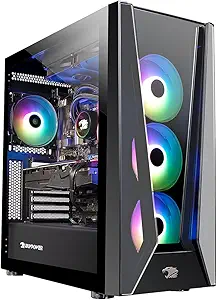
iBUYPOWER embraces a more conventional enthusiast gaming design language centered around high-airflow mesh front panels, dynamic panoramic glass enclosures, and expressive ARGB illumination. Their chassis designs range from conventional dual-chamber cases to expansive panoramic glass setups that proudly showcase internal retail hardware. However, because iBUYPOWER relies on assembly line builders working with varying third-party hardware combinations, cable management execution and internal layout symmetry can vary across specific production runs. The major architectural advantage of iBUYPOWER’s design is long-term serviceability: every standoff, bracket, and mounting point strictly adheres to ATX standards, making full component migrations, motherboard swaps, and custom loop installations vastly simpler than in Omen chassis.