Omen vs CyberpowerPC: Overview
Comparing Omen and CyberpowerPC helps you determine which brand is best suited for your needs in Prebuilt PC. Both brands offer strong choices depending on your budget and key feature requirements.
Key Features & Comparison
Evaluate factors such as build quality, warranty, customer satisfaction, and total value before making your final purchase choice between Omen and CyberpowerPC.
Features
In terms of system features and software integration, HP Omen establishes a distinct edge through proprietary ecosystem development. Central to this experience is the Omen Gaming Hub, a sophisticated, centralized utility that provides granular fan curve manipulation, intelligent network packet prioritization, dynamic undervolting capabilities, and synchronized RGB management via Omen Light Studio. Furthermore, modern Omen machines incorporate specialized hardware features such as tool-less chassis entry, integrated cable routing channels, and the patented Cryo Chamber cooling architecture found on flagship models, which isolates liquid cooling radiators from main chamber heat. These cohesive, OEM-level features streamline system management for users who prefer unified software oversight.
CyberPowerPC approaches features from a modular hardware perspective rather than an integrated software standpoint. Instead of relying on proprietary utilities, CyberPowerPC systems utilize the native BIOS interfaces and motherboard utilities provided by retail board partners such as ASUS, MSI, Gigabyte, or ASRock. This approach grants users unrestricted access to standard XMP/EXPO memory profiles, full PCIe lane configurations, and standard ARGB lighting headers compatible with open-source software like OpenRGB. While CyberPowerPC lacks a single, polished proprietary software suite akin to the Omen Hub, it compensates by featuring standard front-panel I/O configurations, universal motherboard form factors (mATX and ATX), and diverse liquid cooling loops that utilize standard G1/4 fittings, maximizing component-level versatility.
Performance
Performance metrics between HP Omen and CyberPowerPC are shaped largely by thermal envelope management and factory hardware configurations. HP Omen models—such as the 25L, 40L, and 45L—deliver rock-solid, sustained performance under heavy gaming and workstation workloads, particularly in the 40L and 45L tiers where airflow engineering has been heavily prioritized. Omen's firmware is precisely tuned out of the box to balance decibel levels with thermal throttling thresholds, ensuring consistent frame rates without unexpected fan ramping. However, entry-level models like the 25L have historically faced thermal constraints due to compact internal volume, occasionally forcing power-limit throttling on high-TDP processors during prolonged multi-threaded operations.
CyberPowerPC, leveraging spacious, high-airflow retail chassis designs outfitted with multiple intake and exhaust fans, frequently achieves raw thermal and compute performance parity with custom-built rigs. Because CyberPowerPC uses standard retail graphics cards and retail-grade AIO liquid coolers (ranging from 120mm to 360mm radiators), their systems often exhibit higher sustained clock speeds and lower operating temperatures under continuous load. The primary performance trade-off with CyberPowerPC lies in production variance: because component sourcing fluctuates based on supply chains, two identically priced systems might feature different GPU cooling shrouds, RAM timings, or VRM designs, resulting in minor performance variations that do not occur within HP Omen’s strictly standardized production runs.
Design
Aesthetic design and chassis engineering highlight the contrasting identities of both brands. HP Omen showcases an understated, sophisticated industrial design characterized by clean geometric lines, diamond-cut logos, and a minimalist black-or-white architectural chassis. The flagship Omen 45L exemplifies superior chassis engineering with its exterior-mounted Cryo Chamber, which pulls ambient air over the CPU liquid cooler radiator rather than circulating internal chassis air, achieving a masterclass in thermal isolation. The interior architecture of Omen cases is exceptionally clean, utilizing custom metal shrouds, concealed cable routing pathways, and premium tempered glass panels that project a mature, high-end appliance aesthetic suitable for both creative studios and gaming setups.
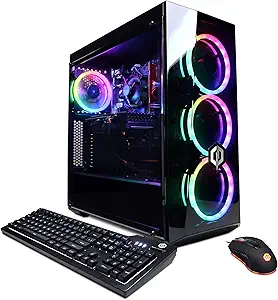
CyberPowerPC embraces a classic, aggressive PC-gamer visual language, heavily favoring panoramic dual-chamber glass cases, extensive addressable RGB lighting, and high-visibility internal layouts. Their chassis selection mirrors the most popular retail trends, often deploying custom variants of popular cases from brands like Phanteks, Lian Li, or DeepCool. While CyberPowerPC builds look striking with their vivid illumination and showcase-style component placement, internal assembly neatness can be variable; cable management depends significantly on the individual assembly technician, occasionally requiring user intervention to tuck away stray wiring harnesses. Nonetheless, for consumers who want an uninhibited, showcase-tier gaming rig with prominent component visibility, CyberPowerPC's aesthetic remains deeply appealing.