CyberpowerPC vs Thermaltake: Overview
Comparing CyberpowerPC and Thermaltake helps you determine which brand is best suited for your needs in Prebuilt PC. Both brands offer strong choices depending on your budget and key feature requirements.
Key Features & Comparison
Evaluate factors such as build quality, warranty, customer satisfaction, and total value before making your final purchase choice between CyberpowerPC and Thermaltake.
Features
CyberpowerPC’s feature landscape revolves around broad customizability and comprehensive peripheral bundling. When purchasing directly, customers can configure virtually every aspect of the machine, selecting from diverse multi-brand partnerships ranging from budget-tier silicon to high-end motherboards. Furthermore, retail configurations usually incorporate complete starter bundles with functional keyboards and mice, as well as plug-and-play driver suites. The trade-off, however, is component variance; off-the-shelf CyberpowerPC units may utilize generic green-PCB system memory or budget bronze-rated power delivery systems that lack modularity, while software management is often fragmented across various third-party vendor utilities rather than a unified ecosystem.
Thermaltake differentiates itself by leveraging a deeply unified component ecosystem governed by proprietary, synchronized software. The brand’s prebuilt machines are outfitted with proprietary TT RGB PLUS ecosystem integration, high-tier Toughpower Gold or Platinum fully modular power supplies, and robust closed-loop or open-loop liquid cooling configurations. Because Thermaltake manufactures the chassis, radiators, and fans, cable management is meticulously optimized with custom routing pathways, and maintenance features like magnetic dust filtration and structural drive cages are integrated seamlessly. Although Thermaltake limits external hardware brand experimentation, the depth and synchronicity of their internal hardware features provide a distinctly more premium operational experience.
Performance
From a raw compute perspective, CyberpowerPC delivers exceptional throughput per dollar spent. Because the company prioritizes allocating the bill of materials toward raw compute engines—namely high-tier Intel Core or AMD Ryzen processors paired with high-wattage NVIDIA GeForce RTX or AMD Radeon GPUs—their systems post impressive initial benchmark scores across modern gaming titles and multi-threaded rendering workloads. However, sustained performance can occasionally be throttled by acoustic and thermal constraints. In entry-to-mid-range units, CyberpowerPC often equips restrictive front-panel chassis with modest air coolers or 120mm liquid AIOs, which can result in thermal saturation during prolonged computational loads and consequent clock-speed throttling.
Thermaltake takes a thermally uncompromised engineering approach that prioritizes clock stability, minimal acoustic profiles, and long-term hardware longevity. Leveraging massive surface-area radiators (frequently 240mm to 360mm) and high-airflow chassis designs engineered for optimal convection, Thermaltake systems sustain maximum boost frequencies over protracted stress periods without intrusive fan noise. Furthermore, Thermaltake standardizes high-speed, low-latency DDR4 and DDR5 memory modules alongside high-throughput PCIe Gen4 NVMe storage drives, eliminating potential internal data transfer bottlenecks. Consequently, while a similarly priced CyberpowerPC rig might match Thermaltake's instantaneous compute bursts, Thermaltake consistently wins in sustained thermal dissipation and operational stability.
Design
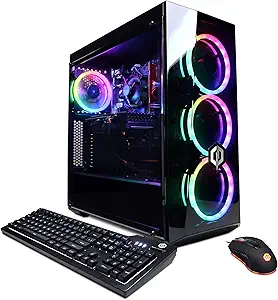
CyberpowerPC’s design philosophy spans a spectrum from standard utilitarian minimalism to aggressively gamer-centric styling. Utilizing a combination of generic OEM cases and branded third-party chassis, their machines often prioritize external flashiness through extensive addressable RGB lighting strips and tempered glass side panels. While visually striking at a glance, the interior architectural design can sometimes reflect assembly-line rushing, manifesting in bundled zip-tied wiring behind the motherboard tray and less deliberate internal component spacing. This variance means that while some high-end custom CyberpowerPC towers look pristine, retail floor models can feel somewhat generic in their tactile build quality and finish.
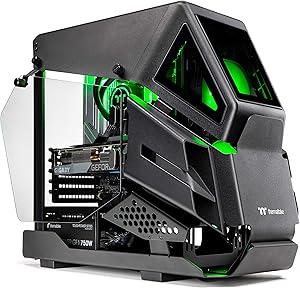
Thermaltake treats chassis design and internal presentation as an art form, making their systems instant centerpieces in any workstation or gaming setup. Utilizing iconic cases such as the open-frame Core P-series or the panoramic Tower-series, Thermaltake excels in modularity, thick-gauge steel or aluminum fabrication, and heavy tempered glass paneling. The internal geometry is purposely architectured to showcase structural liquid tubing, vertically oriented GPUs, and flawlessly routed modular braided cables. This boutique approach to industrial design not only elevates the visual luxury of the prebuilt PC, but also provides unmatched structural rigidity, superior airflow dynamics, and an exceptionally accessible platform for future hardware upgrades.