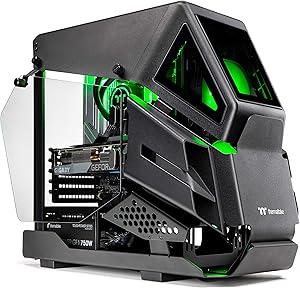
Asus vs Thermaltake: Overview
Comparing Asus and Thermaltake helps you determine which brand is best suited for your needs in Prebuilt PC. Both brands offer strong choices depending on your budget and key feature requirements.
Key Features & Comparison
Evaluate factors such as build quality, warranty, customer satisfaction, and total value before making your final purchase choice between Asus and Thermaltake.
Features
In terms of feature sets, Asus leverages its massive internal portfolio to provide unmatched software and firmware orchestration. Asus prebuilts often come equipped with the Armoury Crate suite, which allows unified control over Aura Sync RGB lighting, automated AI-driven fan profiles, and real-time hardware telemetry. Furthermore, Asus systems frequently integrate cutting-edge motherboard innovations directly from their retail boards, including SupremeFX audio processing, AI noise cancellation, and automated overclocking algorithms. The tradeoff, however, is that Asus sometimes employs semi-proprietary bracket designs, specialized power connections, or non-standard motherboard shapes in their more compact or mainstream lines, which can complicate third-party part swaps.
Thermaltake excels by treating prebuilt systems as bespoke, showcase-grade custom builds rather than mass-produced appliances. Their feature set centers on liquid cooling pedigree, regularly incorporating thick copper radiators, hardline or flexible custom tubing, high-static pressure fans, and premium tempered glass side panels. Motherboards, power supplies, and storage drives used by Thermaltake are standard ATX/Micro-ATX retail parts, ensuring zero barriers to future modular upgrades. While Thermaltake's proprietary TT RGB PLUS software can sometimes feel less unified and more resource-intensive compared to Asus's streamlined utilities, the physical feature set—highlighted by high-end liquid distribution plates and high-wattage Gold or Platinum power supplies—remains a major draw for hardware purists.
Performance
Performance delivery highlights key architectural contrasts between the mass-manufactured engineering of Asus and the custom-loop cooling prowess of Thermaltake. Asus systems, particularly the ROG Strix and ROG Hyperion series, are calibrated extensively at the factory level to extract optimal thermal-to-noise ratios. By pairing high-tier silicon with carefully tuned fan curves and customized heat sinks, Asus prebuilts sustain boost clocks reliably under heavy mixed workloads. However, lower-tier or mid-range Asus chassis can occasionally suffer from restrictive front-panel airflow, leading to higher ambient internal temperatures and louder acoustic profiles during prolonged gaming sessions.
Thermaltake builds typically possess an innate thermal and acoustic advantage during peak sustained workloads, primarily due to their superior cooling methodology. By deploying high-capacity closed-loop AIOs or full custom liquid cooling loops alongside open-frame or high-airflow cases (such as the Core or Tower series), Thermaltake keeps both the CPU and GPU exceptionally cool. This expansive thermal headroom virtually eliminates thermal throttling, allowing top-tier Intel and AMD processors, along with high-TDP NVIDIA graphics cards, to operate at their maximum theoretical clock frequencies indefinitely. While Asus offers greater algorithmic tuning out of the box, Thermaltake wins on raw thermal dissipation and sustained acoustic quietness under load.
Design
Design-wise, Asus leans heavily into a sleek, aggressive cyber-aesthetic characterized by sharp angles, integrated matte-black shielding, and subtle, sophisticated RGB diffusion. From the compact ROG Huracan to the monolithic ROG Strix G35, the design language communicates structural rigidity and premium industrial design. Asus enclosures often incorporate thoughtful functional elements such as built-in headphone cradles, carrying handles, and integrated SSD hot-swap bays. However, the internal layout of some Asus chassis can feel densely packed and industrial, prioritizing space efficiency and transportability over transparent aesthetic curation.
Thermaltake, by comparison, places visual exhibitionism at the very core of its design ethos. Known for their panoramic tempered glass enclosures, open-frame helicopter-chassis designs, and vertical GPU mounting configurations, a Thermaltake prebuilt is engineered to be a living desk centerpiece. The interior cable management is typically executed to boutique standards, showcasing color-matched coolant, illuminated water blocks, and synchronized chassis fans with dramatic flair. While this exhibition-style design requires more physical desk footprint and frequent dusting due to open-air layouts, it offers visual impact and architectural transparency that the more utilitarian Asus chassis rarely match.
Compare current retail pricing, active promotions, and verified stock availability directly from authorized stores: