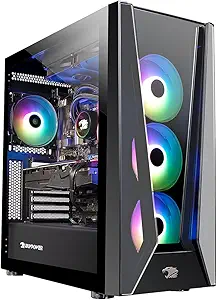
Asus vs Ibuypower: Overview
Comparing Asus and Ibuypower helps you determine which brand is best suited for your needs in Prebuilt PC. Both brands offer strong choices depending on your budget and key feature requirements.
Key Features & Comparison
Evaluate factors such as build quality, warranty, customer satisfaction, and total value before making your final purchase choice between Asus and Ibuypower.
Features
The feature sets of Asus and iBUYPOWER reflect their differing operational models, particularly in software integration and component origin. Asus systems stand out with high-end proprietary features, prominently driven by their Armoury Crate utility. This hub centralizes Aura Sync RGB, hardware telemetry, fan curve optimization, and AI-driven noise-canceling audio filters. Furthermore, Asus often integrates bespoke physical additions such as reinforced integrated GPU brackets, specialized hot-swap SSD bays, and native Wi-Fi 6E/7 antennas tuned to their own motherboard trace layouts. However, this deep software-hardware integration can feel restrictive, as Armoury Crate is historically resource-heavy, and non-standard motherboard headers can limit third-party peripheral synchronicity.
iBUYPOWER approaches features through the lens of open compatibility and physical customization. While they lack an expansive bespoke software suite on par with Asus—often relying on open-source RGB controls or the baseline utilities of whatever motherboard brand is inside—they lead significantly in structural bespoke options. iBUYPOWER features innovations like their signature 'Snowblind' LCD side panel cases, advanced custom liquid-cooling configurations, and extensive custom cabling options right from their assembly lines. Moreover, because they utilize standard retail motherboards (frequently from ASRock, MSI, or Asus itself), users receive full-fat, non-castrated retail BIOS firmware with complete access to overclocking parameters and XMP/EXPO profiles, which are sometimes simplified or restricted on high-volume Asus prebuilts.
Performance
Performance benchmarks between Asus and iBUYPOWER reveal nuanced differences governed by thermal dissipation engineering and component binning. Asus typically exhibits superior initial thermal management in their flagship ROG lines, which feature wind-tunnel internal chassis design, multi-chamber component isolation, and heavy-duty vapor chambers integrated directly into their pre-installed graphics cards. When handling sustained multicore rendering or high-refresh 4K gaming, Asus desktops maintain conservative junction temperatures and lower acoustic profiles. However, in their entry-to-midrange lines (such as the ROG Strix G15 series), airflow can be constricted by aesthetic-first plastic front bezels, occasionally forcing aggressive thermal throttling unless ambient conditions are ideal.
iBUYPOWER counters this with brute-force airflow and expansive radiator compatibility, capitalizing on traditional mesh-front chassis designs. Because iBUYPOWER generally equips modern platforms with standard 240mm or 360mm all-in-one (AIO) liquid coolers and unrestricted intake configurations, their high-TDP processors (such as Intel Core i9 or AMD Ryzen 9 series) often achieve sustained clock boosts that rival custom DIY rigs. The performance caveat for iBUYPOWER rests in component consistency: depending on retail supply availability, secondary components like system RAM timings, VRM phase counts on tier-matched motherboards, and power supply efficiency tiers can vary slightly between batches, creating small performance variances that Asus’s standardized internal supply chain consistently avoids.
Design
From a design standpoint, Asus embraces a hyper-futuristic, industrial gaming aesthetic that makes their prebuilt machines instantly recognizable. Ranging from cyber-text detailing and integrated carrying straps on ROG Strix cases to aggressive angular venting on TUF enclosures, Asus delivers an unmistakably premium, gamer-centric product. The structural integrity of Asus enclosures is exceptionally high, utilizing thick stamped steel, bespoke internal structural braces, and meticulously engineered internal plastic baffles to direct airflow specifically across the CPU and VRMs. The design tradeoff is an occasionally polarizing visual identity that looks out of place in professional environments, alongside non-standard front I/O cabling or form-factor deviations that make case-swapping difficult.
iBUYPOWER’s design philosophy leans into the clean, glass-and-mesh aesthetic dominant in contemporary PC DIY culture. Their cases frequently feature dual tempered-glass 'aquarium' designs, sweeping panoramic panels, and addressable high-airflow ARGB fans, mimicking the builds popularized on enthusiast social media. While the metal gauges used in iBUYPOWER chassis can occasionally feel lighter or less dense than the industrial-grade materials found on Asus flagships, their structural layout is fundamentally modular. Cable management in iBUYPOWER builds is done by hand with standard routing channels and grommets, providing a clean interior presentation and ensuring that servicing, cleaning, or total component relocation remains completely frictionless throughout the lifecycle of the PC.
Compare current retail pricing, active promotions, and verified stock availability directly from authorized stores: