Asus vs CyberpowerPC: Overview
Comparing Asus and CyberpowerPC helps you determine which brand is best suited for your needs in Prebuilt PC. Both brands offer strong choices depending on your budget and key feature requirements.
Key Features & Comparison
Evaluate factors such as build quality, warranty, customer satisfaction, and total value before making your final purchase choice between Asus and CyberpowerPC.
Features
From a feature and software perspective, Asus holds a marked advantage in unified platform management and proprietary technology integration. Asus prebuilts often ship equipped with tailored motherboards featuring AI-driven optimization suites, including AI Overclocking, AI Cooling II, and robust Armoury Crate utility software. This grants users seamless, centralized control over system telemetry, fan curves, and Aura Sync RGB lighting across both the chassis and connected peripherals. Furthermore, higher-end ROG systems frequently integrate high-tier connectivity directly onto their customized PCBs, such as advanced Wi-Fi 6E/7 implementations, front-panel USB-C with fast-charging capabilities, and premium integrated ESS SABRE DAC audio solutions rarely found in standard entry-level prebuilts.
CyberpowerPC takes a markedly different path, leaning entirely on standard retail-grade motherboard architectures without proprietary management skins. While this means users must manage their hardware through third-party or individual component software—such as various RGB utilities or standalone vendor BIOS interfaces—it offers unrestricted platform features natively. CyberpowerPC machines benefit from unlocked retail motherboards with complete, unrestricted UEFI BIOS interfaces, permitting manual timing adjustments, XMP/EXPO profiles, and uninhibited overclocking without OEM-imposed guardrails. While lacking the proprietary software cohesion of Asus, CyberpowerPC systems provide an open-box feature set that mirrors building a PC from scratch, ensuring zero bloatware and full hardware-level configurability.
Performance
In terms of out-of-the-box performance and thermal behavior, Asus relies on meticulously engineered, model-specific thermal envelopes to ensure sustained computational throughput. High-end offerings, such as the ROG Strix series, feature engineered dual-chamber thermal layouts, bespoke multi-fan radiator setups, and proprietary liquid coolers designed to squeeze stable clock frequencies from top-tier Intel and AMD processors alongside heavy-duty NVIDIA GeForce RTX GPUs. Because Asus manufactures its own high-end graphics cards (such as the ROG Strix and TUF Gaming variants), the GPU silicon within their builds consistently benefits from superior VRM phases, massive heatsinks, and tailored acoustic profiles, minimizing thermal throttling under prolonged rendering or gaming loads.
CyberpowerPC matches—and occasionally surpasses—Asus in pure theoretical compute performance per dollar by allocating budget directly toward high-tier silicon rather than bespoke chassis engineering. Because they utilize standard liquid all-in-one (AIO) coolers and standard-form-factor airflow cases, cooling performance is generally strong, provided the specific configuration features an open-mesh front panel. However, component lottery can occasionally influence real-world performance; CyberpowerPC may utilize varying tiers of partner GPUs (such as base dual-fan models versus triple-fan flagship cards) or lower-cost power supplies depending on batch inventory. Despite this variance, when matched dollar-for-dollar, CyberpowerPC frequently delivers equal or higher frame rates simply because a buyer can often afford a superior tier of CPU or GPU compared to the premium-priced Asus equivalent.
Design
The aesthetic and industrial design philosophy of Asus prebuilts is deeply stylized, purposeful, and distinctive. Systems like the ROG Strix and ROG Hyperion-based builds project a heavy, cyberpunk-inspired gaming identity characterized by angular chassis architecture, integrated carrying handles, magnetic side panels, and integrated headphone cradles. Internally, Asus designs custom ducting, internal cable routing channels, and bracket systems that ensure the internal layout is pristine and mechanically protected during shipping. The limitation here is that some chassis utilize non-standard front I/O headers or tailored form factors that can make swapping motherboards or power supplies down the road a tedious process.
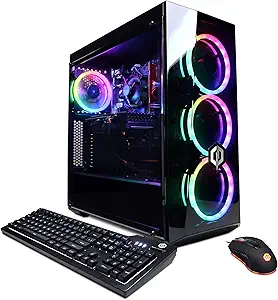
CyberpowerPC adheres to an open, standardized aesthetic that emphasizes the modern panoramic showcase trend. Most of their systems are housed in popular retail chassis—often customized variations of designs from brands like Phanteks, Lian Li, or their own open glass enclosures featuring 270-degree tempered glass and heavy addressable RGB fan arrays. The build aesthetic mirrors the custom DIY enthusiast PC look rather than an OEM consumer appliance. The primary advantage of CyberpowerPC's design is complete physical modularity: every cable, fan header, screw mount, and power rail adheres precisely to standard ATX specifications, making long-term cleaning, case swapping, and individual component maintenance completely frictionless.