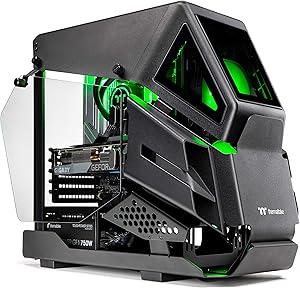
Acer vs Thermaltake: Overview
Comparing Acer and Thermaltake helps you determine which brand is best suited for your needs in Prebuilt PC. Both brands offer strong choices depending on your budget and key feature requirements.
Key Features & Comparison
Evaluate factors such as build quality, warranty, customer satisfaction, and total value before making your final purchase choice between Acer and Thermaltake.
Features
Acer approaches feature sets through a unified, centralized ecosystem designed for user-friendly operation out of the box. Through proprietary software like PredatorSense, users can quickly toggle factory overclocking profiles, monitor telemetry, and adjust integrated RGB lighting zones without diving into complex BIOS menus. However, Acer's hardware feature set is frequently limited by proprietary constraints, such as customized front-panel connectors, restricted PCIe expansion options, and non-standard motherboard power delivery pins that inhibit aftermarket component swaps. Connectivity, while comprehensive with modern Wi-Fi 6E and plentiful external USB ports, often lacks the specialized internal headers desired by advanced users.
Thermaltake completely flips this paradigm by delivering retail-grade platform features directly inherited from its DIY catalog. Because Thermaltake prebuilts utilize standardized ATX/micro-ATX motherboards from tier-one manufacturers (like ASUS, MSI, or ASRock) and retail-grade Thermaltake hardware, users gain access to unthrottled BIOS configurations, full Gen 4 or Gen 5 M.2 expansion lanes, and standard ARGB headers. Moreover, Thermaltake often integrates superior liquid cooling ecosystems—ranging from closed-loop AIOs to intricate custom hardline loops with thick radiators—alongside premium modular power supplies that feature native 12VHPWR connectors, offering significantly greater longevity and platform utility than Acer's closed ecosystem.
Performance
In baseline gaming and computational workloads, Acer systems deliver strong out-of-the-box performance driven by cutting-edge CPUs and GPUs from Intel, AMD, and NVIDIA. However, sustained performance in Acer chassis can be throttled by constrained airflow pathways and cost-optimized CPU cooling solutions. Mid-range Nitro and entry-level Orion rigs often rely on compact air coolers or standard 120mm AIO liquid units, which struggle under prolonged multicore rendering or dense 4K gaming sessions. This thermal envelope forces dynamic clock frequencies down sooner, meaning that while initial benchmark bursts look competitive, sustained boost clocks may degrade under prolonged thermal saturation.
Thermaltake builds hold a substantial advantage in thermal engineering, directly unlocking the upper limits of silicon performance. By engineering systems around their own high-airflow cases (like the Ceres, Tower, or View series) equipped with arrays of high-static-pressure fans and large 240mm to 360mm radiators, Thermaltake maintains significantly lower core and VRM temperatures under sustained loads. This superior thermal headroom prevents thermal throttling, allows modern processors to sustain their highest opportunistic boost states indefinitely, and provides users with the thermal overhead necessary to safely push manual overclocks, yielding more consistent frame rates and superior rendering throughput.
Design
Acer's industrial design ethos skews heavily toward aggressive, futuristic gaming aesthetics characterized by angular plastic cowlings, tinted tempered glass, and signature teal-and-black accenting. Systems like the Predator Orion 7000 showcase distinctive touches such as hot-swappable drive bays and EMI-compliant internal shielding, creating a cohesive, branded appliance feel. However, this heavy reliance on molded plastics, bespoke chassis frames, and compact internal spacing can make cable management and interior servicing cumbersome, often compromising acoustic dampening in favor of a striking, showpiece silhouette on the desk.
In contrast, Thermaltake’s design strategy celebrates the open architecture of custom PC building, prioritizing high-grade steel, panoramic tempered glass panels, and exceptional spatial volume. Their unique form factors—ranging from the vertical-chimney footprint of the Tower series to massive dual-chamber showpieces—treat the internal hardware as a visible gallery. Cable management in Thermaltake systems is executed with meticulous retail-tier precision, accompanied by clean routing channels and optimized airflow pathways. The result is a cleaner, more modular physical product that not only looks professional from every angle but also operates with substantially lower acoustic levels due to superior acoustic-grade fan implementations.
Compare current retail pricing, active promotions, and verified stock availability directly from authorized stores: